Automating logistics concepts: is it feasible?
Between the Lines #3
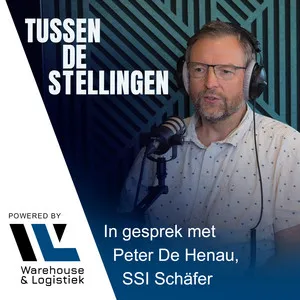
In conversation with Peter De Henau of SSI Schäfer
In this episode of Warehouse & Logistiek’s Between the Lines podcast, we welcome Peter De Henau. Peter is managing director for Belgium and the Netherlands at SSI Schäfer, an integrator and supplier of everything needed to run an intralogistics operation. In the podcast, Peter is presented with 3 dilemmas, among other things. One of them concerns costs. When business owners consider automation, they quickly get the impression that it will cost a lot of money. Is that really the case? The podcast also looks at the ROI of investments and ways to keep doing business despite constraints such as labour shortages, grid congestion and nitrogen-related issues. Peter has extensive experience in intralogistics, so the podcast is packed with useful tips and information for business owners. Presenter: Ferdi den Bakker
Een zakelijke vraag aan SSI SCHÄFER N.V./S.A.? Get in touch
Full transcript
All chapters (20)
- Introduction to the podcast
- Dilemma 1, Is automation necessary because of labour shortages?
- Dilemma 2, Automation is expensive
- Dilemma 3, Choosing the right technology
- Is automation always feasible?
- Labour shortages in practice
- Maintenance and resident sites
- Getting started with automation: data as the basis
- Comparing technologies
- Sectors where automation is used
- Differences between logistics sectors
- The importance of advice on automation
- Showing real-world examples
- Cost savings and ROI
- Convincing customers to automate
- Space and energy constraints
- Energy consumption of automation systems
- How far ahead should you plan for automation?
- Small steps in automation and software
- Wrapping up the podcast
Introduction to the podcast
Ferdi den Bakker Welcome to Warehouse & Logistiek’s Between the Lines podcast. My name is Ferdi den Bakker, and today we’ll be talking about intralogistics automation. My guest is Peter De Henau, managing director for Belgium and the Netherlands at SSI Schäfer. Peter has worked in the material handling and intralogistics sector for more than 30 years. He has an engineering background. SSI Schäfer itself is an integrator and supplier of all kinds of equipment needed to run an intralogistics operation, with solutions for storage, order picking and transport. Welcome, Peter.
Peter De Henau Thank you, it’s a pleasure to be here.
Dilemma 1, Is automation necessary because of labour shortages?
Ferdi den Bakker I’d like to put three dilemmas to you, Peter. It would be helpful if you could briefly respond to each statement, and then we can discuss them in more detail. There is a serious shortage of both technical and operational staff. Businesses face the dilemma of what to do about it. Does the labour shortage mean that now really is the time to take the step towards automation?
Peter De Henau I think so. I’m seeing more and more customers struggling with this today and reaching the tipping point where they have to decide whether or not to mechanise and automate. As a result, new projects are emerging.
Dilemma 2, Automation is expensive
Ferdi den Bakker Now for the second dilemma. When business owners consider automation, they quickly get the impression that it involves a lot of money. Is that right?
Peter De Henau That impression is wrong. I think there are now smaller-scale, scalable solutions on the market for mechanising certain business or logistics processes. It’s true that people used to think that going for full-blown automation would cost a lot of money. It still does, but there are now some great technologies for specific processes that are within reach for more businesses.
Read the full transcriptCollapse transcript17 more chapters
Dilemma 3, Choosing the right technology
Ferdi den Bakker And the third point: how do you approach it? Which technology is right for a particular situation? There are many systems available for storage and picking, but how do you choose the right one?
Peter De Henau That has indeed been a challenge in recent years. Let’s just say that many new players have entered the market. You need to distinguish between companies offering a single technology or solution and integrators offering end-to-end solutions and able to draw on different technologies. Choosing what to do is very important, and it starts with understanding the process, as well as the data. Everything starts with data, so you can determine which technology is available for a given problem.
Is automation always feasible?
Ferdi den Bakker The topic is automating logistics concepts, or intralogistics automation. Is it feasible? How far can or should a business go if it feels it has no choice but to move towards automation, for example because of labour shortages?
Peter De Henau I think you need to bring in the right partners to assess what is feasible and what return you can achieve, based on your data and processes. It starts with understanding those processes thoroughly, then using the data, in our case an inbound file, an outbound file and a stock master data file, to produce a material flow diagram. This immediately shows which parts of the process can feasibly be mechanised. The next step is choosing which technology to use. A multinational with high throughput and large storage requirements will obviously have a much bigger project than an SME, where the aim might simply be to automate or mechanise a picking process.
Labour shortages in practice
Ferdi den Bakker What are you seeing in the market? Labour shortages are nothing new, but they really started to bite four or five years ago. How much more pressure does that put on businesses to consider automation now?
Peter De Henau That’s difficult to say. It depends somewhat on the sector. There are essentially two types of shortage. One is a shortage of operators. This is sometimes addressed by using cheaper labour, but that has its limits too. You have to train people again and again and get them up to speed in those operations. So there is a need for simple, easy-to-understand processes. Then there is the technical skills shortage. Technical specialists are even harder to find. To be honest, this somewhat runs counter to mechanisation. You replace lower-cost pickers with a machine, but a machine requires maintenance and expertise. So you address the operational labour shortage on the one hand, but then you need a number of other, fewer but technically skilled, staff.
Maintenance and resident sites
Ferdi den Bakker That’s what you have suppliers for, isn’t it, to help you with that?
Peter De Henau Exactly. There are solutions where integrators take over the full technical and operational management of installations. That’s what we call resident sites. Schäfer staff are actually based on site to maintain the installation in full and provide first-line support. This means the customer only needs operational staff. Of course, we have to find those people too, because we’re fishing in the same pool. But we can guarantee that staff will be on site and that the installation’s performance will be maintained.
Getting started with automation: data as the basis
Ferdi den Bakker Using automation to address staff shortages or work more flexibly sounds appealing. But how do you know what you need? How do you get started with automation? You mentioned data as the basis.
Peter De Henau Yes, data. You’d sometimes be surprised at how many businesses still lack data. It starts with the master data for what you have in your warehouse: the stock keeping units, or SKUs. Then there are the goods arriving at and leaving your warehouse. We call those an inbound file and an outbound file. In the outbound file, we analyse order processes on a daily and hourly basis, as well as on peak days such as Black Friday. From this, we produce a material flow diagram. This represents the warehouse as a block, with goods arriving as pallets or boxes and then leaving for a pick station or going back into storage. We map all these flows and look at how each point can be mechanised.
Comparing technologies
Peter De Henau For business owners who aren’t familiar with this, it’s important to get guidance from companies such as Schäfer, as well as consultants. Keep your options open and speak to partners who can assess different technologies. Some suppliers sell a single solution, while integrators can compare several solutions side by side. Consultancy means setting out the different options alongside one another. Every solution has an investment cost and an operating cost. The higher the investment, the lower the operating cost may be, and vice versa. This requires close collaboration with the customer: where are they today, and where do they want to be in three, four or five years? That is often difficult to predict, but it is the time horizon you need to take into account.
Sectors where automation is used
Ferdi den Bakker You serve a lot of companies across different sectors. Could you highlight some of the businesses or sectors you work with in particular?
Peter De Henau At Schäfer, we naturally encounter opportunities that don’t really relate to a particular sector. But we have also built up specialist teams based at Schäfer’s central organisation. They cover retail, including everything related to retail and e-commerce, pharma and healthcare, fashion and, last but not least, production logistics. As a local organisation, we can draw on these teams. They monitor the market and trends, and have a global understanding of what major retailers are working on. When we talk about major retailers, we mean the Aholds, Lidls and Aldis of this world. In pharma and healthcare, there are several distribution centres in the Netherlands and Belgium. In production logistics, we work extensively in frozen food logistics, among other areas, as well as with producers of vegetables and similar products. We have built installations for pretty much every type of production.
Differences between logistics sectors
Ferdi den Bakker Can you also describe the typical characteristics of these sectors? Are goods moved on pallets, in boxes or through item picking, for example?
Peter De Henau: Production logistics is often located next to production lines. That means relatively few SKUs are produced in large batches and often stored on pallets. If you look at the supply chain, it often starts with production logistics. This could be Coca-Cola, an industrial bakery or an industrial vegetable processor, for example. Products are usually stacked on pallets. Those pallets then go to the retailer. In retail, operations are much more focused on case level. Pallets are depalletised and processed using a different type of mechanisation. In production logistics, you often see pallet warehouses. In retail, you get a combination of pallet warehouses and light-goods warehouses, meaning warehouses for cases and totes. The goods are then sent to stores. Further down the line, in e-commerce, you get item picking. You and I might order three glasses from bol.com, for example, and they are picked individually. We call that piece picking. In pharma and healthcare, you work with small boxes. You also see pallets at the manufacturer, but distribution to pharmacies often takes place at case level. Fashion has an extra dimension. A lot of clothing is produced in Turkey or Asian countries and often arrives loose-loaded in containers. The garments then have to be unloaded by the case and stacked onto pallets. They are then sent to pallet storage or to systems for hanging garments, where clothing is stored and sorted on hangers. These are all technologies that are often the same, but applied in different ways depending on the logistics challenge.
The importance of advice on automation
Ferdi den Bakker You know what companies need to make their logistics operations efficient, and you advise them. How important is that advice for companies considering automation?
Peter De Henau: That depends on the type of company. Are you dealing with an established business or one taking its first steps? There are many technologies and solutions today that overlap. In recent years, that overlap has become more pronounced. In the past, for example, the only options in the pallet world were single-deep and double-deep warehouses. Today, there are multi-deep warehouses, shuttle systems and various versions of them. The complexity is increasing. You see the same evolution in the light goods segment, where we work with cases and totes. We often look at two things: how many SKUs are held in stock and how quickly they need to be picked. Several technologies overlap in this area. That makes it difficult for customers to choose. I had a customer walking around LogiMAT who said: ‘I see AMRs, robots and picking solutions everywhere. I haven’t the faintest idea where to start when it comes to choosing.’ That is why it is important to get advice from companies that can compare different technologies side by side.
Showing real-world examples
Ferdi den Bakker You can take customers to a reference site to show them how you developed something for customer X or Y, so they can see it in practice. Does that happen often?
Peter De Henau: If it were up to us, as often as possible. Sales pitches for mechanised and automated systems can often feel a little abstract. You talk about concepts, solutions and data, but it is difficult to make them tangible. That is why we try to take customers to our demo centre in Giebelstadt, Germany. All our technologies are there, so they can see everything for themselves. We also try to arrange reference visits along the way, to customers with operations similar to what the prospective customer wants to do.
Cost savings and ROI
Ferdi den Bakker In the Netherlands and Belgium, companies often also ask how they can cut costs while maintaining or improving quality and recouping their investment. What is your view? Is automation expensive, or is it actually quite affordable?
Peter De Henau: That depends on the type of automation. Some mechanisation solutions can pay for themselves within three years. But the payback does not come solely from labour savings. Many warehouses still have a lot of picking errors. Customers receive the wrong products or the wrong quantities. That leads to returns and additional costs. Mechanisation helps get products to the customer on time, in the right quantities and at the right quality. That is often underestimated. So it is not just about FTE savings, but also about the quality and reliability of deliveries.
Convincing customers to automate
Ferdi den Bakker Do you still often have to convince potential customers of the benefits of automation, for example with solutions such as AGVs or AMRs?
Peter De Henau: Customers usually come to us with a specific problem. They ask what can be done to solve it. We then often need to convince them that the systems are reliable. Mechanisation is still machinery, and customers want to be sure it is reliable and will deliver on its objectives: better quality, on-time delivery and sufficient capacity. If customers have not yet taken the step, we can use data to show what is possible. If, for example, you handle 10,000 picks a day with dozens of people in a warehouse, a sound calculation can show the return. When business owners see that return, they are often willing to go ahead.
Space and energy constraints
Ferdi den Bakker There are different kinds of scarcity. Labour shortages are one. You also mentioned industrial space earlier. Is that another important reason to automate?
Peter De Henau: Yes, that’s right. These days, there is a shortage not only of labour but also of space. You still see a lot of warehouses built low, even though modern systems allow you to build up to 40 or 45 metres high. If you look at the ratio of cubic metres to square metres, you can see there is still a lot of potential. There is another kind of scarcity too: electricity. Some companies today cannot get the electricity or power they need to install mechanisation. This is starting to become an issue in Belgium as well, not just in the Netherlands. As a supplier, we also need to develop technologies that take this into account, for example by limiting simultaneity factors or using more battery-powered systems.
Energy consumption of automation systems
Ferdi den Bakker Can you give some examples? Do some types of automation clearly use less energy than others?
Peter De Henau: Yes, that’s right. First, you need to choose the right technology for the problem at hand. But there are clear differences. I often compare a crane system, which has to move hundreds of kilos or even tonnes to move a pallet weighing, for example, 800 kilos, with shuttle technology, which uses a much lighter system. A shuttle might weigh 450 kilos to move a pallet, while a crane can easily weigh four or five tonnes. You see the same thing in systems for cases or totes. You can choose between miniload cranes or AMR systems, which are lighter and often battery-powered. That makes a big difference to energy consumption.
How far ahead should you plan for automation?
Ferdi den Bakker When it comes to investing in automation and responding to shortages, how far ahead should you look to justify an investment like this?
Peter De Henau A project usually takes between eight to ten months and three years. With heavy automation, it can even take three to four years before everything is operational. So first we look at the current data and analyse it with the customer. Then we extrapolate into the future. Scalability is very important here. Many systems today are scalable. Think of AMR or AGV systems. You can increase capacity by adding more robots. You can also expand storage capacity by adding extra racking or totes. This allows you to build a system for today’s needs and scale it up later, towards 2030, for example.
Small steps in automation and software
Ferdi den Bakker You also have some time to speak freely on this podcast. Is there anything else you would like to add?
Peter De Henau We have mainly talked about large automated systems. What is less well known is that Schäfer also supplies many products for manual warehouses. Think of racking, shelves and plastic totes. We use these in automated systems too, but they are just as often used in fully manual warehouses. Between the two is a large middle ground where you can use the same products to build small-scale automation. This makes it possible to support customers as they evolve. You can start with manual systems and later move on to goods-to-person solutions. One thing we have not discussed is software. Every system stands or falls by its software, such as a WMS or warehouse control software. That software controls all processes, in both manual and automated warehouses.
Wrapping up the podcast
Ferdi den Bakker That brings us to the end of this podcast. Time flew by. It is an interesting topic that many companies are dealing with now. Do we want to take a step? Can we take a step? How will we do it? Labour shortages play a part, and automation can help make intralogistics processes more efficient. How did you find the podcast?
Peter De Henau It was an enjoyable conversation. A podcast like this also makes you realise just how many aspects intralogistics involves. You cannot sum up an intralogistics process in half an hour. Our sales cycles often last more than six months, or even a year and a half. There are many aspects and details to consider before you can achieve a good result.
Ferdi den Bakker Thank you for listening to this podcast. Would you like to hear more conversations like this? Are you also working on intralogistics automation, or interested in logistics topics? Then sign up for the Tussen de Stellingen podcast from Warehouse & Logistiek.
Companies in this story


Keep following this
Get an email when a new story is published. No account needed.
- Subject2025
- CompanySSI SCHÄFER N.V./S.A.
- CompanySSI SCHÄFER BV