












Geopolitical uncertainty and the race for an agile supply chain
Image Weerts Supply Chain
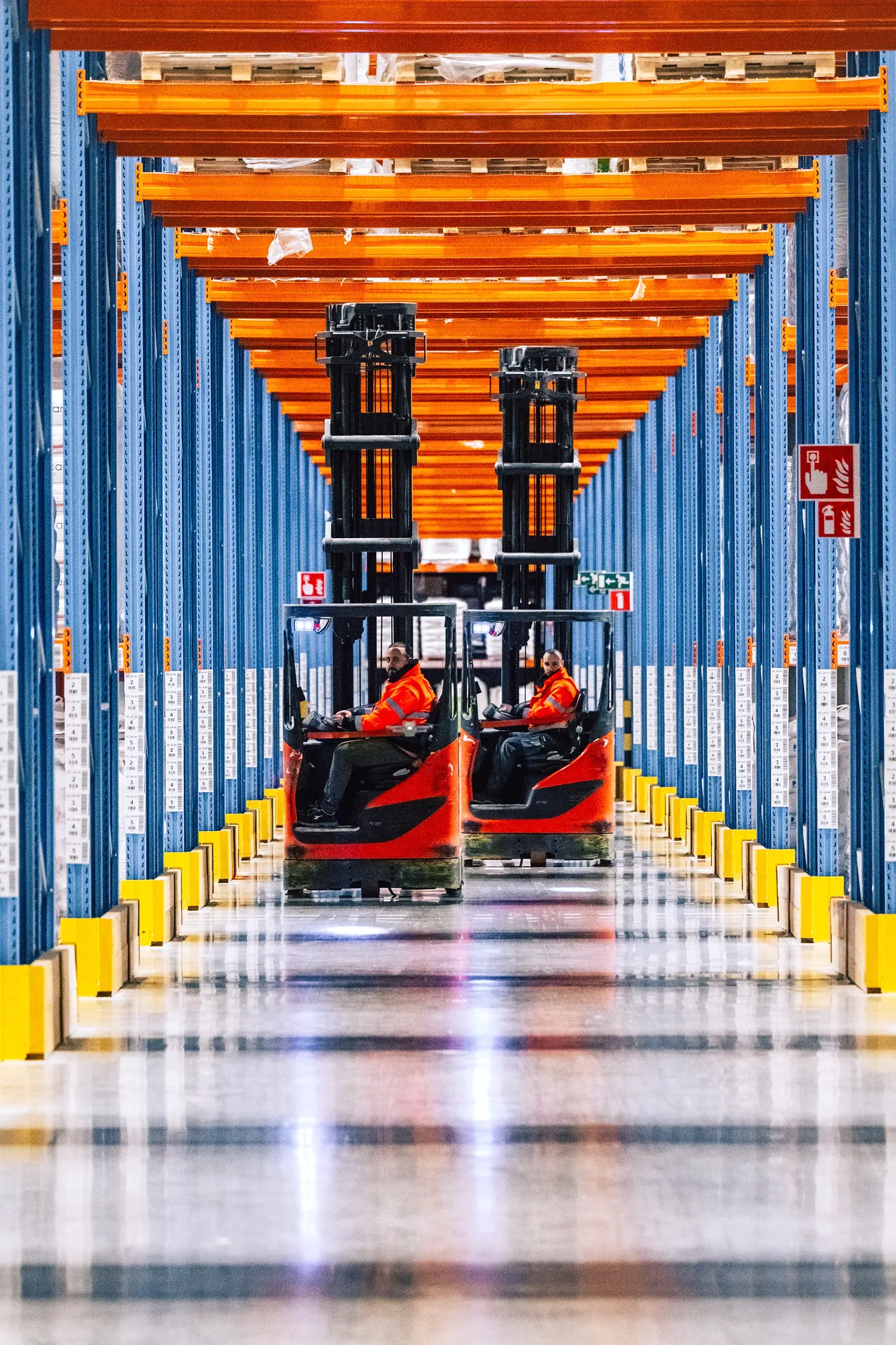
The geopolitical landscape today is fundamentally different from what it was five years ago. Trade tensions, armed conflicts and protectionism are reshaping the rules of the game. For logistics managers in the Benelux, the question is no longer whether these developments will affect them, but how they can become more agile. The combined impact of US tariffs, the conflict in Iran and ongoing disruption to global shipping routes is putting unprecedented pressure on logistics operations.
Containers are stuck in ports. Inventory levels suddenly peak or plunge. Insurance premiums for routes through the Middle East are soaring. And bottlenecks are emerging at the ports of Rotterdam and Antwerp, with knock-on effects across the entire European supply chain.
We spoke to Didier Weerts, CEO of Weerts Supply Chain, a Belgian logistics service provider specialising in regional warehousing, transport and distribution optimisation in the Benelux and across Europe. He sees the pressure on his customers every day.
“Companies are actively looking for alternative suppliers to minimise the impact of tariffs,” says Weerts. “This is changing existing logistics networks, but also causing sudden peaks or sharp drops in warehouse handling activity. Volatility is enormous.”

The figures confirm what the market is feeling
Weerts’s experience is not unique. A study by Maersk of more than 900 European supply chain professionals (September 2025) found that 78% of respondents expect the geopolitical situation, tariffs and international trade policy to have at least a moderate impact on their operations over the next 12 to 24 months. Almost 1 in 2 say they are very or extremely concerned about the geopolitical climate.
The pressure from tariffs is particularly tangible: Maersk data shows that, shortly after the US tariff package was announced on 2 April 2025, companies paid an average tariff surcharge of 54% on US imports. This is no longer abstract trade policy. It is a direct cost on the invoice.
In response, 3 in 4 European companies are now considering actively diversifying their suppliers, and the same proportion are already sourcing from multiple geographic regions or plan to do so.
How geopolitics affects your supply chain
The mechanisms are now familiar, but their intensity is increasing.
Sudden tariff changes make long-term planning in global supply chains particularly difficult. Trade tensions between the US, China and Europe have demonstrated this time and again in recent years. What is a cost-efficient choice today may prove an expensive mistake tomorrow.
The conflict in Iran has added a new dimension. Shipping companies are temporarily rerouting via the Cape of Good Hope, adding two weeks to transit times and increasing fuel costs. Chemical companies and steel producers are already passing on surcharges of up to 30% to customers. The European Central Bank is warning of stagflation, with Germany and the Netherlands identified as particularly vulnerable.
“Almost every sector is under considerable pressure,” says Weerts. “Our customers have to adapt constantly and find creative ways to deal with the situation. This pressure is also driving strong downward pressure on logistics costs, for both existing and new customers.”
Two paths to a more resilient supply chain
Companies looking to rethink their supply chains face a fundamental choice between two complementary strategies. They may seem similar, but are fundamentally different.
Path 1 is nearshoring: moving production or sourcing from distant regions such as China and Southeast Asia to nearby countries such as Poland, Turkey or Morocco. The logic is clear: shorter supply chains, less exposure to geopolitical shocks and faster response times.
Path 2 is regional network optimisation: not where you produce, but where you locate your warehouse or distribution platform in relation to your actual distribution needs. A company that produces in the Benelux and serves customers in Western Europe does not need to have its distribution centre in Eastern Europe. Yet many companies have never analytically answered the question of where it should be located.
Both paths deserve attention. Both are underestimated, albeit for different reasons.
Nearshoring: get started, but know what you are getting into
Nearshoring is gaining popularity, and rightly so. But the business case is more complex than it looks on paper. Didier Weerts sees a number of persistent misconceptions among companies considering the move.
“The most persistent one is the assumption that lower labour costs will remain stable,” he says. “In Romania and Bulgaria, labour costs are already rising by more than 10% a year. Business cases built on a static labour cost gap quickly become outdated.”
The impact of cultural differences is also greatly underestimated. Less team spirit, limited customer focus and communication problems are common complaints. To ensure profitable operations, management is still often provided by Western European staff: an expensive approach that can be counterproductive.
Perhaps the most fundamental misconception is also the most subtle. “Many companies treat nearshoring as a logistics decision, when in reality it is an organisation-wide transformation,” says Weerts. “Those who treat it purely as a location decision overlook the legal, cultural, personnel and logistics dimensions, each of which requires its own lead time and investment.”
That does not mean you should not do it. It means doing it deliberately, with a realistic timeframe and the right preparation.
Regional network optimisation: the underestimated lever
Alongside nearshoring, there is a second, often underestimated strategy that delivers results more quickly and starts closer to home: optimising your existing logistics network to reflect your actual distribution needs.
The key question is simple, yet surprisingly rarely asked: is my warehouse in the best geographic location for my customers?
The tool for answering that question is network analysis: a data-driven study that uses distribution volumes, delivery addresses and delivery frequencies to determine the optimum location for a warehouse or distribution platform. “Companies instinctively want their distribution centre as close as possible to their production site,” says Weerts. “In practice, however, we often find that locating the distribution centre elsewhere can be much cheaper and more efficient. Detailed analysis helps companies quantify the impact of making the right choice, thereby minimising the number of kilometres driven, costs and carbon footprint.”
This is exactly where regional logistics partners make a difference. A provider with an in-depth knowledge of local infrastructure, multimodal hubs (inland waterways, rail and road) and the realities of logistics in the Benelux can offer greater value here than a global network with a limited presence everywhere.
“Many companies choose a hybrid model,” says Weerts. “A global provider for the main flows, complemented by a regional partner for last-mile complexity or specific markets. So the question is less ‘which is better?’ and more ‘which type of partner is right for each part of my supply chain?’”
The cost of doing nothing
What makes the current situation fundamentally different from previous crises is that the disruptions are happening at the same time. Tariff measures, a conflict in the Middle East and shifting trade flows are affecting supply chains not separately, but simultaneously. Any operation optimised for a single stable scenario is now structurally vulnerable.
For supply chain managers who are hesitating, Weerts has a clear argument. “Companies compare the investment cost of change with the status quo. But there is no longer a status quo. The cost of ‘indecision’ is often far higher than the cost of taking a calculated risk.”
Full regionalisation does not have to be the goal. Even a limited step, such as a second supplier closer to home, a warehouse in a better location or an alternative route for one product line, can substantially reduce vulnerability.
“Start small, but start,” says Weerts. “Companies that regionalise now are building expertise that will not be easy to replicate. Those who wait until the situation is ‘clearer’ will enter a market where the best partners, locations and capacity are already taken.”
The most successful companies in the years ahead will not be the biggest, but the most agile.
Question about this story? Ask your question
Keep following this
Get an email when a new story is published. No account needed.
- ThemeThe supply chain under pressure
- SubjectGeneral







