












Shore power trial for shortsea vessels at Parkkade in Rotterdam
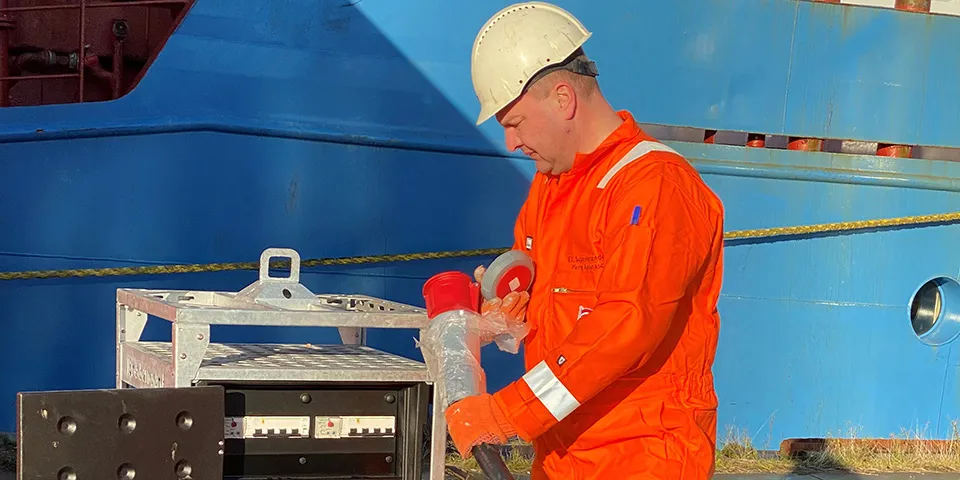
On 13 December, the Municipality and Port of Rotterdam Authority will start a trial to supply small seagoing vessels at Parkkade with electricity. This means they will not need to run their diesel generators to generate power for use on board. This will reduce air pollution and noise. The trial will last around five months, during which five different systems will be tested. In terms of its scale and scope, the trial is unique worldwide.
“Shore power kills two birds with one stone: cleaner air and less CO2,” says Arno Bonte, alderman for Sustainability and Air Quality. “Our ambition is to connect all vessels to shore power, starting with quays close to residential areas. This trial is an important step towards that goal.”
Allard Castelein, CEO of Port of Rotterdam Authority: “We are taking shore power further, step by step. It has already been compulsory for inland vessels for around ten years. Stena Line in Hoek van Holland has it, and we are going to install it for Heerema at Rozenburg. Many more vessels will need to plug in over the coming decades. The larger the vessels, the more complex and expensive it becomes. That will take time.”
Mobile
What makes the trial at Parkkade special is that it will not use a fixed power connection, but mobile solutions. These can therefore be deployed wherever shore power is needed. The trial will look at different energy sources, including hydrogen, batteries, (bio)LNG and hybrid solutions. The latter combine different sources. The fuels mentioned require an on-site generator to convert them into electricity.
The trial will focus mainly on technical and commercial feasibility, ease of use and impact on the surrounding area. Measurements will be taken during the trials to assess the systems’ noise and emissions against those of the same vessel generating power with its own generators.
Many shortsea vessels operated by shipping companies such as Wilson, Vertom and Wijnne&Barends call at Parkkade. In principle, any seagoing vessel mooring there can use the mobile shore power, but many seagoing vessels are not equipped with a shore power connection.
The trial will cost approximately € 500,000. Most of the funding comes from the national government under the National Air Quality Cooperation Agreement. The aim is to improve air quality, particularly in urban areas.
Following the trial of mobile shore power at Parkkade, a second trial will start in 2020. This will focus on innovative shore power solutions for larger seagoing vessels. € 1,500,000 has been made available for this.
High power consumption
Calculations by DNV GL and the Port of Rotterdam Authority show that seagoing vessels in the port have a total energy requirement of around 750-850 GWh. That is equivalent to the consumption of approximately 200,000 households. Shore power could therefore bring benefits for air quality, liveability and the climate.
Shore power is relatively easiest to install and make commercially viable for inland vessels and ferries. The former use relatively little energy, while the latter operate on fixed routes, meaning that, apart from the vessels themselves, facilities are needed in only a few ports.
Shore power for seagoing vessels is more complex because of their higher power consumption and the fact that they call at many different ports. This requires cooperation between ports, terminals and shipping companies. Another important factor is that large seagoing vessels use far more electricity. Cruise ships, for example, have the power consumption of a small town, with their thousands of passengers and crew.
Five trials, five companies, five months
The five companies whose shore power systems will be trialled over the coming five months are:
- ENGIE Ventures & Integrated Solutions B.V.: Hybrid system with a Big Battery Box, integrated with a biogenic-fuel (HVO) engine-generator;
- PON Power & sister companies: Hybrid container with a battery combined with a generator running on blue diesel (HVO), housed in a 20ft container with solar panels on the roof;
- Aggreko Benelux: LNG-powered gas engine in a 20ft container;
- Mobiele Stroom BV: Bio-LNG-powered turbine in a 20ft container;
- JP-Energiesystemen B.V: Hydrogen fuel cell generator combined with a small battery.
Question about this story? Ask your question
Keep following this
Get an email when a new story is published. No account needed.
- ThemeLower-emission transport
- SubjectGeneral







