Fire, you’d rather not think about it! Or should you?
Text Lieke Bousema Image Kingspan Light + Air
When a fire breaks out in a large building and fire safety measures are not up to scratch, the consequences can be enormous, says Stan Veldpaus, Project Adviser, Smoke Control Systems at Kingspan Light + Air. “Although, fortunately, the number of casualties is usually low, the material damage is often considerable. Fires in large buildings that make the national news are more the rule than the exception. What is more, neighbouring buildings are regularly damaged.” A smoke and heat exhaust ventilation (SHEV) system is therefore no unnecessary luxury.
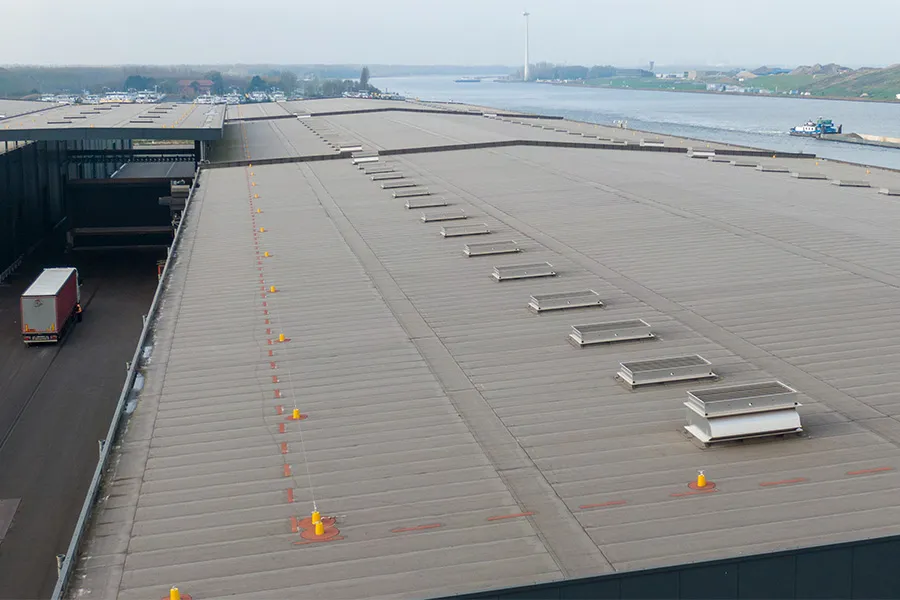
Fire safety in large buildings calls for a specific approach. “Large warehouses, factory buildings and distribution centres may be fitted with a smoke and heat exhaust ventilation (SHEV) system if they exceed the maximum fire compartment size, in accordance with the Besluit bouwwerken leefomgeving (Bbl),” explains Veldpaus. “The main advantage of a SHEV system is that production and logistics processes are not hampered by fire compartments. In the event of a fire, the system effectively removes smoke and heat, while also improving visibility during rescue and firefighting operations. In day-to-day use, the SHEV system can also provide natural ventilation. In a transparent configuration, it can also increase the amount of natural daylight entering the building.”
Exemption from fire compartmentation
In the Netherlands, large warehouses, factory buildings and distribution centres must be divided into fire compartments of no more than 2,500 m2, says Veldpaus. “These compartments must also prevent fire and smoke spreading to other areas for 60 minutes. This is set out in the Bouwbesluit, which was replaced by the Bbl on 1 January 2024. However, owners of large warehouses actively seek ways to avoid fire compartmentation. Not only is it expensive, it also limits the functionality of the building. For example, when ships are being built, the walls of a fire compartment can quickly get in the way. And when forklifts are being driven around the warehouse all day, an alternative to fire compartmentation is desirable. In such cases, NEN 6060 and NEN 6079 provide a solution.”
NEN 6060 and NEN 6079
NEN 6060 is a method for calculating fire load. “This involves mapping all the combustible materials in and on a building,” says Veldpaus. “The maximum size of a fire compartment is then determined based on the calculated fire load.” NEN 6079 focuses primarily on probability, cause and consequence. “In this case, the likelihood of a fire and its potential impact on other compartments or neighbouring buildings are calculated. As long as the result is low, very large buildings can be constructed.”
Specialist expertise
Both NEN standards reward the use of technical solutions such as sprinklers, says Veldpaus. “SHEV systems also earn valuable credits, but various conditions must be met. This calls for specialist expertise, which Kingspan Light + Air is very happy to provide.” Kingspan Light + Air has been advising on, designing, installing and maintaining SHEV systems for 40 years. “We also manufacture all the necessary components in-house or under our private label. These range from smoke vents to (jet) fans, control panels, transmission paths and damper assemblies, as well as the associated fire detection and evacuation alarm systems and automatic connection to the fire brigade. By providing integrated advice, design, installation and maintenance for all our systems, we can guarantee high quality. This not only results in a high level of comfort, but also a low TCO. We work with standard calculation rules, but where applicable we also validate our advice using Computational Fluid Dynamics (CFD) computer simulations, allowing us to estimate as accurately as possible how the system will perform during ventilation and in the event of a fire. This ensures building owners
are fully taken care of.”
The consequences of fire
A building fire cannot always be prevented, stresses Veldpaus. “Even the safest warehouse can catch fire. Companies would be wise to consider the consequences. Are they acceptable? Or are additional measures, such as a sprinkler or SHEV system, necessary to ensure the business can continue operating after an unexpected fire? And what does the insurer require?” A major advantage of a SHEV installation, according to Veldpaus, is that it is also connected to a fire detection system. “This gives a SHEV system exceptional potential to extinguish even the smallest fires immediately. The system prevents or delays flashovers (the sudden spread of fire caused by radiation from a hot smoke layer) and backdrafts (the explosive combustion of flammable gases following a sudden supply of oxygen), while maximising visibility of the fire, allowing more time to escape and reducing damage. This also applies to the storage of hazardous substances. What is more, SHEV systems are often simpler, more flexible and cheaper to install. As the products can also be used for comfort ventilation and to increase natural daylight, clients get several benefits in one.”
Cocoa warehouses
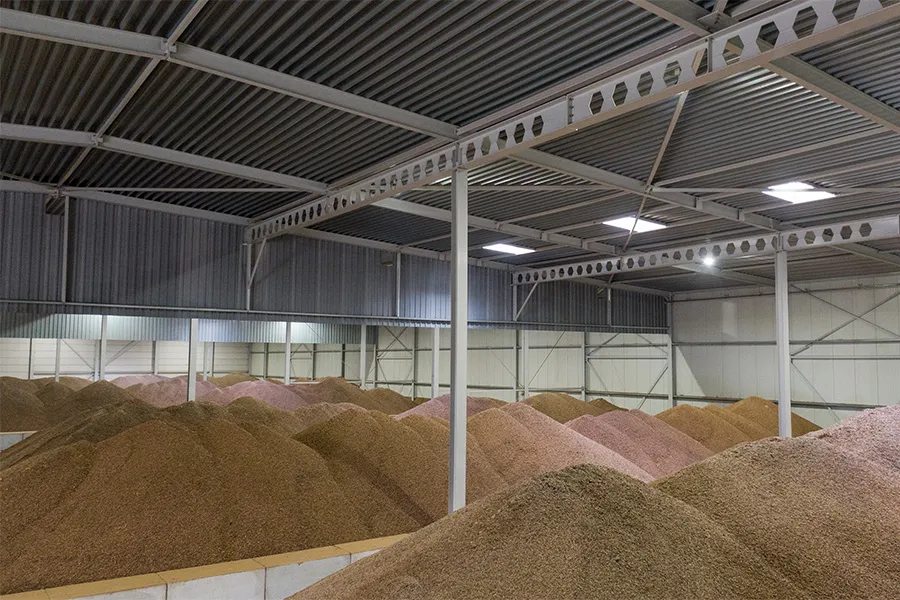
In fire safety for large warehouses, cocoa warehouses have a unique role. The Netherlands has been the leading importer of cocoa beans for many years, and their storage requires specific fire safety measures. “Cocoa is highly flammable. Once it catches fire, it is also difficult to extinguish,” says Veldpaus. “The only solution is to remove the combustible material from the source of the fire and move it outside.” To limit the consequences of a fire, the cocoa industry has jointly agreed on a set of storage measures. “One of these measures is a SHEV installation, which provides enough time to move all the cocoa outside. The storage capacity indoors must also be matched by the capacity outdoors.” Kingspan Light + Air now has extensive experience in applying SHEV systems in cocoa warehouses. “Almost all the warehouses in Amsterdam and Zaandam are now equipped with our SHEV and fire detection systems.”
Question about this story? Ask your question
Keep following this
Get an email when a new story is published. No account needed.
- SubjectAutomation