Shifting up a gear with the help of AI
Text Michiel Leen Beeld SSI SCHAFER
The AI revolution has not gone unnoticed at SSI SCHÄFER. The German provider of warehousing solutions uses artificial intelligence to automate operations while saving considerable space, and to plan maintenance more efficiently.
Like many other players in the warehouse equipment sector, SSI SCHÄFER has faced demand for more automation on the one hand and high expectations surrounding artificial intelligence on the other. As with the general public, there is a widespread belief in logistics that we are only at the start of an AI revolution, although it is less easy to say exactly what that will look like.
SSI SCHÄFER is already offering some clear pointers. The company has built a strong reputation for its robust (automated) warehouse solutions, and is now placing increasing emphasis on smart, integrated software technologies that enhance these systems. An inspiring presentation on the future of logistics at the Benelux headquarters in Oosterhout showed how SSI SCHÄFER is responding to current market developments. The event opened with a digital likeness of founder Fritz Schäfer, brought to life with the help of AI, a nod to the past with a clear eye to the future.
Smart robots replace the conveyor
SSI SCHÄFER had already offered a glimpse of the FastBots at the Logimat logistics trade fair, and went into more detail in Oosterhout.
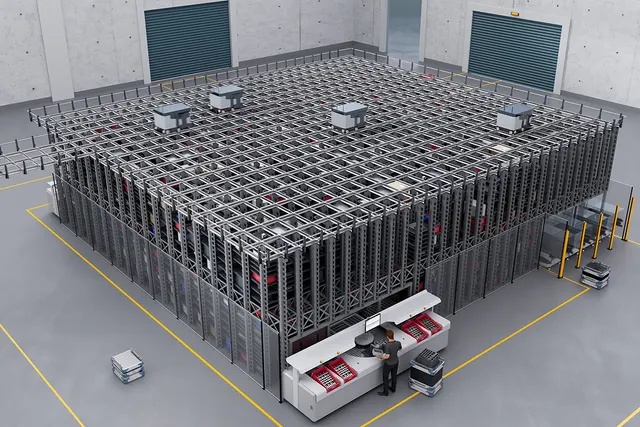
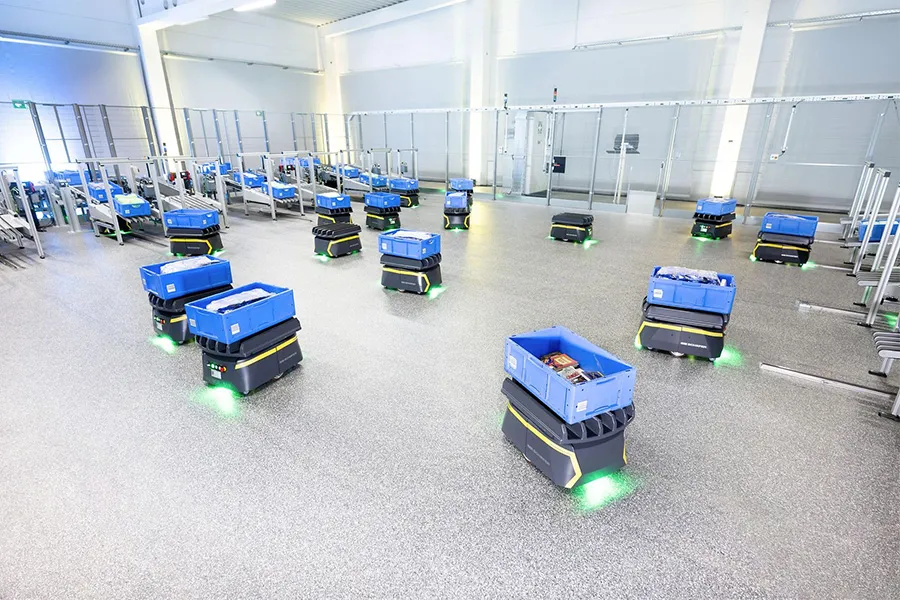
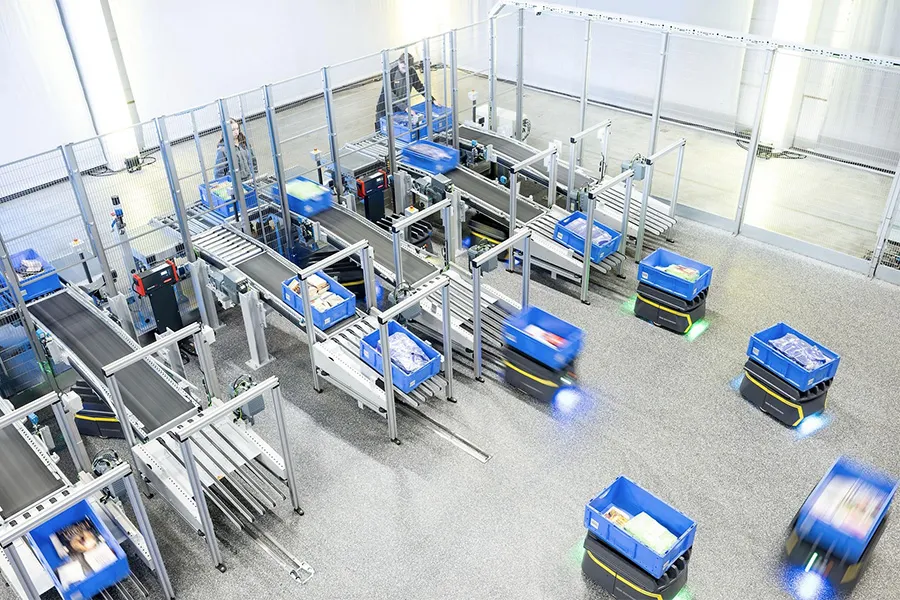
“FastBots transport goods between the storage area and the picking station,” says Peter De Henau, managing director for Belgium and the Netherlands. “FastBots can replace a complex conveyor layout in high-performance environments handling up to 10,000 inbound and outbound movements per hour. Normally, this often requires several conveyor loops, which take up a lot of space and call for a complex warehouse layout. This system does away with that: it consists of a fleet of small AMR robots that transport goods from storage to the picking station or outbound area, and vice versa. This more compact set-up saves space and costs.”
The innovation lies mainly in how the robots are controlled. These are not AGVs that follow a fixed route, but a fleet of robots that criss-cross the warehouse without getting in one another’s way or colliding. Controlled by a fleet management system integrated into the WCS, the FastBots constantly know where their “colleagues” are. Another major advantage of the system is its high degree of standardisation, which makes it possible to scale the FastBots solution to meet the customer’s needs.
Maintenance: prevention is better than cure
Another major innovation is the rollout of predictive maintenance for the various warehousing solutions. SSI SCHÄFER has also recently started using AI to manage maintenance more efficiently. The WAMAS Maintenance Center, a software tool for maintenance planning, uses Big Data and artificial intelligence to accurately predict when equipment will need servicing. Sensors in the equipment feed a constant stream of data to WAMAS. To transmit it, SSI SCHÄFER uses an edge device (Siemens Nanobox) connected to both the control system and the cloud.
This edge device meets the highest IT security standards and is compatible not only with all SSI SCHÄFER products, but also with hardware from other suppliers. It can be installed quickly and easily via plug-and-play, without shutting down the system.
AI algorithms process the data provided, then make diagnoses and/or predictions about upcoming maintenance needs. The aim is to prevent costly unexpected repairs and downtime as far as possible. The more urgent a repair, the more expensive it often becomes. Prevention is therefore better than cure. Thanks to the predictive capabilities of artificial intelligence, problems can be addressed before they arise, and maintenance can be scheduled efficiently, with as little disruption to warehouse operations as possible.
For logistics operators whose focus is mainly on the visible, tangible hardware of warehouse equipment, the rise of self-learning software systems can often be intimidating. It is up to the provider to allay those fears. “We have to overcome a certain fear of the unknown among both technicians and management,” says Stefan Unterberger, manager of Business Transformation. “The facts are in our favour, though. A return on investment can be achieved within just a few weeks. Unplanned downtime costs a logistics company between 1,000 and 5,000 euros per minute. This system reduces those unforeseen stoppages by at least 60 per cent.”
Een zakelijke vraag aan SSI SCHÄFER N.V./S.A.? Get in touch
Companies in this story


Keep following this
Get an email when a new story is published. No account needed.
- SubjectAutomation
- CompanySSI SCHÄFER N.V./S.A.
- CompanySSI SCHÄFER BV