A smooth warehouse move
Text and images SSI SCHÄFER
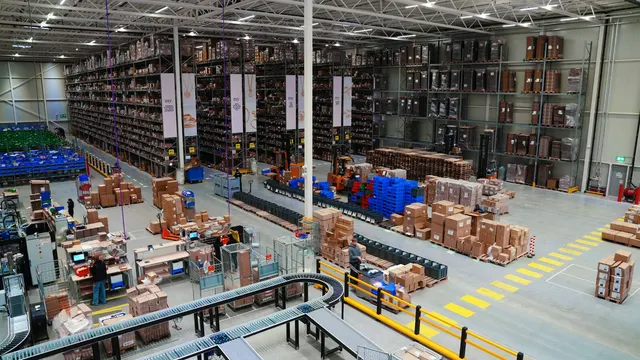
How do you move a fully operational warehouse to a new site without disrupting day-to-day operations? Sunrise Medical, a supplier of mobility products, faced this challenge. As the business grew, the global company set up a new warehouse in Nieuwegein with the help of SSI SCHÄFER. The implementation phase showed just how important thorough preparation, careful planning and a flexible approach are. While the new warehouse was fitted out with racking from the old site in less than two months, day-to-day operations continued as usual. Sunrise Medical EDC Operations Manager Stanley Meijer: “On a project like this, it is crucial that everyone involved works as one team.”The new warehouse, with an impressive A+++++ energy rating, serves as the European distribution centre (EDC). From here, mobility dealers across Europe receive mobility scooters, wheelchairs, rollators, seating and positioning products, and spare parts with long supply chains. The EDC also plays a crucial role in supplying assembly components to Sunrise Medical’s 5 factories in Europe. It also provides strong support to Sunrise Medical’s Dutch market. “By consolidating these inbound flows through our warehouse, we make significant savings on transport and inventory costs in Europe,” says Meijer.
The challenge
A new warehouse was urgently needed. The previous building in Nieuwegein, which had also been fitted with SSI SCHÄFER racking, was too small and no longer met today’s requirements. The lack of space had even forced Sunrise Medical to rent a second warehouse a short distance away. “That was far from efficient,” says Meijer from the new building, which is less than a kilometre away as the crow flies. “Here we have a modern warehouse with a floor area of 6,789 square metres (5,521 m2 of standard floor space and 1,268m2 of mezzanine floor space), more than 30 per cent larger than before. And because this building is 8.5 metres high, we can make much more efficient use of the space than in the old building, which was 5.5 metres high.”
The solution
Meijer took plenty of time to plan the warehouse layout. He was supported by colleague Marc van Thuijl, who is responsible for Facility, Safety & Warehouse Improvement at Sunrise Medical. For almost two years, the pair worked closely with intralogistics partner SSI SCHÄFER, and specifically sales expert Jessica Pronk. Every option was considered, from a conventional wide-aisle warehouse to a fully automated storage system. “I think SSI SCHÄFER produced around eighteen drawings. And we made at least as many sketches ourselves,” laughs Van Thuijl. Meijer nods in agreement. “We only get one chance to build a new warehouse, and we want to get it right. Jessica Pronk at SSI SCHÄFER gave us all the time and space we needed. The result is a solid foundation for further growth and operational improvements.”
Interchangeable frames
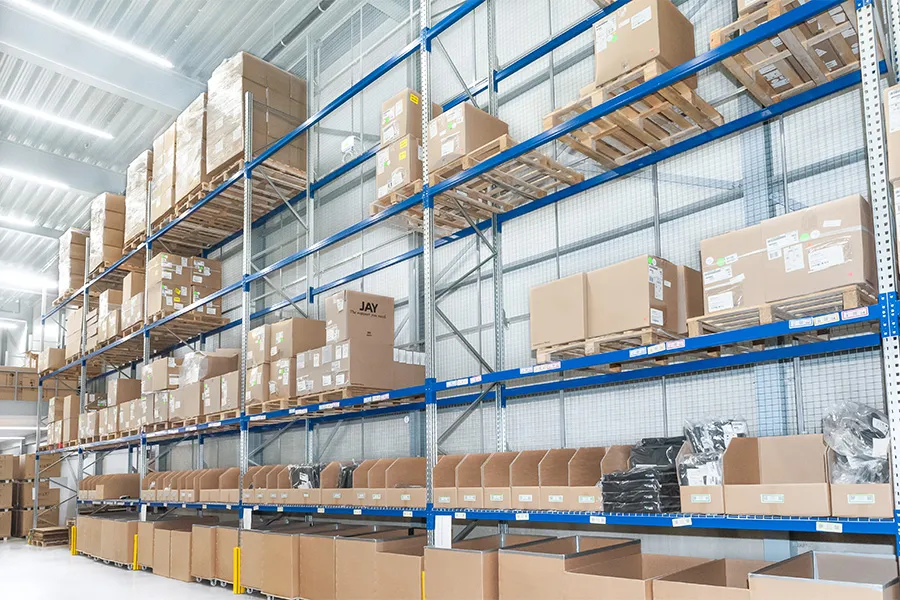
The new warehouse consists of three halls. The first hall is largely fitted with extra-deep PR 600 pallet racking, reaching up to the ceiling. Seating cushions and other positioning products are stored here and picked using a high-lift order picker. “The racking is 1.20 metres deep and arranged in single rows, so we can pick from both sides. This prevents us from wasting too much space on air in our storage,” explains Meijer.
The second hall, with six dock doors, is used partly for loading and unloading lorries and containers. Drive-in racking along the wall opposite the docks is used for bulky products such as mobility scooters and wheelchairs. “We brought that racking over from the old warehouse,” says Meijer. “The old drive-in racking was slightly too low, so in the new warehouse we used the frames from the old pallet racking. They are fifty centimetres higher, which allowed us to add an extra storage level and store 18 per cent more pallets. That is one of the advantages of SSI SCHÄFER: the frames used for drive-in and pallet racking are interchangeable.”
No narrow aisles
The third hall offers the most storage space and is largely set up as a reach-truck warehouse. That was not the original plan. “We had actually wanted to install a narrow-aisle warehouse here. That would have given us the approximately 7,000 pallet locations needed to make a viable business case,” says Meijer. “Using very narrow-aisle trucks would have required induction wires to be installed in the floor. As the project progressed, it became clear that this solution was not feasible because of the building’s structural constraints. Working closely with SSI SCHÄFER, we quickly adapted and found a suitable alternative. In the end, we opted for a combination of pallet racking and reach trucks, a flexible layout that meets our current requirements.”
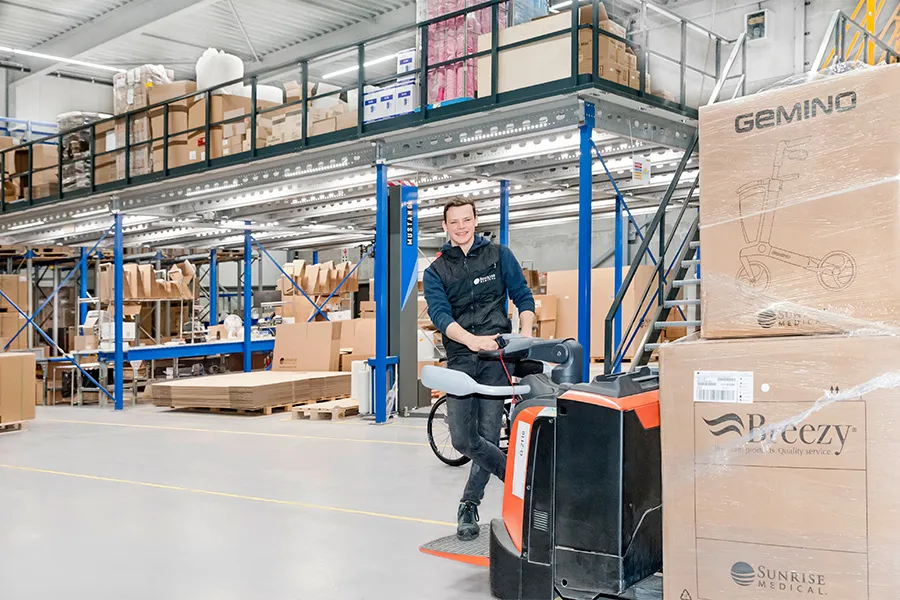
With additional measures, Sunrise Medical and SSI SCHÄFER managed to create enough pallet locations after all. “We brought the mezzanine floor over from the old warehouse and rebuilt it above the packing lines in hall two, allowing us to store additional pallets on top. We also installed extra racking along the wall opposite the reach-truck area in hall three, to create even more pallet locations. SSI SCHÄFER and we kept working through the options until this logistics box was completely filled,” explains Meijer.
Turning plans into reality
Once the puzzle had been solved, the biggest challenge was still to come: implementing the layout and moving to the new warehouse. SSI SCHÄFER had just two months to complete the work. Sunrise Medical’s decision to reuse the racking from the old warehouse made the project even more complex. “There were still pallets in the racking, of course, because operations had to continue uninterrupted. So we first had to move those pallets to the new warehouse before SSI SCHÄFER could dismantle the racking,” says Meijer.
Tight schedule
The success of a project like this depends on thorough preparation. After the contract with SSI SCHÄFER was signed, the first step was a kick-off meeting with everyone involved. “That was incredibly important. The kick-off shows how everyone is approaching the challenge. Everyone involved, from Sunrise Medical, the contractor and SSI SCHÄFER, needs to work as one team and pull together,” says Meijer.
Another key success factor is a tight schedule. When will the racking be empty? When can it be dismantled? And when can it be rebuilt in the new warehouse? “Timing is crucial,” says Gijs Eggink, who was responsible for the schedule as Project Manager and, like all other Project Managers at SSI SCHÄFER, holds an IPMA D certificate. “As a warehouse designer, you can sell a fantastic project. But if implementation does not go to plan, the partnership comes under pressure. For example, when some of the racking was dismantled, the original bolts could not be undone as expected. They had to be carefully cut through and replaced with new ones. That required quick adjustments on site, which the team handled efficiently and with great flexibility.”
Flexible installation team
A key success factor that should not be underestimated was the flexibility and commitment of the in-house installation team. SSI SCHÄFER has its own pool of installers from Latvia, who work on all kinds of high-quality, technically demanding projects around the world. They are highly trained, with a wealth of experience, extensive product knowledge, an excellent work ethic and strong communication skills. “We had an excellent team of passionate installers who never stopped. I even gave the foreman the keys to the building. That shows how much confidence we had in the team,” says Meijer.
Meijer was impressed by the discipline with which the installation team worked. All dismantled racking was carefully counted, bundled and recorded so it could be quickly rebuilt in the new warehouse. “For six weeks, they made constant trips between the old and new warehouses. If they couldn’t continue at one site, they carried on at the other.”
Sounding board
Now that the warehouse is fully operational, Sunrise Medical still stands by the choices it made. Operations have improved considerably. The layout is more logical, travel distances are shorter and working methods are clearer. “We work not only faster and more efficiently, but also more safely. What’s more, we have room to grow again. I’m already quietly thinking about new innovations,” says Meijer. “We’re always looking for ways to improve. We now know how valuable it is to have a sounding board like SSI SCHÄFER.”
Een zakelijke vraag aan SSI SCHÄFER N.V./S.A.? Get in touch
Companies in this story


Keep following this
Get an email when a new story is published. No account needed.
- SubjectAutomation
- CompanySSI SCHÄFER N.V./S.A.
- CompanySSI SCHÄFER BV