A resilient construction sector on the road to climate neutrality
Text Geert Van Cauwenberge Beeld Embuild Vlaanderen
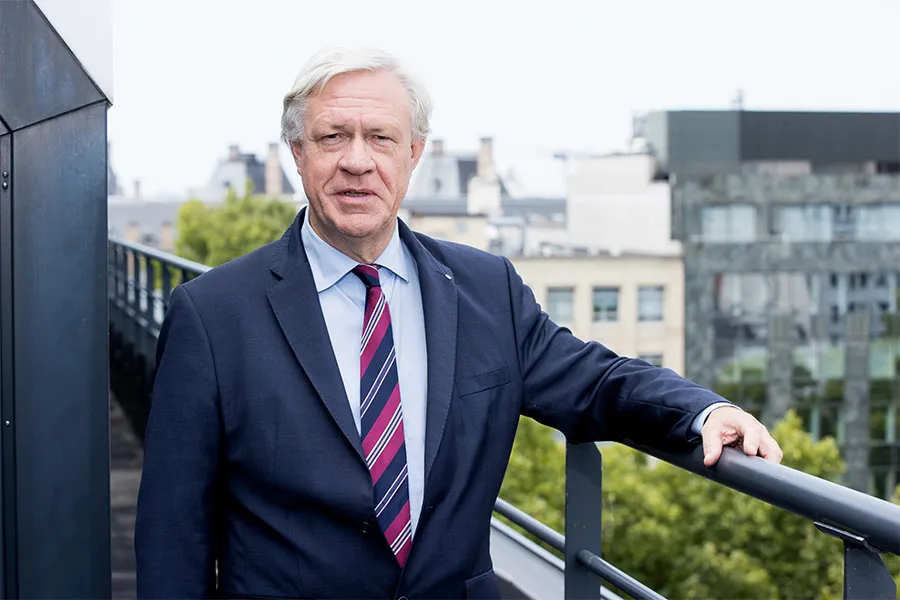
Location, available (business) premises, skilled staff and competitiveness. According to specialists, these four factors determine how attractive a region can be for logistics, with full order books at industrial construction companies as a positive side effect. For construction entrepreneurs in our country, Marc Dillen, director-general of Embuild Vlaanderen, sees both great opportunities and considerable challenges. The biggest challenges, in his view? Developing a future-oriented permitting policy and finding enough skilled workers.
The cliché is that construction acts as a barometer for the economy. A thriving construction sector is a sign of strong business confidence. Unfortunately, the latest key figures make for less positive reading. “Since 2018, the Flemish Environment Department’s online portal has published annual figures for the number of planning permit applications submitted for industrial and business projects, covering the first eight months of each year in Flanders,” says Marc Dillen. “And what do they show? In 2022 and 2023, we saw a sharp fall in applications, with 1,984 and 1,801 applications submitted respectively. This stands in stark contrast to the 2,313 and 2,232 applications in 2019 and 2021.”
“The press also reported a record number of bankruptcies in Flanders during the summer of 2023,” says the head of Embuild Vlaanderen. “The construction sector appears particularly vulnerable, with 1,367 Flemish construction companies having gone out of business since the start of this year. It is also striking that more and more young construction companies are going under.”
Leading by example
“These alarming figures give us pause for thought, but should also spur us to keep investing in a resilient, future-proof sector,” says Marc Dillen. “In recent years, our members have shown the resilience needed to turn challenges such as sustainable construction and renovation, digitalisation and automation, compliance and workforce management into opportunities. Take, for example, the efforts many manufacturers and construction companies are making to align their products and services with European regulations for a climate-neutral construction sector by 2050. Energy-neutral construction and renovation, recycling building materials, circular construction and green transport are just some of the practices running through our sector. And let’s not forget the importance of efficient water management, with a focus on both rainwater infiltration and collection. The new Flemish Rainwater Regulation, which came into force on 2 October 2023, sets out new guidelines in this area.”
Ecology meets technical durability
Also worth mentioning is the first Flemish Concrete Agreement, co-signed in April 2023 by many members of Embuild Vlaanderen. “With this agreement, we want to make concrete production and use in our region as environmentally friendly as possible,” says Marc Dillen. “We are setting the bar high, with a 30% reduction in CO2 emissions from concrete production by 2030 and a complete reduction in emissions by 2050.” He adds a caveat, however: “We must not separate our focus on ecology from technical durability. In other words, applying circularity in the construction sector must not come at the expense of high-quality building materials. After all, it cannot be the intention to use 20% more concrete for bridge piers to guarantee their strength simply because recycled building material is being used.”
All hands on deck!
Returning to what Marc Dillen sees as the two biggest challenges for the construction sector: permits and staff. “On the first issue, we often see projects stalled by procedures that are too complex and time-consuming. Can it still be justified that it takes an average of 3 years and 10 months to obtain a permit in Flanders? The number of permit applications is rising year after year, while the same number of civil servants have to process an ever-growing volume. Moreover, it is not only spatial planning regulations that play a decisive role, but also Flemish environmental legislation. A rethink of which activities require a permit, which require notification and which are exempt from both is urgently needed!”
The construction sector also needs all hands on deck when it comes to workforce management. “The list of occupations in short supply grows longer every year, meaning more and more construction projects are either not started or not completed on time. We must do everything we can to stem this brain and skills drain, both by adopting a robust retention policy to keep talented and experienced workers on board and by making careers in construction more attractive.”
“Let’s work even more closely with education and training institutions to encourage young people to join our sector. And, of course, we will continue to rely on talented workers from abroad to fill vacancies.” ■
Question about this story? Ask your question
Keep following this
Get an email when a new story is published. No account needed.
- SubjectAutomation