












PODCAST: Leasing as a driver of warehouse automation
Between the Racking #6
Spotify Embed: #6 - Leasing as a driver of warehouse automation
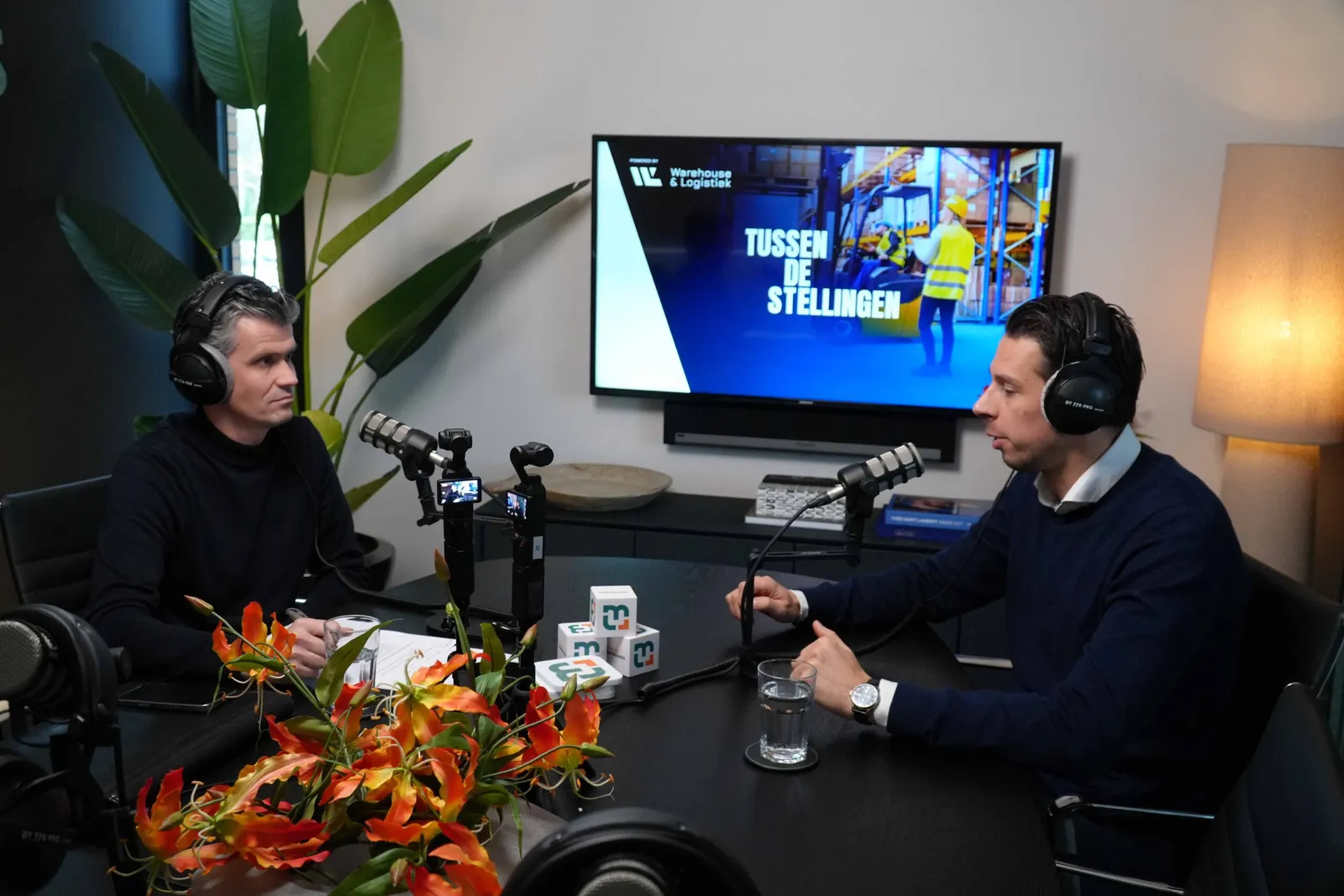
In this episode of Tussen De Stellingen, Roel van Gils speaks to Guido Guiking (DLL, De Lage Landen) about financing warehouse automation and robotics.
Guiking explains how companies can use leasing to carry out major automation investments without a large upfront capital outlay. By converting CAPEX into OPEX, they can keep cash flow and the balance sheet manageable, while aligning the financing term with the contract period. The discussion covers financial lease, operational lease and more flexible models such as pay-per-pick and Robotics as a Service, which are particularly attractive to 3PLs and fast-growing businesses.
The conversation also looks at residual values, second-hand markets for AGVs and AMRs, and the rapid rise in warehouse automation. The key message: involve financing early in the automation process, as a strategic part of decision-making.
Een zakelijke vraag aan De Lage Landen International B.V.? Get in touch
Full transcript
All chapters (33)
- Podcast introduction and guest
- Pay-off “We are always here for you”
- DLL, De Lage Landen internationally
- How does financing help companies?
- Tailored financing
- What exactly is financed?
- CAPEX versus OPEX
- Interest rate risk and long lead times
- Scalability and flexible models
- Financial lease versus operational lease
- Off-balance benefits of operational lease
- Pay-per-pick and Robotics as a Service (RaaS)
- RaaS for fast-growing businesses
- Administrative impact and partnerships
- The future of RaaS
- Is there a second-hand market?
- Leasing and equipment returning to the market
- Software upgrades and integration
- Growing within existing sites
- Depreciation and residual value
- What happens when the financing period ends?
- Financing for 3PLs versus end customers
- Multi-client facilities
- What is fully financed?
- When to involve DLL
- DLL at LogiMAT in Stuttgart
- Generating business on the exhibition floor
- Staffing and follow-up
- Expectations for the next edition
- Increasing levels of automation
- Leasing for large-scale roll-outs
- Final question: the key message
- Closing
Podcast introduction and guest
Roel van Gils Welcome to the Tussen de Stellingen podcast from the Warehouse & Logistiek platform of Louwers Mediagroep, here in Weert. Joining me is Guido Guiking from De Lage Landen. Welcome, Guido.
Guido Guiking: Thanks, Roel. Let me introduce myself. My name is Guido Guiking, and I work for De Lage Landen as an international account manager in intralogistics. We help major end customers, as well as manufacturers and suppliers, deliver their automation projects in logistics. Specifically, that means robotics and automation in warehousing.
Pay-off “We are always here for you”
Roel van Gils Your website carries the pay-off: “We are always here for you”. Could you give an example of what that means?
Guido Guiking: By always being there, we mean that the size of the project does not matter to us. We work on projects ranging from a single small robot to fully automated warehouses, like the ones you know from the likes of bol.com. We facilitate the financing for these customers from A to Z.
DLL, De Lage Landen internationally
Roel van Gils You, DLL, De Lage Landen, I should say, combine strong financial and operational expertise. Could you explain that in more detail?
Guido Guiking: That’s right. To come back to DLL, De Lage Landen: it’s great that you mention it, because De Lage Landen has been a well-known name in this field for more than 50 years. Certainly in this region, but also in the Benelux. But ‘De Lage Landen’ doesn’t roll off the tongue so easily internationally. So five or ten years ago, they decided that something had to be done about their international branding. The name was changed to DLL to make it easier to pronounce internationally, because the G doesn’t work in many regions.
Roel van Gils But it still stands for De Lage Landen?
Guido Guiking: Absolutely. A lot of companies ask what it stands for. It’s simply De Lage Landen.
Read the full transcriptCollapse transcript30 more chapters
How does financing help companies?
Roel van Gils How does financing help me as a company? Can you give an example?
Guido Guiking: In many different ways. You need to distinguish between the types of companies. Broadly speaking, we help two types. There are large multinationals, major American or European companies operating worldwide, and SMEs moving from a few warehouses into the next phase and starting to automate.
Guido Guiking: For SMEs, we mainly help with liquidity and project financing. The reason is often different for large companies. They generally have good access to capital, but it is more about cash flow. They have a project with a certain payback period and want to raise capital for exactly that period. Or they have a five- or ten-year business case with an end customer and want to match the funding to that term. That is often why large companies choose leasing.
Tailored financing
Roel van Gils So you have a wide range of financial solutions, really.
Guido Guiking: Exactly. For small businesses as well as multinationals. And it is always tailored to the customer.
Roel van Gils And it is always tailored to the customer.
Guido Guiking: Exactly. That is also because these projects are always tailored to the customer. No two projects are the same. We also finance lorries, which have a diesel or electric engine and can travel a certain distance. The only thing that might differ is the colour. But here, every aspect is different: the scope, the size, the type of products to be handled. Sometimes it is refrigerated pallets that need to be moved from A to B, and sometimes small boxes of medicines.
What exactly is financed?
Roel van Gils Do you finance all of those as well?
Guido Guiking: Yes, we finance the equipment needed to handle and store those goods.
Roel van Gils So everything in a warehouse?
Guido Guiking: Everything in or outside a warehouse can be financed. I focus specifically on robotics and automation within the warehouse. That includes racking, equipment and software. Hardware often makes up the largest share, with software accounting for a smaller part, although software is becoming increasingly important, particularly with AI.
Guido Guiking: Hardware includes racking, shuttle systems that run through the racking, and AGVs, robots that lift and transport pallets or boxes. They are controlled by software, such as a warehouse management system. We finance the entire project.
CAPEX versus OPEX
Roel van Gils What is the difference between CAPEX and OPEX? And why do companies choose one solution over another?
Guido Guiking: We see CAPEX as an investment made by the company itself. OPEX is an expense. Expenses are often easier to accept than a large investment. If you put an automation project on lease, you convert a CAPEX investment into OPEX. You do not have to make an upfront investment, but pay monthly lease instalments.
Guido Guiking: That is easier for many companies to accept and get approved internally than an initial investment of 40 or 50 million. Projects like these often generate savings, too, for example through lower staffing levels, greater efficiency or increased revenue from the same space. If the cost reduction is equal to or less than the lease payment, it is a logical investment.
Interest rate risk and long lead times
Roel van Gils To what extent is there interest rate risk?
Guido Guiking: There is often interest rate risk because these projects take a long time. If you decide to automate today, it often takes nine to twenty-four months for everything to be in place. A lot can happen to interest rates during that time. We can manage and hedge that interest rate risk. That means fixing your interest rate today and avoiding exposure to market risk.
Guido Guiking: Predictability is more important to companies than speculating on interest rate movements.
Scalability and flexible models
Roel van Gils In terms of scalability, are you more scalable if you choose a flexible model?
Guido Guiking: That could certainly be the case. The current trend is towards many new models entering the market that offer even greater flexibility. We already know this from other markets, for example SaaS, software as a service. Now there is also robotics as a service in this market. It is essentially an extension of the pay-per-pick model. These are offshoots of more advanced operational lease, like what you know from cars, where the end user has complete flexibility.
Financial lease versus operational lease
Guido Guiking: In the Netherlands, you usually see either a financial lease or an operational lease. With financial lease, ownership eventually transfers to the end customer, who owns the equipment at the end of the term, for example after five or ten years. With operational lease, ownership remains with the leasing company. At the end of the term, the end customer can choose whether to return it, buy it for a small amount or continue renting it for another period.
Off-balance benefits of operational lease
Roel van Gils That is also the most widely used model in intralogistics, isn’t it?
Guido Guiking: Yes, exactly. The advantage, particularly for large companies, is that it is often treated as off-balance. That means the balance sheet does not grow and the balance sheet ratios are not affected. Financial lease is treated as additional debt on the balance sheet. That is why nine times out of ten, many multinationals prefer operational lease.
Pay-per-pick and Robotics as a Service (RaaS)
Roel van Gils You just mentioned pay-per-pick or RaaS. Are those sub-models?
Guido Guiking: Yes, they are sub-models of operational lease that give the end customer even more flexibility. With pay-per-pick, you do not pay a fixed monthly amount, but a fixed amount per pick. You pay according to the number of orders that go through the line. It is attractive, partly because under the latest accounting rules it is fully off-balance.
Guido Guiking: It also offers flexibility if revenue falls. Companies with seasonal peaks pay less during quieter periods. They pay more during peak periods, but revenue is higher then, too. However, the more flexibility you have, the higher the cost. Someone has to pay for that flexibility.
RaaS for fast-growing businesses
Guido Guiking: For start-ups or fast-growing businesses, it is difficult to estimate exactly how much equipment they will need. These models can help them get off to a good start. A multinational in the food industry can often predict its revenue exactly. A fast-growing e-commerce company, however, is less able to do so. A RaaS model then scales perfectly with revenue.
Administrative impact and partnerships
Roel van Gils Does that mean more administrative work for you as well?
Guido Guiking: That’s right. That is why we work with partners on this. It is not something we offer stand-alone. We currently have a partnership through which we are rolling out this model.
The future of RaaS
Roel van Gils Do you expect to see more of it in the future?
Guido Guiking: RaaS will certainly play a major role in smaller robotic solutions, such as packaging machines, AGVs and AMRs. I do not see it happening as quickly for large, complete projects, such as those at DHL or bol.com. Those companies can predict their demand accurately.
Is there a second-hand market?
Roel van Gils Is there a secondary market, a second-hand market?
Guido Guiking: The short answer is: not really, yet. There has traditionally been a large second-hand market for forklifts. AMRs and AGVs are the next step. The technology is relatively new and has only been widely applicable in recent years. Equipment typically runs for five to seven years before being decommissioned. So it will be a few more years before that market develops.
Leasing and equipment returning to the market
Guido Guiking: AMRs and AGVs can return to the market after a lease period and be put to work by another company as second-hand equipment. Their technical lifespan is often ten to twenty years. Because they are software-controlled and not operated by people, they last longer.
Software upgrades and integration
Roel van Gils So the software has to be upgraded?
Guido Guiking: Yes, the software has to be integrated into a new environment and sometimes updated. But that is getting easier all the time. I expect the market for AGVs and AMRs to grow in the future. Other fixed installations, such as shuttle systems in racking, are less suitable for relocation to another site.
Growing within existing sites
Guido Guiking: If a system has been running for ten years and the user outgrows it, a new end user can move into the same site. The lifespan of equipment is often underestimated. Technology is depreciated over ten to fifteen years, but we see examples of systems running for 25 to 30 years, such as shuttle systems and high-bay cranes.
Depreciation and residual value
Roel van Gils Does the first customer then pay the full depreciation?
Guido Guiking: That depends on the structure. For accounting purposes, equipment is often depreciated over ten or fifteen years. Whether ownership lies with the customer or the leasing company depends on whether it is a financial or operational lease. We do include residual values in our calculations, but they are relatively low because they are difficult to verify. That is also necessary in order to offer an off-balance-sheet operating lease.
What happens when the financing period ends?
Roel van Gils What happens when the financing period comes to an end?
Guido Guiking: With a financial lease, you become the owner of the equipment. With an operational lease, ownership remains with us. That makes sense if, for example, you only have a five-year contract with an end customer. You may not want to keep that equipment. An operational lease gives you the flexibility to extend the term, take ownership or return it.
Financing for 3PLs versus end customers
Roel van Gils What is the difference in financing between end customers and 3PLs?
Guido Guiking: 3PLs are logistics companies that provide logistics services for third parties, such as manufacturing companies. We work with both types of customer. There is a clear trend for many manufacturing companies to outsource their logistics to logistics service providers, because logistics is not their core business. So many of our customers are 3PLs.
Guido Guiking: They often have a contract of a certain length with an end customer. It may be short, three years, or long, ten to fifteen years. Particularly with longer contracts, it makes sense to invest in automation, given the payback period for these projects. They often want their cash flow to match the contract term. So if they have a seven-year contract, they also want a seven-year financing solution. This ensures neutral cash flow throughout the contract.
Multi-client facilities
Roel van Gils But there are also arrangements where 3PLs serve multiple end customers?
Guido Guiking: Absolutely. Many 3PLs have a multi-client facility. In that case, they sometimes opt for a shorter financing term, for example three or five years, to spread the investment costs. They then retain the system and can use it for different end customers.
Guido Guiking: The end customer often has a significant influence on the 3PL’s investments. They set requirements for quality, error rates and throughput capacity. Meeting a lot of requirements means you need a lot of people. In Western Europe, and particularly in the Netherlands, labour is expensive and people expect to earn more each year. At the same time, the end customer often wants to pay a fixed amount per order. Automation is an ideal solution in that situation, because you can forecast your costs accurately over the contract period.
What is fully financed?
Roel van Gils Does that also mean all project costs are covered for 3PLs? Installation, transport?
Guido Guiking: Exactly. We include everything: engineering costs, which often account for 10% of the project, the hardware, the software and everything else involved. In a worst-case scenario, if things go wrong, we also want full ownership so we can deploy it for another party.
Guido Guiking: For example, if we finance a facility for DHL and the contract ends, there are plenty of other parties willing to take over the installation. But that is only possible if we have financed the entire project, including the software, cabling and all the components. That is why we prefer to finance the whole project.
When to involve DLL
Roel van Gils When does it make sense to involve you?
Guido Guiking: At an early stage. Once you have an idea of the technical installation you want to put in place and a rough estimate of the investment, whether we are talking about one million, ten million or one hundred million, it makes sense to involve us.
Guido Guiking: We can then determine the most suitable financing solution: a short-term financial lease, an operating lease or a combination. This gives you a clearer picture of cash flow sooner and increases the chances of the project being approved quickly.
DLL at LogiMAT in Stuttgart
Roel van Gils You will also be at LogiMAT in Stuttgart. What can we expect?
Guido Guiking: This will be our second year with our own stand there. LogiMAT is the world’s largest logistics trade fair. All the major and smaller suppliers attend. We visited for years, and last year we had our own stand for the first time. It was such a success that we are taking part again this year, in an even better location. I think we are in Hall 3, a prime spot.
Guido Guiking: Many of our partners will be there too. We work with both end customers and suppliers. When they meet end customers there, they can speak to us directly about financing options.
Generating business on the exhibition floor
Roel van Gils Do those conversations already happen at the trade fair itself?
Guido Guiking: Absolutely. Last year, far more companies than we expected came to see us. Some were not customers yet, but wanted to find out what the options were. Others were further along in the process and wanted to know specifically whether we could help with implementation.
Guido Guiking: We actually won business last year from customers who met us there. We did not expect that.
Staffing and follow-up
Roel van Gils Do you have the staff to cover it?
Guido Guiking: Absolutely. There are always two or three people on the stand. Our management also maintains relationships with partners who are attending. If there are live leads, we can follow them up quickly. A lot of business is done at trade fairs.
Expectations for the next edition
Roel van Gils Are you expecting a lot from it?
Guido Guiking: It is the most important trade fair in Europe. Last year was successful. We are seeing growing demand for financing and automation. The economic situation in Europe may not be fantastic, but that is not stopping companies from investing.
Guido Guiking: If they do not invest now, they will fall behind. Supplier lead times have previously stretched to two or three years. Companies have learnt from that and are now investing when an opportunity arises.
Increasing levels of automation
Guido Guiking: When we started five or six years ago, projects were often pilots involving a few robots and some software. These were investments of a few hundred thousand. Many of those pilots proved successful and grew into fully automated warehouses.
Guido Guiking: Even so, not everything is automated yet. The level of automation may be around 60%, sometimes 80%. There is still plenty of scope for further automation. New builds are also becoming increasingly automated.
Guido Guiking: Capital investment in new warehouses is increasing. Ultimately, operating costs come down because you need fewer people, work more efficiently and make fewer mistakes. But the initial investment is higher.
Leasing for large-scale roll-outs
Guido Guiking: For companies with not just one, but, say, one hundred warehouses worldwide, these are enormous capital-intensive investments. Leasing is a strong solution in that situation.
Final question: the key message
Roel van Gils Is there one last thing you would like to tell listeners?
Guido Guiking: They can always get in touch with us to discuss possible solutions. It may be that there is no suitable solution at that point, but we can still offer guidance for future investments.
Closing
Roel van Gils Thank you, Guido, for the conversation, and best of luck at the trade fair.
Guido Guiking: My pleasure, Roel. Thank you. I’m sure it will go well.
Companies in this story

Keep following this
Get an email when a new story is published. No account needed.
- ThemeAutomating goods flows
- SubjectGeneral
- CompanyDe Lage Landen International B.V.







