












Water transport: a sustainable solution for the civil engineering and infrastructure sector
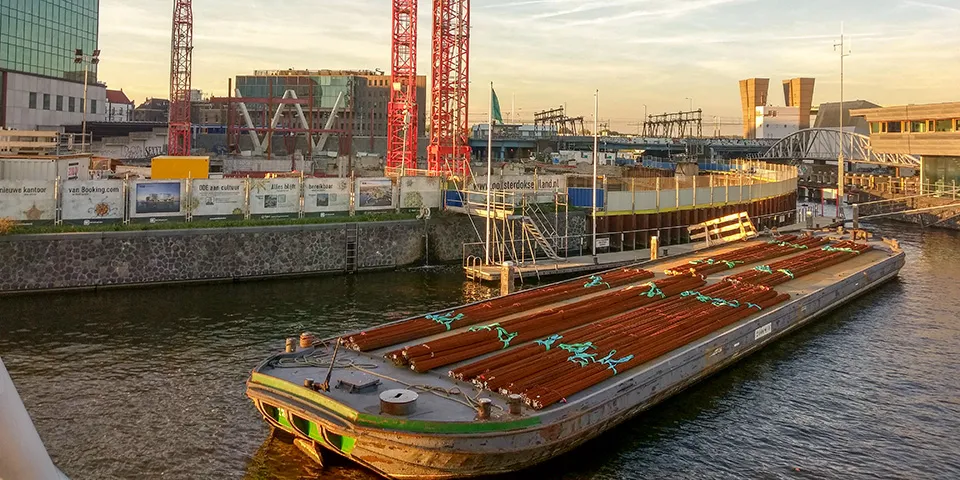
Since the early 20th century, deck barges have been used as work platforms and storage vessels on construction projects, as well as for transporting goods. Their very shallow draught makes them ideal for water transport, including in urban areas where low bridges and various navigable profiles have to be taken into account.
Sleepdienst en dekschuitenverhuur Blom BV has many years of experience in the hire and transport of deck barges, cargo barges and hopper barges, among other vessels. The company has its own storage and transshipment quay in Amsterdam’s Coenhaven. In recent years, its fleet has grown to include coupled deck barges (15-42 metres), pontoons, painters’ rafts and tugboats, bringing the total to more than 70 vessels. Blom director Nancy Blom explains: “Thanks to our advantageous location and spacious loading and unloading quay, which has a 70-tonne crane, we can combine road and water transport and also transship cargo directly from vessel to vessel. Our equipment can be deployed throughout the country for all kinds of water-related projects, as well as in Belgium, Germany and France.”
The reinforcing steel was then transported by water to the construction site.
Versatile deployment
“A logistics operation starts with a request from the customer. What do you want to transport? How large and how wide is it? We draw up a plan accordingly. We have a solution for every challenge.” Blom’s deck barges and pontoons are not just used for the sustainable delivery and removal of construction aggregates, materials and equipment. The possibilities are endless. “Our deck barges are also often used as floating work platforms or construction hubs. Coupled deck barges are used for projects involving cranes or piling rigs. And the pontoons can even be used for events. Or for the world’s largest inflatable fish…”
The pontoons can even be used for events. Or for the world’s largest inflatable fish.
Sustainable transport in urban areas
Many current and future construction projects in Amsterdam are located directly on a canal or on the IJ. “These sites are therefore very easy to reach by water,” says Blom. “Blom has developed ‘Green Development’ for the sustainable delivery and removal of construction materials and aggregates to and from central Amsterdam. This forward-thinking approach reduces freight traffic in the city centre and, in turn, CO2 emissions, while promoting sustainable logistics.” Blom cites the Egelantiersgracht in the Jordaan as an example, where water transport saved 1,000 lorry journeys during a quay improvement project. For another major project, almost all the construction materials, including sand, concrete piles and even 300 tonnes of reinforcing steel, were transported by water. “The huge quantity of reinforcing steel was brought from Germany to our own quay, transshipped directly onto our deck barges and then taken into the city centre. It’s fair to say that we can transport anything that needs to be moved by water. We know the city inside out and always have a solution!” Blom concludes: “Our current tugboats run on biodiesel. To operate even more sustainably and responsibly, we are currently having an electric tugboat developed. That means we’ll be fully prepared for the future!”
Question about this story? Ask your question
Keep following this
Get an email when a new story is published. No account needed.
- SubjectGeneral







