












Use of pumice in reinforced soil structure for rail is unique in the Netherlands
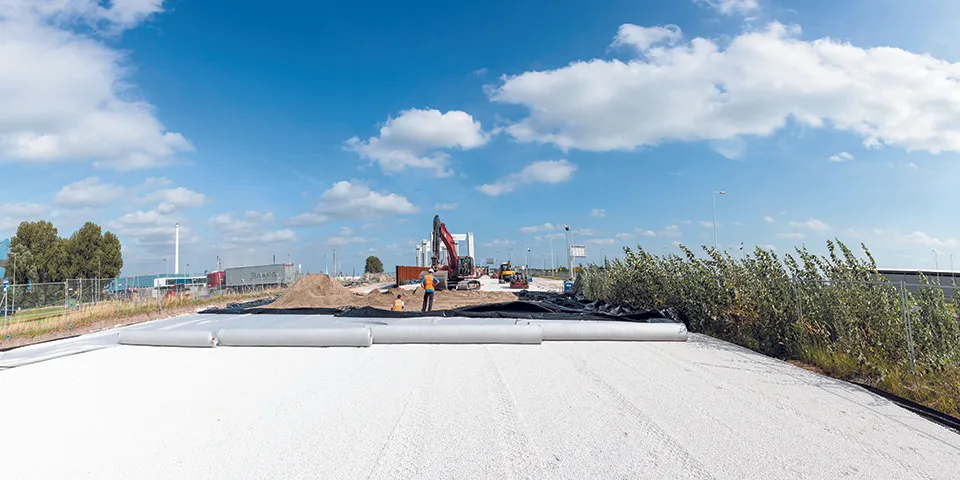
The old Botlek Bridge has been demolished and the new one built. Cars, cyclists and pedestrians have been using it for some time, but the railway still had to be connected to the port railway network. This work had to take account of the Botlek tunnels beneath it, carrying rail and road traffic, as well as vulnerable industrial pipelines. An added challenge was the unstable ground.
Arcadis therefore asked Joosten Concepts partner Geologics to design the connection. The solution is unique in railway construction: pumice was chosen as the material for building a reinforced soil structure. This ultra-light yet highly stable foundation material, which offers excellent water permeability, was used on both the west and east sides.
Looking to the future
Two sheet-pile walls were installed on the east side of the planned railway, and one on the west side; the other side is a slope. Formwork that moved upwards as each layer was built prevented direct pressure on the sheet-pile walls in the event of slight settlement of the structure. The void was filled with uncompacted pumice to prevent pests and vegetation, while allowing the structure to bulge outwards. The key advantage is that this construction method makes it possible to remove the sheet-pile walls and excavate the surrounding area as new developments take place, without affecting the track substructure.
Optimum protection
The pumice layers are reinforced with RE Geogrids from Tensar. A Tensar SS20 Geogrid was also installed for mechanical stabilisation, in an optimised 90-centimetre-thick design. Pumice is stronger than sand, but can crush under high pressure. A load-spreading top layer of sand prevents this. The sand layer is separated from the pumice by HDPE film to prevent damage caused by moisture ingress or contamination. Beneath the film is a TenCate Polyfelt TS non-woven geotextile for protection. An RE grid placed directly on the film prevents the sand from sliding, and is also incorporated as reinforcement in the next two to three sand layers.
The project was carried out by Joosten Concepts partners, Molhoek-CCT and Loonbedrijf Van Etten. Materials were supplied by Joosten Kunststoffen in collaboration with TenCate and Tensar.
Question about this story? Ask your question
Who worked on it
Botlekbrug
- designGeologics
- carried out byMolhoek-CCT
- carried out byLoonbedrijf Van Etten
- materialsJoosten Kunststoffen
- materialsTenCate
- materialsTensar
Keep following this
Get an email when a new story is published. No account needed.
- ProjectBotlekbrug
- SubjectGeneral
- CompanyGeologics
- CompanyMolhoek-CCT
- CompanyLoonbedrijf Van Etten
- CompanyJoosten Kunststoffen
- CompanyTenCate







