












Robots in building cleaning: a solution to staff shortages
Text Kärcher
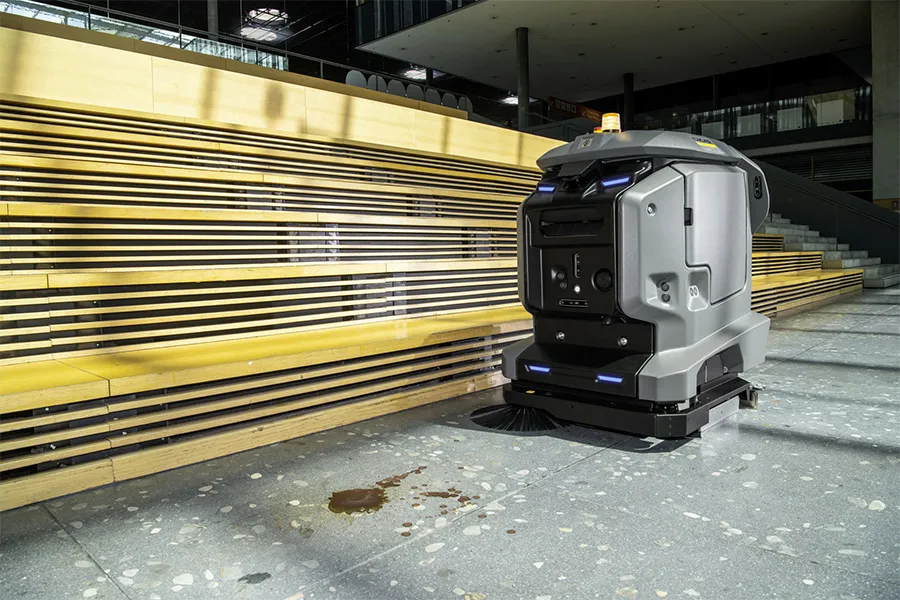
When machines become autonomous
It is still unusual to see autonomous scrubber-dryers in action. They have yet to become established in the cleaning sector. However, with the growing shortage of skilled staff, reducing time-consuming tasks is becoming increasingly important in many countries. This is where cleaning robots come in. Easy operation and high safety standards make them suitable for a wide range of applications, from supermarkets and hospitals to airports.
The aim of autonomous machine operation is to minimise the need for human intervention. Models are now available that autonomously connect to a docking station. They recharge and refill with water without operators having to do anything. Ideally, scrubber-dryers can clean even the smallest corners without any additional manual work. If the machines are equipped with powerful software, sensors and the ability to reverse autonomously, they can free themselves from dead-end areas.
Advanced technology for accident-free operation
Full autonomy would be of little use if cleaning robots did not meet the strictest safety standards, especially in areas open to the public. Laser scanners and 3D and ultrasonic sensors can monitor the area around the robot through 360°. People, other moving obstacles and stationary objects are therefore detected reliably. Depending on the model and manufacturer, the safety features are certified in accordance with the requirements of CSA (North America) or IEC (Europe). An independent body must always confirm that the robot can operate safely in compliance with the relevant standards.
Easy operation for everyone
Some people are still hesitant about operating robots, even though they are now very easy to control. When the first scrubber-dryers came onto the market, only service technicians with technical equipment and specialist programming skills could create a route plan. However, improved sensors, higher data quality and modern control concepts now allow any user to create, correct or combine routes without technical support. Depending on the model, step-by-step instructions show users what to do. To programme a route, the user selects a starting point. This point is marked with a code that the robot can read. The user then teaches the robot the planned cleaning route, or moves it around a defined cleaning area, which the robot subsequently covers autonomously.
Robots and people are one team
Although cleaning robots might be seen as rivals, experience shows otherwise. A coherent cleaning plan that takes account of the increased demands for cleanliness and hygiene in public spaces requires the expertise of skilled staff. The robot’s deployment schedule must also be carefully planned to minimise distances and combine routes efficiently. The codes used to start routes and the locations of docking stations must therefore be set accordingly. There are also clear limits to the level of automation that can be achieved. In sectors such as logistics, retail, manufacturing, transport and healthcare, robots are a good solution for monotonous, time-consuming tasks that incur high costs. Using autonomous machines for these tasks allows cleaners to take on other, more complex jobs for which they previously had too little or even no time.
Daily floor cleaning as an example
Daily floor cleaning is often a time-consuming task that also requires considerable effort from cleaners. Scrubber-dryers can be a valuable aid in this area, as they can cover medium-sized to large areas, depending on their design, and manoeuvre safely in confined spaces.
They can clean an area of several thousand square metres a day without human intervention. To achieve consistently excellent results, the water volume, cleaning agent dosage and operating speed are set in advance according to the level of soiling. ■
Question about this story? Ask your question
Keep following this
Get an email when a new story is published. No account needed.
- SubjectGeneral







