












New rainfall index: The Hague worst hit by extreme rainfall
TU Delft and consultancy ‘HKV lijn in water’ have developed a rainfall index to compare the risks posed by extreme rainfall in different cities. The method was applied to the provincial capitals in the Netherlands. The Hague comes off worst.
Heavy downpours are increasingly causing flooding in urban areas. When excess rainwater cannot be drained quickly enough through sewers, ditches and canals, pluvial flooding occurs. Ongoing urbanisation means that an ever greater proportion of the land is paved over. However, measures can reduce both the likelihood and the impact of this flooding.
Benchmark
TU bachelor’s student Tjerk Krijger has therefore developed a method for assessing the risks posed by extreme rainfall, interpreting those risks and comparing cities. He was supervised by Dr Bas Kolen (TU Delft and consultancy ‘HKV lijn in water’) and Dr Saskia van Vuren (TU Delft and Rijkswaterstaat). The method is based entirely on open data and quantitative analysis, making it reproducible. This enables cities to be compared effectively.
The latest rainfall statistics and models were used to determine the volume of water on the ground during peak rainfall. The method was applied to the provincial capitals in the Netherlands. Various parameters were quantified to assess the risk and define ambitions, including the number of properties that could be affected, the number of residents and the number of reports.
Flood risk associated with extreme rainfall in the capitals of the Netherlands. The size of each circle indicates the scale of the risk.
Risk increases
The risk was calculated for each city, which were then ranked accordingly. This was done for both the current situation (2018) and the future (2050). Climate change, which increases the likelihood of extreme rainfall, and socio-economic developments, such as urbanisation and economic growth, are increasing both the likelihood and the impact of extreme rainfall. The study shows that this is the case for all the cities examined.
The Hague
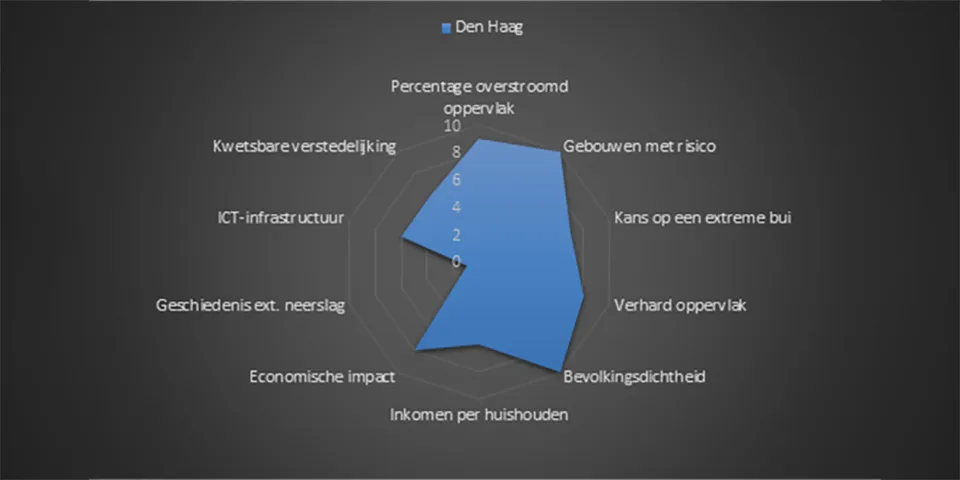
Of all the provincial capitals, The Hague has the highest rainfall risk in both 2018 and 2050. The rainfall index shows that The Hague has the largest number of buildings affected by extreme rainfall and faces the greatest economic impact in the event of pluvial flooding. The index also reflects the high level of risk: The Hague has a relatively large proportion of paved surfaces and a high degree of urbanisation.
The expected economic growth (more than 80%) is also a greater contributor to the increase in risk by 2050 than the expected rise in rainfall (8%). However, economic development also offers opportunities to reduce rainfall risk.
Reducing risks
The rainfall index shows that cities such as The Hague have clear ways to reduce or better manage rainfall risk. More green spaces could be created, for example, to reduce the area of paved surfaces. Parts of the city could also be renovated or raised, reducing the number of buildings that may be affected by extreme rainfall.
Encouraging climate adaptation
Cities can use the rainfall index to set specific ambitions for various parameters and translate them into practical targets. Bas Kolen says: ‘Our ambition is to further develop the method, adding new parameters and improving the relationships between risks. We believe that this approach, which compares cities, offers an interesting way to encourage municipalities to take climate adaptation measures. We intend to publish an updated list for all cities in the Netherlands every few years.’
Text and images: Land+Water trade magazine
Question about this story? Ask your question
Keep following this
Get an email when a new story is published. No account needed.
- SubjectGeneral







