












Column | Liesbeth Schippers
Get to work
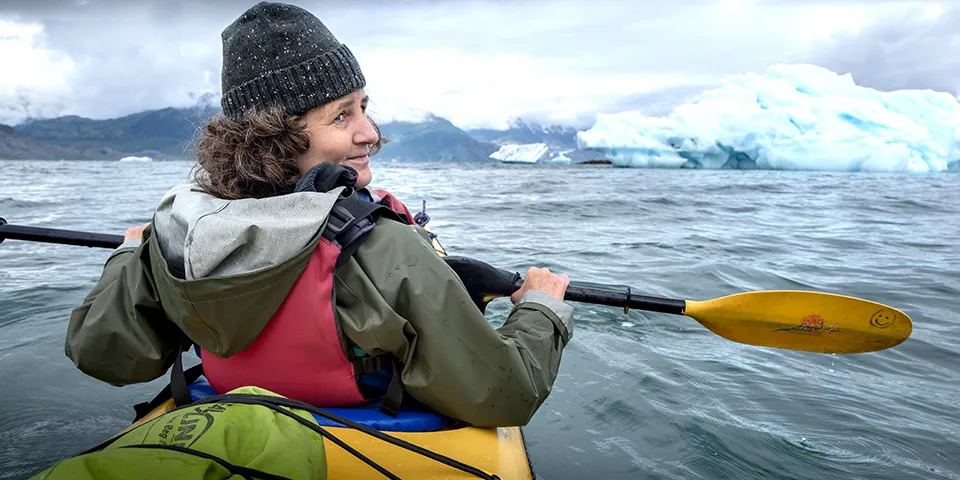
Alaska, sea kayaking at the foot of the Columbia Glacier. If there is one place on Earth where climate change makes itself felt, this is it. Retreating glaciers, huge chunks of glacial ice floating out at sea. The sound of melting ice cracking all around you.
The challenge of limiting global warming to 1.5 ℃ is unimaginably huge. We all need to get to work, sooner rather than later. The government, households and you too, the people building our country. Because there is a lot coming your way. Did you know, for example, that the government’s aim is to have an almost energy-neutral built environment (BENG) by 2050? And that does not mean you will not have to deal with it for some time yet. On 2 November 2018, the Building Decree was amended, introducing a so-called label C requirement for offices. Offices that do not have that label on 1 January 2023 may not be used, subject to a few exceptions. If you are about to carry out major maintenance on your office, you would be wise to plan for this. Planning to build a new office? From 31 December 2020 at the latest, it will have to meet the “BENG” standard. Solar panels on the roof, connection to a thermal energy storage system (WKO), geothermal energy, wind energy (your own wind turbines or purchasing power from a local wind farm), aquathermal energy, insulation and, of course, simply reducing energy use: these are all ways, on their own or in combination, to make your office energy-neutral.
If you rely heavily on freight transport, it would also be wise to minimise this. On 9 November 2018, the Minister of Infrastructure and Water Management published the “Truck Toll” policy framework. The intention is to apply the principle that “the user pays”. The more truck drivers use the roads, the more they will pay. Legislation still needs to be introduced. The toll is expected to be levied for the first time in 2023. But here too, it does no harm to plan ahead. How can you make your freight transport more efficient now, so that you do not face unnecessary extra costs later? More transport by water, perhaps, but using shore-side power. Or by rail: the Betuweroute is there for a reason. Yesterday, a bus passed me in the street. I thought: I can’t hear anything and, more importantly, I can’t smell anything. None of that unpleasant diesel smell we are used to from buses. An electric bus, a breath of fresh air, literally and figuratively.
Sustainable construction is not just about what you build, but also how you build it. Excavators powered by electricity (or hydrogen) must surely exist, but I have not seen any. I understand that you cannot keep stopping roadworks to plug the asphalt paver into a charging point, but there must be smart technologies that can be developed. Innovation is absolutely essential. And for that, we depend on you, businesses, working with research institutes and universities. We all have a huge task ahead of us. Every innovation, however small, is welcome.
Liesbeth Schippers
Partner and lawyer at Pels Rijcken
Question about this story? Ask your question
Keep following this
Get an email when a new story is published. No account needed.
- SubjectGeneral







