












A new approach to tendering deserves praise
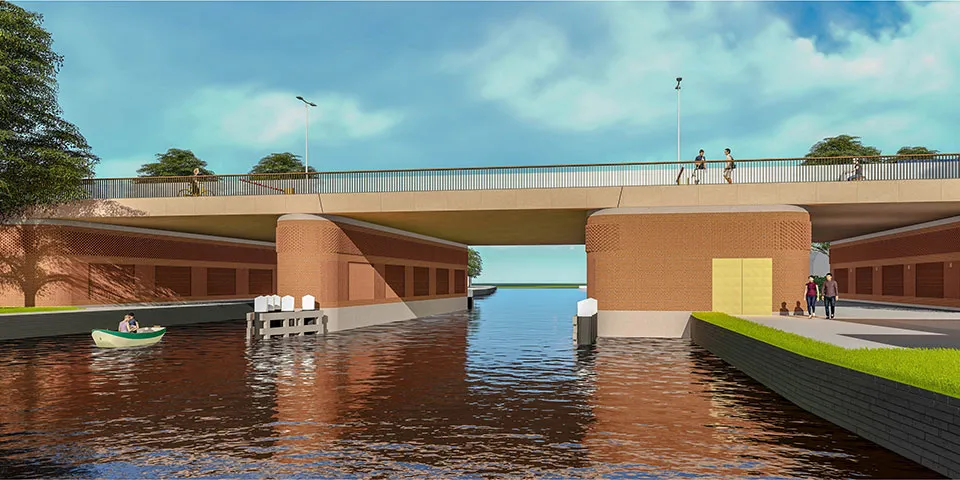
Innovation is not always about technology. Often, it is also about the way we work. The Province of South Holland can be proud of the new form of tendering it is using for the Steekterbrug project. The approach is based on the DOEN method, which Rijkswaterstaat has already gained experience with, and has been adapted in certain respects to the province’s way of working. We stay in touch with Rijkswaterstaat to exchange our experiences with each other.
The project involves replacing the old Steekterbrug and falls under the responsibility of the province’s Steekterbrug core team. We spoke to the team members about a new form of tendering that brings the necessary change from the traditional way of working.
The interviewees are Hans Schutjes, project leader, Eliane Scharten, environment manager, and Marcel Kluter, contract and technical manager. They are all members of the core team for the Steekterbrug Replacement project. Tendering for the work began in November 2019 and will continue until November this year. In the first quarter of 2020, work began on demolishing buildings and diverting a ditch, cables and pipelines.
Selecting the contractor on the basis of attitude and behaviour
Kluter opens the conversation: “With our new approach to tendering, we want to work in a significantly different way. We want more interaction with contractors, with two things at the heart of our approach. We want to embark on the design process together, strengthening integration between the work and the design, and we want to select the contractor on the basis of their attitude and behaviour.” We learn that this is guided by four objectives. Kluter continues: “You could call them ‘the four commandments’. First, we aim for optimal collaboration. Second, we want to prevent waste in every process at all times. Third, the required quality must be delivered, with no compromises. And fourth, which is also very important, the work must be done fairly for a fair price.”
These four pillars are built into the tender, and everything that is done is assessed against the four commandments. So how do you select the contractor, we ask. Kluter: “We issued a request for proposals containing only general information about the project itself. We provided no drawings, requirements or design. We simply asked bidders to submit a vision based on our requirements for collaboration. We received a number of vision documents, from which we selected five companies to proceed to phase two. Naturally, we also checked that those selected met the technical requirements and had sufficient experience in bridge construction.”
Phase two: assessment under independent supervision
The five selected companies were then assessed by consultancy firm Twijnstra en Gudde to gauge their attitude and behaviour. Schutjes explains: “We designed case studies for this. The first was fictional, the second was based on the Steekterbrug. There was no way to put on an act at that point, Twijnstra en Gudde monitored everything.” Kluter adds: “Our team also went through the assessment process. It was an emotional experience at times, for both the participating contractors and us. You are held up to a real mirror. That can be hard to take, but the aim is also to take a critical look at your own organisation. That was an unexpected benefit, and good things came out of it. The first time, our team ‘failed’. We acted on that, and as a team we now work more openly and honestly, and share more.” Our conclusion is that the assessment itself already meets the four pillars. Kluter agrees. Scharten notes: “The process could be hard to take for the contractors too, but taking part in the assessments gives you a much deeper insight into your own organisation.”
A question of trust
The Steekterbrug core team received only the scores in the final assessment from Twijnstra en Gudde. “So we don’t know what the contractors answered, we only see the final score. That means we can remain impartial, placing 100% trust in the competence of Twijnstra en Gudde.”
Schutjes continues: “A probity manager has also been appointed, who in turn checks the assessments. Contractors can also take their questions to him, as he acts as an ombudsman. Working this way ensures that everything is fair. We ask the contractor to provide their own justification for the budget and help them with it. The process was sometimes challenging for the contractors who took part in the assessments, as they are not used to it. We gave them only the essential information they needed to proceed to the next phase.”
The decision has been made
Scharten: “Phase 3 of the process was the plan of approach: how do you arrive at a design? Matters such as the process and risks are important here. We are currently in phase 4, the design phase and company formation, together with the preferred contractor. The contract has been awarded to the Heymans Hillebrand contractor consortium.” Kluter explains: “At this stage, it must be demonstrated that all the key objectives will be met in terms of budget, timing and acceptable disruption, and that the design meets the required quality.”
The contract is awarded in phase 5. “That is the construction phase, with some design work still to be done,” says Scharten. Schutjes adds: “The risks must also be borne and fit within the budget. This affects the organisation at every level. People will really have to get used to working with us. But trust is the key here too. This way of working also creates room for innovation. And asset managers are not brought in at the last stage, they are involved from the outset. In fact, this way of working is a real celebration.”
Question about this story? Ask your question
Who worked on it
Steekterbrug
- contractors' joint ventureHeymans Hillebrand
Keep following this
Get an email when a new story is published. No account needed.
- ProjectSteekterbrug
- SubjectGeneral
- CompanyHeymans Hillebrand







