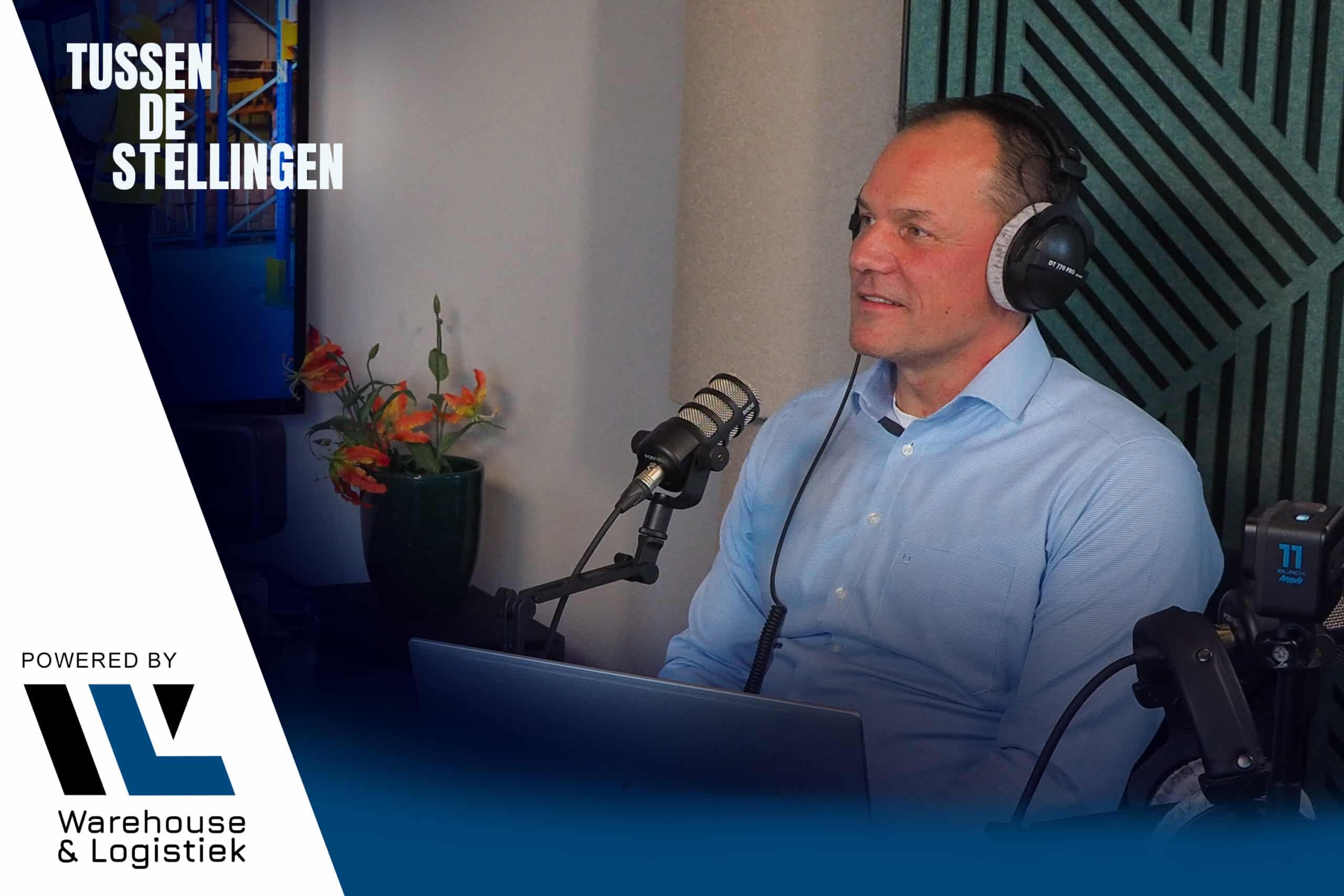
[00:04] Introduction to the podcast
Ferdi den Bakker: Welcome to the podcast Between the Racks of Warehouse & Logistics. My name is Ferdi den Bakker and today we are going to talk about cable solutions that are indispensable for smooth intralogistics processes. Welcome Pascal.
[00:19] Welcome from the guest
Pascal de Vries: Good morning.
[00:20] Introduction of Pascal and LAPP
Ferdi den Bakker: Hello. You are Customer Success Manager Intralogistics at LAPP.
Pascal de Vries: That is indeed true.
Ferdi den Bakker: Supplier of cable solutions. LAPP Benelux is a sales company and was founded in 1989.
Pascal de Vries: True also.
Ferdi den Bakker: The company provides products and advice to system integrators, for example, such as suppliers of warehouses and automation within warehouses.
[00:44] Who are the customers of LAPP
Pascal de Vries: It also goes a little further still. We have many customers of course, but if we look at intralogistics, our customers are the system integrators and the machine builders who build parts for system integration.
[00:56] Launch of the theses
Ferdi den Bakker: I want to start by throwing three dilemmas at you. It would be nice if you give a brief response to each dilemma. We'll come back to that in more detail later.
Pascal de Vries: Fine.
[01:14] Thesis - investing in uncertain times
Ferdi den Bakker: The first. Macroeconomic challenges make companies very cautious. When in doubt, you'd rather not invest. Are there arguments for putting that caution aside?
Pascal de Vries: It is indeed quite unsettled macro-economically at the moment. We see that reflected in the market that companies are hesitant to invest. Especially when you talk about intralogistics solutions. Those are often expensive investments. There is some reluctance in the market right now.
[01:46] Thesis - role of suppliers in cost savings
Ferdi den Bakker: Second proposition. Cost savings are popular. How important is a supplier's role in making that happen?
Pascal de Vries: Very important. As a company, we are a problem solver ourselves. So we offer solutions to customers and those are going to translate into a piece of ROI increase.
[02:12] Thesis - certainty or solutions
Ferdi den Bakker: Third proposition. What do companies need more: security or solutions to challenges they face?
Pascal de Vries: Solutions to challenges. So that's where the profit is that companies can make. It can be anything. There are thousands and one solutions. It's up to us to offer the right solution.
[02:31] Keeping intralogistics moving
Ferdi den Bakker: The theme of this talk is keeping intralogistics moving. The world is changing. Global megatrends such as digitization and automation are changing society and with it intralogistics. How do you view this, Pascal? From your role as a supplier of cable solutions.
[02:53] Growth of the intralogistics market
Pascal de Vries: We see a clear trend. It has been going on for years. We see that the intralogistics market has been growing faster than other markets in the industry over the past ten years. And the expectation is that it will continue to do so over the next ten years. That is why we are also developing specialties in this area and entering into international cooperation with large companies in order to achieve good solutions.
[03:22] Target groups within intralogistics
Ferdi den Bakker: So who do you focus on as a company? What are your customers?
Pascal de Vries: It's mainly the system integrators, so those who offer machine lines as a solution. But also the machine builders who produce parts of those lines and therefore need the corresponding cables and connectivity solutions.
[03:48] Examples of intralogistics applications
Ferdi den Bakker: So what kind of intralogistics processes do you provide cabling for? Do you have some examples of that?
Pascal de Vries: Yes indeed. So you have the AGVs and the AMRs. Those are automated vehicles that drive from A to B. That's where we're seeing tremendous growth now. We also see storage systems, think ASRS or small parts warehouses that are gaining tremendously in popularity and increasing efficiency for our customers. Of course also conveyor belts, so solutions for moving goods from A to B. Those are really the biggest applications that we deal with in intralogistics, though.
[04:37] Automation and investment in intralogistics
Ferdi den Bakker: These are very big developments, often big investments. Although, it can also be concise, it can be small. How do you look at the development of this form of automation? From those self-driving vehicles to big bin systems like Autostore. How do you look at that?
Pascal de Vries: That is an indispensable development. That has to do with it because of two things. One is the shortage of hands in the market right now. And two a piece of increasing the return on investment. So if you automate then you can just run 24/7. That's a little bit of the application and the applications, so you can run your business more effectively as a customer of LAPP.
[05:33] Growth of intralogistics automation market
Ferdi den Bakker: How fast is that market growing? How big is the demand for this kind of solution and your support in that?
Pascal de Vries: I do have percentages of that, I don't have them here right now. But what we see is that that market is just growing faster than other markets in the industry. So that's just a given. And that's obviously gaining in popularity in relation to that it's more efficient in operations and produces a higher return.
[06:04] Role of consulting in cable solutions
Ferdi den Bakker: I can imagine that as a company you don't just know exactly what you need. How big a role do you guys play in giving advice? How big is that need among customers?
Pascal de Vries: Often they have already made a design of the machines or the lines they produce. And then it's up to us to take a look: your colleague does it that way, how do you do it? So then it's about a piece of connection of the control current, or power cables. Or the data communication cables. There are just different protocols behind that. And at some companies they work slightly differently than at other companies. And if you exchange a bit of experience there, that is of course of added value for the customer.
[06:59] Complexity of intralogistics systems
Ferdi den Bakker: Is it easy to oversee that whole landscape? What exactly is needed then? Because every process is different.
Pascal de Vries: That's right. Every application is also different, of course. Only if you look at the bigger picture, so if you look at a piece of power supply and a piece of communication of the machines and the AGVs for example, then it's actually similar. And then it doesn't matter so much which application that is. There's a difference, of course, but the big picture is pretty similar.
[07:36] Example of a practical solution
Ferdi den Bakker: Problems are always good, so are examples. Are there any examples of challenges that companies faced where you were able to play your role as a problem solver well?
Pascal de Vries: Yes, there are plenty of those to mention. But I think the best example is that companies used to work the cables themselves a lot. What do I mean by that? Buying cable, buying connector, buying ferrules and so on. So now we have the ability to pre-assemble a piece of the cables. And that solution is received with enthusiasm in the market. Of course, it also has to do with the shortage of hands. You can better employ a good assembler in a different way than standing around installing connectors.
[08:35] Advantages of pre-assembled cables
Ferdi den Bakker: That shortage of hands always comes back. How much benefit can you generate for a party if a process can go smoothly?
Pascal de Vries: It benefits on several levels. It's time saving. You have a mechanic who, with plug-and-play, is immediately ready with the connection. What is also the advantage, of course, is that we as a supplier produce the cable ourselves. In many cases, we also produce the components ourselves. And we have in-house assembly plant. So on the cost side, we can provide an economically viable solution for our end customer.
[09:31] Failures due to incorrect cable assembly
Ferdi den Bakker: It does surprise me that companies used to process cables themselves. That seems like a specialized job to me.
Pascal de Vries: That's a specialized job. And if you connect a hundred connectors, there are always two or three that aren't right. With all the consequences of failures. And then you often have a connector on two sides. So which side is the one that's not right? Then you have to disconnect both of them to solve the problem. That, of course, takes a lot of time. So apart from the initial connection of the connectors, repairing takes at least as much time.
[10:09] Emergence of the prefab cable strategy
Ferdi den Bakker: When did that change, that idea of we want to do that ourselves to more outsourcing?
Pascal de Vries: That's kind of in the strategy of our company. Senior management in Germany about 15 years ago looked at how we could differentiate ourselves in the market. How can we add value to our customers? Offering a piece of prefabricated solutions is certainly one of them. Hence, that is what has been put to full use. We currently already have five assembly plants in Europe. That really says it all.
[10:57] Specific solutions for Warehouse & Logistics
Ferdi den Bakker: This is obviously a podcast for Warehouse & Logistics. Are there any specific solutions focused on this sector that you would like to highlight that might add more value than others?
Pascal de Vries: The solution is tricky, because every customer has a different challenge. It's not like we've invented a new wheel now. You have different types of cables. You have power cables, there are developments in those but they are not major changes. You have a piece of communication cables and there are other protocols behind that. What we as LAPP do is look along with our customers: what are you working on, what developments are there, what is your R&D department doing and do we still have the right products to serve you well in two or three years. These are questions that we ask ourselves and that we also discuss internationally with salesexperts within intralogistics.
[12:10] New developments in communication and nutrition
Ferdi den Bakker: Are there certain developments you can point to? Something that is being worked toward now?
Pascal de Vries: Right now there are some developments in the field of communication protocols. People often want to combine communication cable with power supply, with power. There are already developments of that, but then we as a cable supplier look at whether we can offer other solutions for that so that one cable can be used for both communication and power.
[12:48] Quality of cables
Ferdi den Bakker: What is the most important thing when it comes to cables? Is it the quality?
Pascal de Vries: Yes indeed.
Ferdi den Bakker: How do you guarantee those?
Pascal de Vries: Cables that we produce are measured with high voltages. You have to imagine: a production line, for example a control current cable four times one and a half, is run forty to fifty kilometers per production on a very large reel and that is measured with high voltage. Then if the conductor insulation or the outer jacket is not good somewhere, that is measured through. They see a fault somewhere and cut the fifty kilometers in half. Then they measure twenty-five kilometers. If it's not in there, it goes to production. The other twenty-five kilometers are measured again. In this way we eliminate a lot of technical problems at the front end.
[14:09] How much cable is in a warehouse
Ferdi den Bakker: Is it possible to give an example of how many meters or kilometers of cable are in an average warehouse?
Pascal de Vries: That varies very much per project. I happened to be at Schiphol Airport yesterday. There is a new cargo handling hall there. I think there are hundreds of kilometers of cable in there. But that's also a hall that I think is one and a half kilometers long. You get lost in there. Superb. But you also have projects where the system is not even a tenth of what's there. So it's very dependent on the project size.
[14:41] Change in wiring of systems
Ferdi den Bakker: What creates a lot of length? Is it the size of the warehouse or the type of automation?
Pascal de Vries: What used to happen a lot, about twenty years ago, was often controlled from a central point. So there was a central point in the middle of the factory hall and from there the cable was laid back and forth. Both the power cable and the data communication cables. So there were huge miles of cable going in. Now we're dealing much more with loops. So machines are linked together and loops are made. As a result, you need less cable. For us as a cable manufacturer, that's somewhat unfortunate, but on the other hand, of course, it's completely understandable that systems are set up that way.
[16:07] Saving on cable usage
Ferdi den Bakker: So is that a savings opportunity? That companies say, we want to work with less cable?
Pascal de Vries: There is some savings in that. What it means for us is that we have to make sure that we can offer all types of cable that are used. Even though less cable is used in the application, we have to make sure that we still keep the number of meters roughly the same.
[16:29] Automate or move to Eastern Europe
Ferdi den Bakker: The theme is keeping intralogistics moving. That also means companies have to make choices. Do we stay here or do we go somewhere else because of costs?
Pascal de Vries: Definitely. Companies struggling with staffing and rising costs sometimes make the trade-off: am I going to move my production to Romania or am I going to automate? I have a good example of that. A welding company opted for automation. My client was a machine builder that builds parts for welding machines and makes AGVs. What happens next? A half fabrication is automatically picked up, driven to the welding robot, the robot does its job and then the product is automatically removed again. That owner told me that he recouped his investment within one year and eight months. And he said, I'm glad I didn't move to Romania.
[17:30] Collaboration with system integrators
Ferdi den Bakker: You guys are doing more and more consulting. Does that sometimes clash with system integrators who already have a design?
Pascal de Vries: That varies per system integrator. Some have their design fixed for years. But I then share my experiences with other companies. Often engineers and R&D people are open to that. That doesn't mean they immediately adapt everything, but it does help to exchange ideas.
[18:34] Investing in times of uncertainty
Ferdi den Bakker: One of the dilemmas was about investment caution. Is that caution justified?
Pascal de Vries: Misguided I wouldn't call it. But what we say at LAPP is: every crisis is also an opportunity to prove yourself in the market. The end customer often has to make an investment of several millions. Banks are critical. There is uncertainty. But just then we say: investing can actually offer opportunities.
[19:34] Share of cables in an investment
Ferdi den Bakker: How big is your stake in such a multi-million dollar investment?
Pascal de Vries: If you look at cables and accessories, such as glands and connectors, that's about one to one and a half percent of the total project budget.
[20:00] What is a good cable
Ferdi den Bakker: And what is a good cable?
Pascal de Vries: A good cable is one that you plug in and don't have to look at for twenty years. That's what our customer wants. He wants the certainty that he won't have to worry about it for ten to twenty years.
[21:03] Future of cabling
Ferdi den Bakker: Unless the landscape suddenly changes with new systems.
Pascal de Vries: Yes, exactly. But cables will still be needed for communication and power. I don't see wireless power distribution happening any time soon.
[21:16] Internationalization within LAPP
Ferdi den Bakker: Part of the podcast is a moment when you can explain something yourself.
Pascal de Vries: We see in the market an increase in internationalization. Our customers operate worldwide. They expect us as LAPP Group to be a single point of contact with a joint strategy. In recent years, a lot has been put into this within the organization. Experts from different countries work together to support customers worldwide.
[22:12] International knowledge exchange
Ferdi den Bakker: Do you also adopt solutions from other countries?
Pascal de Vries: Absolutely. Austria, for example, has many large intralogistics companies. We have a lot of contact with colleagues there. Solutions that work well there we can translate into solutions for customers in the Benelux.
[22:52] Closing the podcast
Ferdi den Bakker: Then this is the end of the podcast. Without cabling, little functions in logistics. It's an indispensable part of automation. What did you think of the podcast?
Pascal de Vries: I enjoyed doing it. Intralogistics is my job and it's a diverse customer base with different applications. I think we were able to cover a nice part of the load in this podcast.
[23:46] Final question
Ferdi den Bakker: Do you see yourself as a podcasting phenomenon?
Pascal de Vries: Well, not that. I enjoyed doing it, but I don't have to do it every week.
[23:57] Final word
Ferdi den Bakker: Thanks for listening. Want to listen to more conversations like this and are you interested in intralogistics processes and logistics developments? Then sign up for the podcast Between the Theses from Warehouse & Logistics.