[00:01] Introduction to the podcast
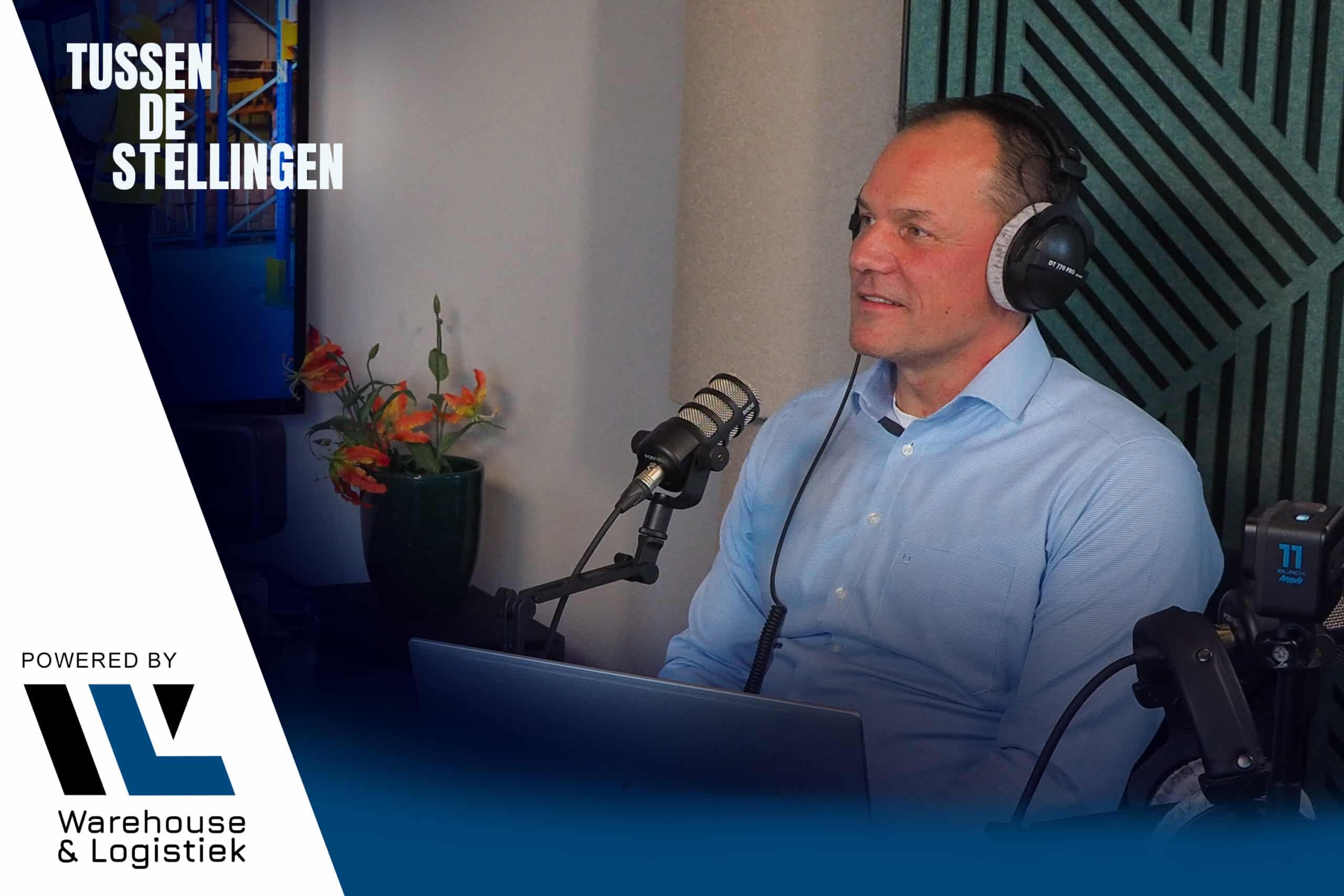
Ferdi den Bakker: Welcome to the podcast Between the Positions From Warehouse & Logistics. My name is Ferdi den Bakker and today we are going to talk about intralogistics automation. My guest in this podcast is Peter De Henau, Managing Director Belgium and Netherlands at SSI Schäfer. Peter has been active in the material handling and intralogistics sector for more than 30 years. He has a background in engineering. SSI Schäfer itself is an integrator, supplier of all kinds of resources needed to run an intralogistics operation with solutions for storage, order picking and transport. Welcome Peter.
Peter De Henau: Welcome, you're welcome. A pleasure to be here.
[00:52] Dilemma 1 - Is automation due to labor scarcity necessary?
Ferdi den Bakker: I want to present you with three dilemmas Peter. It would be nice if you could give a brief answer for each proposition and then we will discuss them in a little more detail later. There is a major labor shortage, technical and operational. Entrepreneurs face the dilemma of what to do with it. Because of the labor shortage, is it really time to move toward automation?
Peter De Henau: I think so. I see more and more customers struggling with that today and so indeed are at the turning point of: am I going to mechanize and automate or not. And as a result, new projects arise.
[01:27] Dilemma 2 - Automation is expensive
Ferdi den Bakker: Then the second dilemma. When entrepreneurs think about automation, they quickly feel that it involves a lot of money. Is that feeling correct?
Peter De Henau: That feeling is not correct. I think there are smaller scalable solutions on the market today to mechanize certain business processes or logistics processes. Indeed, there used to be a feeling that if you go to full-blown automation that it costs a lot of money. It still costs a lot of money, but for specific processes today you have nice technologies that are feasible for multiple parties.
[02:09] Dilemma 3 - Choosing the right technology
Ferdi den Bakker: And then the third point. How do you tackle it? Which technology is suitable for which specific situation? There are a lot of systems available for storage and picking, but what is the right choice?
Peter De Henau: That is indeed a challenge of the last few years. Let's say that a lot of new players have come in. That you have to distinguish between firms that offer one particular technology or one particular solution. And then integrators that actually offer total solutions and can draw from different technologies. The choice of what you do is very important and actually starts from knowing the process, but also the data. Everything starts with data to know what technology is available for what problem definition.
[03:04] Is automation always feasible?
Ferdi den Bakker: Topic automation of logistics concepts, intralogistics automation. Is that a viable option? How far can you or should you go as a company if you feel you have no choice and that you have to move toward automation, for example, due to labor shortages?
Peter De Henau: I think you have to get the right parties involved to start looking, based on that data and based on your processes, at what is feasible and where you can make a return. That actually starts with a good understanding of the processes and then looking at the data - we do that from an inbound file or an outbound file and a stock master data file - and distilling a kind of material flow diagram. Then you immediately see which part of the process is feasible for mechanization. Then it's a choice of what technology you put against that. Obviously, a multinational company with a lot of throughput and storage will have a much bigger project than an SME where, for example, you just need to automate or mechanize a picking process.
[04:25] Labor shortages in practice
Ferdi den Bakker: What do you notice in the market? Labor shortage is not from yesterday, but it really started squeaking and creaking about four or five years ago. How much more pressure does that put on companies to look at automation now?
Peter De Henau: That's hard to say. It depends a little bit on the industry. You actually have two types of scarcity. You have the scarcity of operators. That is sometimes filled with cheaper labor, but that too has its limits. It's training people every time and rotating them into those operations. So there is a need for simple and understandable processes there. There is also the technical scarcity. Technical profiles are even harder to find. That actually goes against mechanization a little bit, to be honest. Because you're going to replace cheap pickers with a machine, but a machine requires maintenance and knowledge. So you're going to address labor scarcity in operations on the one hand, but you then need some other, less but technical profiles.
[05:53] Maintenance and resident sites
Ferdi den Bakker: That's what you have the supplier for, right, to help you with that?
Peter De Henau: Indeed. There are solutions where integrators take over full technical and operational management of facilities. Then you go to what we call resident sites. In that case, there are really people from Schäfer at the site who fully maintain the installation and do the first line of support. So the customer only needs to have operational people. Of course, we have to find those people too, because we are fishing in the same pond. But we can give guarantees that the people are there and that the performance of the installation remains guaranteed.
[06:44] Starting with automation: data as the basis
Ferdi den Bakker: It sounds attractive to use automation to solve a lack of people or to work more flexibly. But how do you know what you need? How do you start with automation? You already mentioned data as a basis.
Peter De Henau: Yes, data. You'd be surprised sometimes how many companies still lack data. It starts with the master data of what you have in your warehouse: the stock keeping units, the SKUs. You also have inbound deliveries to your warehouse and outbound deliveries. We call that an inbound file and an outbound file. In that outbound file we analyze the order processes on a daily basis, on an hourly basis and on peak days, for example Black Friday. From that we distill a material flow diagram. In it you look at the warehouse as a block where goods come in as pallets or boxes and leave again to a pick station or again to storage. We map all those flows and at each point we look at how we can mechanize that.
[08:08] Compare technology
Peter De Henau: What is important for entrepreneurs who are not versed in this is to get guidance from companies like Schäfer, as well as consultants. The important thing is to keep the horizon open and talk to parties who can look at different technologies. You have vendors who sell one solution and integrators who can juxtapose multiple solutions. Consulting means putting different options side by side. Each solution has an investment cost and an operational cost. The higher the investment, the lower the operational cost and vice versa. This requires close cooperation with the customer: where are they today and where do they want to be in three, four or five years? This is often difficult to predict, but it is the horizon you have to consider.
[09:14] Sectors in which automation is used
Ferdi den Bakker: You serve a lot of companies in different sectors. Can you highlight some of those companies or sectors that you serve emphatically?
Peter De Henau: Yes, within Schäfer we obviously have opportunities that come along where you don't really talk about sectors. But in addition to that, we have specialized with separate teams that sit centrally at Schäfer. Those are there for retail, everything to do with retail and e-commerce, for pharma and healthcare, for fashion and last but not least production logistics. These are teams that we as a local organization can fall back on. Those are teams that follow the market and look at trends and have global insight into what major retailers are doing. When we talk about large retailers, we are talking about the Aholds, Lidls and Aldis of this world. In pharma and healthcare, there are several distribution centers in the Netherlands and Belgium. In production logistics, we are often involved in frozen food logistics, but also with producers of vegetables and the like. Actually everything that is production, we have built installations there.
[10:40] Differences between logistics sectors
Ferdi den Bakker: Can you also name typical characteristics of those sectors? For example, are goods moved on pallets, in boxes or via item picking?
Peter De Henau: Production logistics is often adjacent to production lines. Then you get relatively few references produced in large batches and often stored on pallets. If you look at the chain, it often starts with production logistics. That could be Coca-Cola, for example, an industrial bakery or an industrial vegetable processor. That's usually stacked on pallets. Those pallets then go to the retailer. In retail, people start working much more at the box level. There, pallets are stacked off and processed in a different type of mechanization. In production logistics, you often see pallet warehouses. In retail, you get a combination of pallet warehouses and light-goods warehouses, so box and bin warehouses. These are then shipped to stores. If you go even further toward e-commerce, you get item picking. For example, you and I order three glasses from bol.com and they are picked separately. We call that piece picking. In pharma and healthcare, you work with small boxes. There again you see pallets at the manufacturer, but distribution to pharmacies is often done at box level. Fashion has an additional dimension. Many clothes are produced in Turkey or Asian countries and often arrive unloaded in containers. These must then be stacked via boxes onto pallets. Then they go to pallet storage or hanging garment systems, where clothes are stored and distributed on hangers. These are all technologies that are often the same, but applied differently depending on the logistical problem.
[12:57] The importance of advice in automation
Ferdi den Bakker: You know what companies need to make a logistics operation efficient, and you provide advice. How important is that advice for companies thinking about automation?
Peter De Henau: It depends on the type of company. Are you dealing with a mature company or a company taking its first steps? There are many technologies and solutions today that overlap. In recent years, you see that overlap more and more. For example, in the pallet world, we used to only have single-deep and double-deep warehouses. Today you have multi-deep warehouses, shuttle systems and different variants of them. That complexity is increasing. In the light goods segment, where we work with boxes and totes, you see the same evolution. There, we often look at two things: how many references are in stock and how fast to pick. That's where different technologies overlap. It then becomes difficult for a customer to make a choice. I had a customer who walked around LogiMAT and said, I see AMRs, robots and picking solutions everywhere here. I wouldn't know by God how to start to make a choice. That is why it is important to get advice from parties who can put multiple technologies side by side.
[14:40] Showing practical examples
Ferdi den Bakker: You can take customers to a sample company to show how you developed something for customer X or Y, so they can see it in practice. Does that happen often?
Peter De Henau: If it depends on us, as much as possible. In mechanized and automated systems, sales often remains a bit of air. You talk about concepts, solutions and data, but it's hard to make it tangible. That's why we try to take customers to our demo center in Giebelstadt in Germany. There, all our technologies are on display and they can see everything. We also try to arrange reference visits along the way to customers where an operation is running similar to what the new customer wants to do.
[15:39] Cost savings and ROI
Ferdi den Bakker: In the Netherlands and Belgium, the question of how companies can save money, while at the same time delivering the same or better quality and recouping investments, is also often an issue. How do you look at that? Is automation costly or is it actually not that bad?
Peter De Henau: It depends on the type of automation. There are mechanization solutions that can pay for themselves within three years. But that payback is not only in personnel savings. A lot of picking errors still happen in many warehouses. Customers receive the wrong products or wrong quantities. That leads to return flows and extra costs. Mechanization helps to get products to the customer on time, in the right quantity and with the right quality. This is often underestimated. So it's not only about FTE savings, but also about quality and reliability in delivery.
[17:06] Convincing customers about automation
Ferdi den Bakker: Do you still often have to convince potential customers of the usefulness of automation, for example with solutions such as AGVs or AMRs?
Peter De Henau: Usually clients already come to us with a concrete problem statement. They ask what is possible to solve that problem. Then we often have to convince them of the reliability of the systems. Mechanization remains a machine and customers want to be sure that it is reliable and that the objectives are met: better quality, on-time delivery and sufficient capacity. If customers have not yet taken the step, we can demonstrate with data what is possible. For example, if you do 10,000 picks a day with dozens of people in a warehouse, you can show with a good calculation what the return is. If entrepreneurs see that return, they are often willing to go along with it.
[18:44] Scarcity of space and energy
Ferdi den Bakker: There are also different forms of scarcity. Labor scarcity is one. Industrial space you also touched on earlier. Is that also an important reason to automate?
Peter De Henau: Yes, that's right. Today you get not only scarcity in labor, but also in space. You still see a lot of warehouses that are built low, whereas with modern systems you can build up to 40 or 45 meters high. If you look at the ratio of cubic meters to square meters, you see that there is still a lot of potential. Another form of scarcity also arises, namely electricity. There are companies that are not getting the necessary electricity or power today to do a mechanization. This is also starting to play out in Belgium, not just in the Netherlands. So it is also up to us as a supplier to develop technologies that take this into account, for example by limiting simultaneity factors or by working more with battery-driven systems.
[20:20] Energy consumption of automation systems
Ferdi den Bakker: Can you give examples of that? One form of automation clearly consumes less energy than another?
Peter De Henau: Yes, that's right. You have to look at the right technology for the right problem first. But there are clear differences. I often make the comparison between a crane system that has to move hundreds of pounds or even tons to move a pallet of, say, 800 pounds, and shuttle technology that uses a much lighter system. For example, a shuttle may weigh 450 kilograms to move a pallet, while a crane easily weighs four or five tons. You see the same thing in systems for boxes or totes. There you can choose between miniload cranes or AMR systems that are lighter and often battery-powered. That makes a big difference in energy consumption.
[21:40] How far ahead to look in automation
Ferdi den Bakker: When it comes to investing in automation and responding to scarcity, how far ahead do you need to look to justify such an investment?
Peter De Henau: The lead time for a project is usually between eight to 10 months and three years. For heavy automation, it can even take three to four years before everything is operational. That's why we first look at the current data and analyze it together with the customer. Then we extrapolate to the future. What is very important in that is scalability. Many of today's systems are scalable. Think of AMR systems or AGV systems. By adding more robots, you can increase capacity. You can also expand storage capacity by adding additional racks or bins. In this way, you can build a system for today's situation and later scale it up toward, say, 2030.
[23:43] Small automation steps and software
Ferdi den Bakker: Within this podcast you also have some free speaking time. What would you like to add?
Peter De Henau: We've talked mostly about large automated systems. What is less well known is that Schäfer also supplies many products for manual warehouses. Think racks, shelves and plastic bins. We also use these in automated systems, but they are used just as much in fully manual warehouses. Between the two is a large intermediate segment where you can build small-scale automation using the same products. That makes it possible to follow customers in their evolution. You can start with manual systems and later advance to goods-to-person solutions. What we haven't discussed yet is software. Every system stands or falls with software, such as a WMS or warehouse control software. That software controls all processes, both in manual and automated warehouses.
[26:09] Closing the podcast
Ferdi den Bakker: This was already the end of this podcast. The time flew by. It's an interesting topic that many companies are working on now. Do we want to take a step? Can we take a step? How are we going to do it? Scarcity of personnel plays a role in this, and automation can help make intralogistics processes more efficient. How did you find it going, this podcast?
Peter De Henau: It was a pleasant conversation. In such a podcast, you also realize how many aspects are actually involved in intralogistics. An intralogistics process cannot be summarized in half an hour. Our sales processes often take longer than half a year or even a year and a half. There are many facets and details that you have to take into account before you reach a good result.
Ferdi den Bakker: Thanks for listening to this podcast. Would you like to listen to more conversations like this? Are you also involved in intralogistics automation or interested in logistics topics? Then subscribe to the podcast Between the Positions of Warehouse & Logistics.