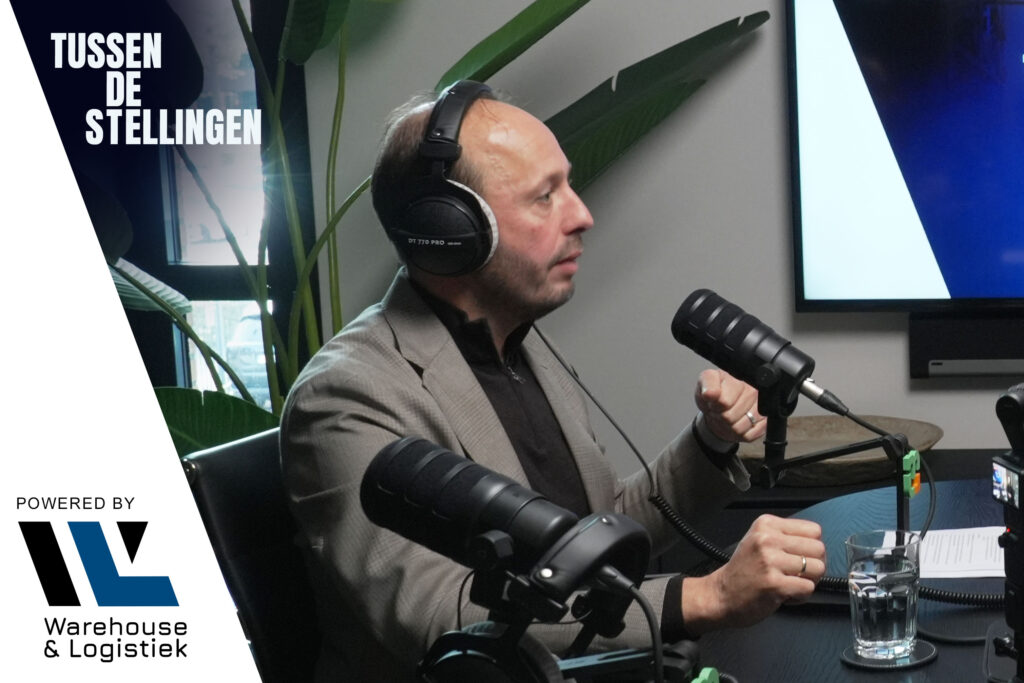
Transcript: Boltrics – Between the Racks (Warehouse & Logistics Benelux)
Guest: Jan-Cornell from Ekris (Boltrics)
[0:00] Welcome to another new episode of “Tussen de Stellingen” from Warehouse & Logistiek Benelux. Today we’ll be discussing software and AI in logistics. AI offers plenty of opportunities for the logistics sector, but where does the real added value lie? And how do you avoid implementing technology without a specific goal? In this podcast, we’ll discuss with Boltrics how logistics service providers can use AI to improve processes, why data and industry knowledge are indispensable in this regard, and how you can lay the groundwork today for tomorrow’s applications. Because ultimately, it’s not about more AI, but about better logistics. Joining me at the table is Jan-Cornell from Boltrics. Welcome. Please introduce yourself, Jan-Cornell.
[0:37] Yes, Jan-Cornell from Ekris—he’s indeed one of the owners of Boltrics, which he co-founded with two others in 2010. Before that, he had been active in IT for many years, though mostly within standard ERP environments. And we actually started Boltrics in 2010,
[0:59] with what was actually a completely new concept. Up until then, what you’d see was that software companies… and this is actually a bit of an anecdote. I’d been working in the metalworking industry for ten years—mechanical engineering, a completely different industry. I eventually made the switch to IT in 2001. And then I started working for a software vendor. And maybe I was a little naive, but I had this idea: a software vendor makes its money by selling software. But after I’d been there for a while, it turned out to be quite different, because while they did deliver the software, they ultimately made their money by providing services. And as a consultant, I was also evaluated based on: okay, how many billable hours did you log?
[1:44] But there really wasn't anyone who asked the question: Hey, are we actually adding value? Are we helping that customer move in the right direction?
[1:52] No, really, the only thing that was considered was billable hours. And we’ve seen that, ultimately, while this does help your clients, in many cases it doesn’t steer them in the right direction—which means you end up with custom solutions tailored entirely to that specific client. As a result, they get stuck and can no longer keep up with new technological changes. And yes, if you look at the current situation…
[2:20] And AI is, of course, a great example of that. But over the past 16 years that we’ve been in business, we’ve seen that IT in general is innovating at an ever-faster pace. So whereas in the past you could stick with the same version for ten years, we now do monthly releases. So that’s really the difference in speed. And so it’s very important that you can keep up with new technology. And that’s actually what Boltrics focuses on: creating software for a specific target audience—logistics service providers—that’s always up-to-date, always uses the latest technology, so that you’re always ahead of the curve and can operate in an agile manner.
[2:59] So you’re prepared for new circumstances that arise and can adapt to them. Yes, because how did that transition to logistics service providers go? Yeah, that was a really fun one. As I mentioned, we were already active in the ERP world as a Microsoft partner. And we got our first client, which was actually a cold storage and freezer facility—a logistics service provider specializing in temperature-controlled logistics. They were using standard Microsoft as their ERP, but they had a lot of customizations on top of that. They were having some issues, which we resolved for them. And he said, “I also have a friend who’s in the cold storage and freezer business. He also uses Microsoft Dynamics as his platform.”.
[3:42] But yeah, they were having problems. So we went there to solve those problems, too. Only, once again, we had to start from scratch. That’s actually how we came into contact with the president of the Dutch Cold Storage and Freezer Association. And yes, we had that meeting there. And we realized that all of their members were actually facing the same problem. There was no off-the-shelf software or an industry-standard solution. That’s different from off-the-shelf software. Because off-the-shelf software means very rigid, one-size-fits-all. And of course, that’s not going to work. It never does. The “standard” is a very nice promise, but it usually doesn’t work. But an industry standard—that’s a different story altogether.
[4:21] So we said: Okay, what if we create a solution for this industry that all the members of that association can use, so they don’t have to keep reinventing the wheel? We sometimes compare that to a peloton. If you have a bike race… Look, you can join the lead group. That’s really fun. You might think you’re riding out front. But the question is how long you can keep that up. Because you have to put all that energy into it. Whereas the peloton shares the energy. And you often see that—I’d say in 95% of the cases—one rider from the peloton has the best legs for the final sprint. So that’s the question: where do you want to be? Then you might need to conserve your energy. Yes, exactly.
[4:55] And that’s basically the idea. That’s how it all started. So in 2010, we began development, helped our first customers go live—also in 2010—and then continued to refine the product. And largely through various acquisitions from the U.S.—companies that expanded into Europe—we also made the move toward internationalization. So now we actually serve customers globally, all over the world. But beyond just cold storage and freezer facilities? Yes, because, you see, those cold storage and freezer facilities are actually a specific niche within the logistics services sector.
[5:30] And yes, I always say: they’re, at most, just a little bit more complex than a standard dry storage warehouse. So our focus is on logistics service providers in general. From small to large? From small to large. We have customers with 2,000 or 3,000 pallet spaces. But we also have customers with more than 200,000 pallet spaces in a single, fully automated high-bay warehouse. And as I mentioned: in the Netherlands, but also worldwide. So we’re actually present on every continent. From the Netherlands as well? We do that through local Microsoft partners. Because what we believe in is that we can deliver a global solution, but one implemented with local expertise. So we’re close to the customer.
[6:14] With local consultants who speak the local language and are rooted in the local culture. Because, ultimately, that’s what ensures the software will work properly. You can have the best software solution in the world, but if you don’t implement it correctly for the client, you won’t have a successful project in the end. And that’s exactly why having consultants on the ground is so important. But it has to be based on that standard—in parentheses—software. Exactly, that’s the industry-standard solution. Because that actually brings us to the next point in our concept. We believe you need to limit variables in order to ultimately scale more effectively. So customization—a specific solution for each individual client—creates a lot of variables.
[6:58] If you consolidate those variables—in our case, into a single codebase solution, which means that exactly the same code runs everywhere worldwide—then we can automate updates. Whereas in the past, an update required at least three months, two logistics consultants, and three developers to migrate a customer from one major release to another, we now do 30, 40, 50, or 60 in a single night, fully automated, with just one or two people on standby in case something goes wrong. Everything else is fully automated. That also means you can continue developing faster. Exactly, 100%.
[7:32] And on top of that, our customers don’t have to constantly reinvent the wheel or keep paying for new developments. Because when we make a change… everyone benefits. Yes, because we roll it out worldwide every month. So if one logistics service provider has us make an adjustment, it’s available everywhere the next month. Yes, but that also means you’re keeping up with trends and developments on a global scale. Yes, exactly. And because of that, we’re inherently many times faster than any party that develops specifically for a single company. And there’s another point to consider here. Because then you might say: yeah, that’s nice, but what if my competitor has exactly the same software as I do?
[8:13] Yeah, so where’s the benefit for me? Well, I definitely have the answer to that: software is a commodity. It needs to run in the background. It needs to enable you to deliver the best logistics services to your customer. And that’s where you ultimately make the difference—in my opinion, not with the software itself. Because it has to be an enabler. But you need to deploy as much of your human capacity as possible where it’s visible to your customer. And you can see that in the group I just mentioned. Those are different teams, and they collaborate to a certain extent. But they are competitors. And that brings us to the next point. So we have a single codebase,
[8:49] But actually, from the very beginning of the software’s development, we didn’t develop it in a rigid way, with predefined business processes; instead, we focused right away on in-depth workflow technology, which allows us to model business processes according to customer needs. And all the functionality we’ve added over the past 16 years has been incorporated as small functions in function libraries. Now we can essentially take those and say, “Okay, that customer has that specific problem—we’ll integrate that function into the workflow.” That’s how we tailor the solution to the customer’s needs. But you still have the consistency of the standard. Exactly.
[9:29] Okay. The topic of this podcast is also AI in logistics. When did AI first come into the picture for you? Well, actually, as soon as we started talking about generative AI. Because, after all, LLM models and the like have been around for much longer than just the past few years. It’s just that it’s really taken off recently. And when we saw ChatGPT and models like that—which were becoming widely applicable—we realized: hey, this is a major development, and we need to make it our own. It’s just another innovation, one of many over the years. And we need to get comfortable with it. We need to start using it in the right way for ourselves as a company,
[10:17] Not only to stay competitive, but also for our customers—so we can help them become even more productive and innovative. Yeah, okay. We’ve also come up with a few statements. Our podcast is called “Tussen de Stellingen.” So here’s the question for you: agree or disagree? And of course, you’re welcome to explain your reasoning. Should every logistics service provider start using AI now? Absolutely. If you’re not already working on that, I think you’re going to run into a big problem. And of course, you have to do it the right way. Security-wise, I completely agree. But if you don’t do it, your competitor will. And otherwise, it’s just not sustainable. Look, and you really shouldn’t… I just simplified it a bit by saying:
[11:01] It’s just the next innovation. And I think that’s how you should view it—to help alleviate some of the resistance and uncertainty surrounding it. It’s simply a new innovation, just like the ones we’ve seen throughout history. And you have to embrace it.
[11:18] But at the same time, you have to put it in the right perspective. And that’s when I say:
[11:25] Language was the first major development in ancient history. The second was writing. Language allows us to share knowledge more quickly than by using our hands and feet. Writing allows us to store that knowledge as well. Then came the printing press, which made it possible to disseminate it more quickly. Then came the internet, bringing it into living rooms around the world. And now, with AI, you’re going to accelerate this process many times over, make it more intelligent, and generate even more content. And that innovation is so vast that it’s on that scale. So if you don’t jump on board, if you don’t do something with it—really—sooner or later you’ll simply be left behind. To stay in the pack. Yes, because what’s the difference between experimenting wisely and haphazardly adding AI? Well,
[12:15] And that brings us to the next point, indeed. What you sometimes see is that AI is—or was—also a bit of a hype. And everyone thought: Oh, what a huge innovation—we have to do something with it. And that’s actually kind of an issue. Because, well, people started using AI just for the sake of using AI. And also just so they could say they were doing something with AI. Yeah, we’re doing something with AI, too. And well, that leads to situations like the one highlighted in that MIT report last year: 95% of AI projects don’t generate a return on investment. But that’s because you’re turning to AI just for the sake of AI. So what we’re really saying is: take a very concrete look at where there’s currently a problem in your organization when it comes to a lot of manual tasks, repetitive tasks, and so on.
[13:08] And keep the scope of the project small—just start small. Take small steps. So, in any case: let your employees make the most of ChatGPT. Yes, give them a subscription. A subscription, indeed, and so on. And again, on that note—and this is another point—we’ve based our software on Microsoft Dynamics as a platform. We could have simply built our own solution from scratch. That might have been interesting from a technical standpoint. However, we anticipated that when you look at technological developments over time, it’s incredibly difficult to keep up with them all. And because we used Microsoft Dynamics as our foundation, we don’t have to worry about…
[13:51] Well, when we started in 2010, it was all still on-premises. So the entire shift to true SaaS solutions—that is, multitenant SaaS solutions—we made that transition in a fairly straightforward way, because Microsoft… Riding the wave, yeah. Yeah, Microsoft made the entire underlying platform fully SaaS-ready. Well, and that also applies to AI, for example: Microsoft has integrated Copilot into Microsoft Dynamics.
[14:18] We don’t have to figure that out ourselves. It’s just that we’re building the application for logistics service providers. So what Microsoft does is fairly generic. We’re here to adapt it for logistics service providers. And so far, we’ve completed about 450 installations worldwide. So we have quite a bit of expertise. We know what’s going on in the industry. And that’s how we make that adaptation. But this approach allows us to remain agile as a company. And it means we only have to focus on what’s important to logistics service providers. As a result, we can keep pace with new innovations, stay ahead of the curve, and consistently deliver a great deal of added value to our customers.
[3:02 p.m.] As AI becomes more closely integrated into operations, the logistical context and reliable integration become more important.
[15:10] So you're benefiting from those 450 implementations. Exactly, because that really gets to the heart of the matter. And you can actually see that with software in general.
[15:21] We’re talking about “Tussen de Stellingen” here, so we’re talking about a warehouse management system—what you need for that. Well, there are countless warehouse management systems on the market. However, there’s a big difference between a private warehouse management system and a public warehouse management system. Most warehouse management systems are initially focused on private warehousing. So if you own the goods—you purchase them or produce them and then resell them—you’re essentially making money through trading. But a logistics service provider doesn’t do that at all. They don’t own the goods; they simply store them for their clients.
[15:58] So it includes typical features like multi-client warehousing, contracts, and billing—things like pricing agreements, invoicing storage costs, value-added services, and so on. Well, those features aren’t usually included as standard in warehouse management systems. Because we’ve focused 100% on logistics service providers from the very beginning, our WMS is entirely geared toward that. And you see that even more clearly with AI. Look, if you apply AI generically, that’s great, but in logistics, you’re missing the mark. You have to add context and industry knowledge to it. Add it. Because generic AI models don’t know that. No, they don’t know that. And it’s precisely because of the context… Look, if you don’t give AI any information…
[16:46] AI exists because of data. So data is incredibly important. And the more data the AI model has—specifically tailored to your industry—the more value AI will be able to deliver, and the more you can trust the accuracy of what AI does for you or how it helps you. Yes, and that’s exactly the added value you offer as a software partner. Yes, one hundred percent. When you look at the AI solutions we make available to our customers, we basically use the Microsoft Dynamics platforms, with Copilot and the like. But that’s more of a side note. Again, when you’re talking about software designed to empower you, you’re dealing with functionality, business processes, and the like.
[17:36] But another very important issue these days is governance and security. Well, look, security: two weeks ago, Albert Heijn, and so on. A week before that, somewhere in the Benelux or France, I think, a hack caused the temperature in all kinds of cold storage facilities to rise to 50 degrees. That’s happening in the industry, too. Exactly, exactly. So temperature-controlled facilities and food logistics, in particular, are very interesting targets for hackers, for example. Because with those, you can really cause disruption. So from a governance perspective—but also from a security perspective—it’s becoming very important that you’ve got your act together at the enterprise level, to put it simply.
[18:25] And while you could reinvent the wheel in that area as well, we’re also collaborating as much as possible with Microsoft on that front. So you’ll see that their SaaS solutions—managed and secured by them—,
[6:35 p.m.] are at a level that we, as an individual software provider, simply can't reach. And you see that again with Copilot, for example: if you have Microsoft 365 Copilot, Microsoft
[18:47] It ensures that the data stays within the tenant—within your tenant. So all sorts of things that you’d otherwise have to worry about a lot and spend a lot of time on are simply taken care of by default. You don’t have to think about that; you can spend your time on your customers.
[19:02] Those are also the advantages of an integrated platform like that, in that sense. Yes, 100%.
[19:07] Okay, here’s a statement: we’re too afraid to give AI control. What do you think about that? I can totally see where that’s coming from. Because if you just let an agent start working out of the blue, all at once, that’s pretty nerve-wracking. When you hire a new employee at your company, you don’t let them do everything right from the start, either. Then
[19:34] … And that’s why, with AI, it’s so important to start working with it right away. To make it your own. And besides, as I mentioned earlier, you should take small steps. I also think you shouldn’t just jump straight into fully autonomous AI—that is, AI that makes its own decisions and takes action on its own—without a plan. However, there is a path toward that. So take small steps; let AI help you get things done. I touched on this earlier, but I sometimes try to explain it by saying: well, there are actually three main categories within AI. You have personal AI, hybrid AI, and embedded AI. And personal AI really refers to the use of models like ChatGPT, Claude, Grok, Gemini, and so on.
[20:27] Just for your personal productivity—to check emails, draft messages, and so on. But there’s also hybrid AI. And that’s actually at the intersection of personal and business processes. But also at the intersection of unstructured data and structured data. And that’s what generative AI is really good at: reading, recognizing, and translating unstructured data into structured data. Can you give an example of that? Or illustrate it for logistics service providers? Well, for example: we’ve been familiar with EDI for a long time now—it allows systems to work together, but especially to prevent manual tasks.
[21:13] But those are challenging processes—linking everything together, coordinating it, and so on. Setting that aside, you see that larger customers often do that, but there are still quite a few customers who aren’t able to work via EDI. Instead, they send emails with PDFs, or just text in the body of the email. Or an Excel file attached, and so on. Well, until now, it’s always been difficult—or actually impossible—to transform that into structured data in a predictable way. And this is exactly what AI excels at. And in that regard, if you look at our Boltrics AI Assistant, which we offer integrated into Microsoft Dynamics 365 Business Central…
[21:54] You can basically just say: “Well, I’m getting a file like this.” It could be an email, an Excel file, a PDF, and so on. It doesn’t matter what format it is? It doesn’t matter. Just drop it in. AI reads it. And it recognizes everything on its own. And in nine out of ten cases, it automatically generates a warehouse inbound order, outbound order, transport order, or freight forwarding shipment. Because we’re talking about warehouse management right now, but in addition to warehouse management, we also handle transport management and freight forwarding. So we can truly support the entire business processes of logistics service providers. But all of that is recognized and automated by the Boltrics AI Assistant. And if it doesn’t recognize something, it’ll just ask you a question. Then
[22:35] He says: Hey, I haven't seen that yet. Or: “This customer—I don’t actually know them yet. Do you want to create a record for them?” “Yeah, tell me more.” “Yeah, and the moment you say, ‘Yeah, create a record for them’… Yeah, then it’s smart enough to pull information from the internet on its own.” Do you know all that? So that entire customer profile—the master data—is already complete.
[22:55] So those are good solutions, so to speak, for moving from unstructured to structured. And then a smaller step, in that sense. Exactly, exactly. Very manageable, because the system doesn't work completely on its own yet. You can
[23:08] … And that allows you to stay in control, see what’s going well and what isn’t. And that actually serves as the first step toward moving more toward embedded AI or agentic AI. And by embedded AI, I mean—let’s say—AI that’s truly integrated into your business processes, where an agent starts doing things on its own. Or, for example, in the warehouse, when you’re talking about slotting or wave planning. Or, well, reducing truck travel times and things like that. That sort of thing. But that’s actually quite a bit more difficult—especially when it comes to autonomous operation. Because, look, when you’re talking about reducing driving times, for example: we’ve had all kinds of algorithms for that in our solution for quite some time now.
[23:55] And those are actually quite good, based on all that experience. And they’re also very fast. So you’d still have to make quite a few strides with AI to really improve on that. And I think you should probably always be a little bit conservative in that regard. Van: Okay, if it’s already working well and AI can’t improve it yet, then you just shouldn’t do it just yet. There are plenty of other areas where AI can improve all sorts of things. Yes. Because when do you expect… how long will it take—it’s exciting—for AI to take over all those tasks as well? Well, it’s happening incredibly fast. If you ask me to give a future outlook—where is this headed?—for logistics service providers, and especially when it comes to warehouses, there are two areas. You have AI that will do intelligent things in the future, and you have automated warehouses.
[24:47] And if you look at those two areas separately, let’s start with automation. We’re already seeing a lot of fully automated warehouses, and that trend is on the rise. However, I do think that as a logistics service provider, you’ll always face the challenge of working for clients. And your client base changes over time. That means you need flexibility. Fully automated warehouses can be a very good solution in some cases. We’ll certainly see them continue to grow. But the trend isn’t moving toward automated warehouses alone. Logistics service providers, in particular, simply need that flexibility. So I see a mix there. Are there already examples of warehouses that operate completely autonomously?
[25:30] Yes, yes, yes. Those do exist. It’s just that, as far as I know at least, you see them more often at companies—let’s say—that manufacture their own products and have their own warehouse. Because there are far fewer variables there. But a logistics service provider simply has many more variables. And that’s why you see more combinations at logistics service providers. So part of it might be automated; you might have an AutoStore environment for robotic picking, but there’s still a manual component as well, for example. Because that’s how you can deliver that flexibility. But that’s about the automation side of things. When you talk about AI, and what AI will do for companies… I just mentioned a few areas where AI will help, and where AI will also become more autonomous.
[26:16] I’d like to say this: if you look within your company, anything that doesn’t require physical effort—or that doesn’t involve emotion—will eventually be completely replaced by AI. And by “emotion,” just to clarify, I mean, for example, customer contact. Or contact with a supplier. So, in situations where you need to interact with, well, a human being. Yeah, with an actual person, so to speak. See, because then they say: AI, chatbots… That’s all well and good, but wait a minute… if I’m doing business with a supplier and I need to ask a question, and I get one of those chatbots, well, I know that… It’s a bit annoying, and sometimes you get stupid questions. You just want to talk to someone on the phone.
[27:07] You feel that way too, to some extent… Do you think that will also apply to the next generation? Well, I do think that will change to some extent, actually. So if you look even further into the future, you’ll see AI playing an increasingly larger role there as well. But I think when it comes to speed, I expect that the functions and activities that are more internally focused—where there’s no direct contact with the outside world—will undergo the most significant changes. And I’m seeing that happen—not only with our clients, but also within our own company. Where do you see AI having the biggest impact first? In development. Where, over the past 16 years, development capacity
[27:51] That used to be a constant concern for us—and sometimes even affected when we could start a project with a client—but that’s simply no longer the case. Thanks to AI, our developers have become ten times more productive, and we can now add new functionality with virtually no limits. The only thing that matters is that we check: Does this add value for the logistics services market? Does it compromise that single codebase? Those are the checks we perform, but other than that, the possibilities are virtually unlimited. Because we can do so much—we can add far more functionality than we can, so to speak, roll out to clients. And
[28:28] That goes for those areas too: especially on the front end—sales, business development, customer service—but also, for example, for our consultants who handle the implementations; you just need that human touch there. But that’s also how we develop new features together, of course. Yes, 100%. Together with customers. Yes, 100%. Because that’s the next step. I mentioned our Boltrics AI Assistant earlier. It doesn’t just convert unstructured data into structured data. What it also does is allow a customer or a consultant to ask the assistant: “Hey, I have this environment here, with a certain configuration, and now we have a new customer who wants cycle counting—just to give an example.”.
[29:08] How do I set that up? I can just ask the assistant, and it’ll give me an answer, saying, “Well, you’ll need to adjust such-and-such a function in the scanning process,” and so on. So there’s no longer any need to ask a consultant that question. Consequently, the work of a consultant will also change. However, since this really involves your business-critical, primary processes—essentially the heart of your organization—you can see that it will take some time before this is fully automated. Yes, and how do you prevent twenty separate AI tools from operating alongside each other—or alongside the WMS or TMS—in the future? Well, that’s the next issue, because I think that’s also one of the major risks with AI:
[29:46] AI significantly lowers the barrier to entry when it comes to developing new functionality. And for logistics service providers, that can mean: ‘Oh, wait a minute—now the sky’s the limit.’ But, as the saying goes, “garbage in, garbage out.” Well, with AI, you get garbage in, exponential garbage out.
[30:11] Because that speeds things up, so to speak.
[30:13] And that’s exactly why you need to pay very close attention to—actually, take a really good look at—your foundation. So how is your data structured? If you’ve scattered it across all sorts of different applications, in all sorts of silos, with little data harmonization, then AI will have a really tough time making sense of it. So going forward, it’s going to become even more important: okay, how is your data structured, and how clean is it? On top of that, you really need to be careful not to end up using a wide variety of different AI tools. Because then, just like in the old days when you did custom development, you’ll end up with a tangled mess of all kinds of tools that, at some point, you simply won’t be able to control anymore. And
[31:00] It’s becoming nearly impossible to manage that in terms of governance and security, but also—ultimately—to steer your business processes—the very foundation of your company—toward the future. Because that management issue, that maintenance issue… We can certainly say: yes, but AI…
[31:19] I just tell the AI to tweak it a bit, and then you adjust that application, and so on. That’s certainly true. But things are really picking up speed. And so that single-codebase concept, which I started with at the beginning, is still important—and perhaps even more so in the future—when it comes to AI: keeping your foundation solid, building smart things on top of it, but doing so in a structured way. And that’s where we help clients figure out: okay, which AI solutions should you implement? Because it’s definitely not the case that we just say, “You have to do this.” No, because clients still need room to experiment on their own. Yeah, sure, sure.
[31:57] But we do help them with that—we do advise them. And we also offer our own solutions to prevent them from having to shop around at all sorts of small AI software companies, which, of course, are popping up like mushrooms. Yes, that might be a good conclusion, then: the winner in AI isn’t the one with the most AI features, but the one with the best foundation. Exactly, and that…
[32:20] Because it’s all about your data. As I’ve been saying: AI can only work if it has the right data. And whoever struggles the most to keep their data in good shape—to keep their foundation solid—is the one who’s going to lose out in the end. Not the one who does or doesn’t have one or more AI tools.
[32:43] Because what do you hope customers will notice in a few years as a result of the choices Boltrics has made now? Well, look, what we guarantee our customers is that they’re always in the driver’s seat. So we basically take the hassle off their hands—as we briefly mentioned at the beginning: commodity. It’s an enabler. It’s the engine of the organization. We make sure that engine keeps running. That it’s always equipped with the latest technology. That our customers are always able to apply the latest technology and integrate it with our solutions. So they can be agile. Because that’s also one of the key things. Look, you can see that technological innovations are happening very quickly. But you can also see that all kinds of developments in the world are happening very quickly.
[33:30] Well, there’s Hormuz, Iran, and so on. We’ve had COVID, that sort of thing. Well, those are disruptive changes. And so it comes down to: how are you going to deal with them? Well, that’s very hard to say, because none of us has a crystal ball. We don’t know what changes the future will bring. But it does mean that you have to make sure your organization is agile—that you’re capable, once again, of using the latest technology. And then it really doesn’t matter what kind of changes come your way. In fact, that’s when things really get interesting—when there are a lot of changes. Because it’s precisely when there are many changes that you’re better equipped to handle them.
[34:10] And that’s how you’ll make a bigger difference compared to your competitors. Yes, exactly—a world where there’s a lot of change and a lot of innovation is actually perfect, because that enables you, as a logistics service provider, to make a difference. However, you do need a platform that can handle that. And that’s what we provide. Look at that. Because I understand you also organized a webinar on that topic earlier this year—about reducing complexity in logistics processes. Yes. Why is that so important right now? Well, because of those developments, of course. Yes, exactly. The more complex your foundation is, the harder it will be to build on it.
[34:48] So, once again, we’ve completed 450 installations so far—or more than 450 installations worldwide. On the one hand, you have that single codebase, which reduces complexity. On the other hand, we do have 450 customer-specific configurations in place for our clients, thanks to that workflow technology and all the features we integrate to automate processes. So on the one hand, we’re reducing variables to increase speed; on the other hand, we’re giving you the flexibility to respond fully to your customers’ needs, so you can make a difference. Look, that’s great. Well, I think that’s a really great story, Jan-Cornell. Today we’ve talked about experimentation, the value of data and context, human oversight, and the importance of a solid foundation.
[35:35] What do you think is the most important question logistics service providers should be asking themselves right now? And how can Boltrics help with that? Yes, I’d say: the most important question when it comes to IT, when you’re going to invest, when you’re going to prepare for the future…
[35:51] So what questions should you ask? Point 1: Do you have a software solution tailored to a specific industry? Because that means you don’t have to reinvent the wheel. Is that software based on a true SaaS application? That means that all administration and management, availability, and security are handled by the SaaS provider. And just to reiterate: a lot of companies claim that their software solution is in the cloud and that it’s a SaaS solution. But very often, it’s just an IaaS solution hosted somewhere—perhaps on Microsoft Azure, Google Cloud, or AWS. But that’s not what I mean by true SaaS. I mean a genuine, true multitenant SaaS solution, managed by one of the five major tech companies.
[36:36] Because they also take responsibility for security, and so on. That ensures you’re technologically ready for the future. It means you don’t have to worry about all the things your competitor has to worry about if they aren’t using that kind of platform. So that’s the second point. The third is flexibility in configuration. You need to be flexible in adapting your business processes—especially as a logistics service provider, and especially when you’re acquiring new customers with new requirements, and so on. Next are open APIs. It’s very important that you can connect with the rest of the world in the best possible way. Because these days, we only have fully integrated supply chains.
[37:16] Or are moving more and more in that direction. So that’s an important one. But open APIs are also important for preventing vendor lock-in—where you’re forced to use only that provider… That provider, yes. Yes, exactly. So that’s an important one. And yes, I’d say: if you’ve got all that in place, then I think you’re ready for the future. That you’re future-proof when it comes to your IT. Well, look at that. Great. That’s a lot of information, Jan-Cornell. Finally, here’s a link to the ICT & Logistics trade show, because I understand you’ve also scheduled a panel discussion there. Yes, that’s a really good one. At the ICT & Logistics trade show, we’ll have our architect—one of our architects who works extensively with AI within our company and on how we create solutions for our clients.
[38:04] He’s giving a presentation there and will be speaking from the perspective of governance and security. He’ll be going into more detail on that—which I think is very relevant and interesting. So I definitely recommend checking it out. Okay, great. Thanks again. Listeners, thanks for tuning in. Thank you very much. And thanks for coming. Yes, thank you very much.