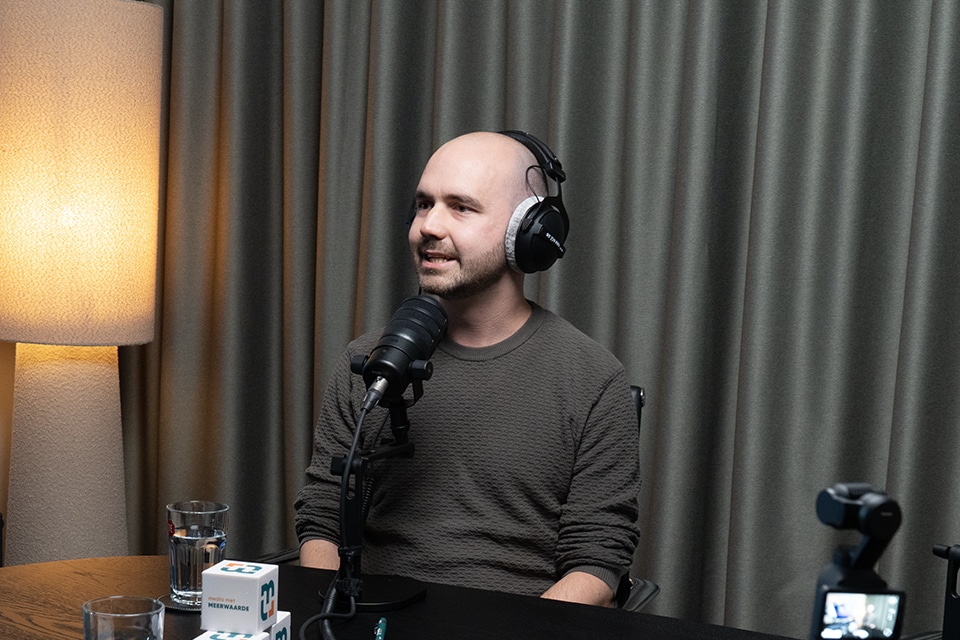
[00:00] Introduction
Roel van Gils: Welcome to another new episode of Between the Positions, the Warehouse Logistiek Benelux podcast. Today we’re taking a look at the world of warehouse projects. How does a new warehouse actually come to be? What decisions are made before the first pile is driven into the ground? And how do you ensure that a design ultimately works in practice? We’ll be discussing this with Etienne Teunissen of Groenewout, a specialist in warehouse design and implementation. Welcome, Etienne.
Etienne Teunissen: Yes, thank you.
Roel van Gils: Please introduce yourself.
Etienne Teunissen: My name is Etienne Teunissen. I have a background in mechanical engineering. I studied in Delft. Afterward, I worked for two logistics systems integrators. Five years ago, I joined Groenewout as a logistics consultant. I focus on everything that happens within the four walls, primarily automation projects.
Roel van Gils: So, the technology?
Etienne Teunissen: Yes, the technology.
[00:52] The Start of a Warehouse Project
Roel van Gils: Of course, many people see a building filled with racks, machines, and processes. But where does a project like that actually begin?
Etienne Teunissen: Yes, actually, with a good design. So we often start with data. First, we look at what the client is currently doing and where they want to grow in the future. That way, we try to identify their logistics needs for the present, but also for a few years down the line, depending on the timeframe we agree on together. Based on that data, we then explore various concepts.
Roel van Gils: But clients come to you with an idea, so to speak, like: “We want a new building, or an expansion, or whatever?”
Etienne Teunissen: Yes, there’s often an underlying reason. They either have the opportunity to rent a new facility or they’re facing another challenge. They need to scale up; their current logistics setup is no longer sufficient. There’s usually something at that point that makes them think: Okay, this is a good time to take a fresh look at our own logistics.
[01:47] Working with Data
Roel van Gils: So you're saying that starts with data?
Etienne Teunissen: Yes, often based on data. Because, really, that’s the easiest way to look at different scenarios very objectively and, in that way, make the right decision.
Roel van Gils: And data—what kind of data are we talking about? What do they do? What kind of data do you need?
Etienne Teunissen: Yes, ideally as much as possible. In that case, we want to know everything about inventory, replenishments, and that sort of thing—in quite some detail. But it can also be done at a higher level. Then it’s more about how many order lines you process in a day, what the demand is, and a bit about storage capacity. So it can actually range from a single Excel file to twenty files that we analyze together and use to build an entire model.
Roel van Gils: And are his customers aware that they actually need that data to move forward?
Etienne Teunissen: These days, actually, yes. Most clients have a lot of data available, so it’s often very easy. And also, as I said, if there’s less data available, we can still work with it. In that case, we rely more on interviews and a tour of the facility. But even that way, you can still get a good picture of the current situation. You really want to know where you’re starting from, partly so you can properly compare those new models.
Roel van Gils: So you're not actually going to start drawing and building right away?
Etienne Teunissen: No, no, no, definitely not.
[03:08] Various scenarios
Roel van Gils: And what are the most important decisions to make at such an early stage?
Etienne Teunissen: Actually, it’s mostly scenarios. So we often look at, for example, a completely manual scenario. We compare that to a number of other scenarios. These scenarios mainly vary in terms of the degree of mechanization, for example. So you look at a fully manual scenario, a scenario where things are a bit more automated, and yet another scenario where we really pull out all the stops. That way, you mainly get different options. That’s not so much the final solution yet.
Roel van Gils: So you'll just present that, so to speak? Or are you going to fine-tune it together?
Etienne Teunissen: Yes, together. We end up calculating everything in detail: what’s the impact on the number of people in the space, building usage, how many square meters you need, and how much you can grow with a concept like this.
Roel van Gils: Yes, and also toward greater flexibility in the future.
Etienne Teunissen: Yes, some business models can simply facilitate a company's growth for longer than others.
Roel van Gils: But is it still common for the process to be done entirely by hand?
Etienne Teunissen: Yes, sometimes. It really depends on the products. Some of our customers’ products aren’t suitable for full automation. It certainly depends on how much capacity you have. If you have a slightly smaller operation and you’re dealing with complex products—such as very large wooden panels, for example—and you don’t run very many production lines, automation often isn’t the solution. In that case, you can still look for the optimal manual process. But automation alone is often difficult in such situations.
[04:42] Reaching a decision together
Roel van Gils: Anyway, so you have a number of scenarios, and then it’s up to the customer to choose: I’ll go with this, or a little bit of that, or maybe a mix.
Etienne Teunissen: Yes, that’s basically how we arrive at a solution together. So you start with a few scenarios—maybe three, four, or five. Then we hold workshops with the client to discuss those scenarios. From our perspective, we can really focus on the objective side—purely in terms of numbers. We also discuss the qualitative aspects together, such as flexibility, quality, and sustainability. Those kinds of aspects are better discussed in a workshop setting.
Roel van Gils: And how long does that preliminary phase—if you want to call it that—last?
Etienne Teunissen: This process—a feasibility study—takes about twelve to sixteen weeks, depending somewhat on the project. That’s really just the beginning.
[05:32] Further development of the chosen concept
Roel van Gils: Yes, the beginning. Once you've finished your degree and made your decision, what happens next?
Etienne Teunissen: As part of that feasibility study, we’ll select a concept sometime around weeks eight through twelve. We’ll then take that selected concept a step further. We try to flesh it out a bit further so that, by the end of the feasibility study, the client has a clear picture of what to expect and what to look out for. This isn’t a detailed plan yet, but it does provide a rough layout. You’ll have an idea of how your warehouse will be laid out. It’s essentially a first step toward moving forward with that concept into the next phase.
Roel van Gils: So does that mean the feasibility study is basically over?
Etienne Teunissen: Yes, that's actually part of those twelve to sixteen weeks I just mentioned. This is included in that as well.
Roel van Gils: Next, you move on to the next phase.
Etienne Teunissen: Yes, that's right. Then you can take your concept one step further.
Roel van Gils: Like what? What do you mean by that?
Etienne Teunissen: For example, when it comes to storing goods. Dig deeper into the model to determine exactly what kinds of locations you need and how many of each type. Create your own Material Flow Diagram (MFD) to see how many lines you need to process per hour. Basically, take everything one step further.
[07:01] Developing the details or involving suppliers
Roel van Gils: So is everything already known at that stage? Like what it's going to look like?
Etienne Teunissen: Yes, you can. That’s really a matter of choice. So you can do this—that’s one approach. On the other hand, you can also reach out to suppliers early on, keep this tender process a bit more open, and seek out a genuine partnership with the supplier. So the next phase is actually selecting a supplier, often starting with a Statement of Requirements.
Roel van Gils: A supplier in the sense of?
Etienne Teunissen: Yes, one that can provide the solution. There may be one or more of them. We often do this based on a Statement of Requirements (SOR). Depending on what you want, you can specify your expectations in great detail in the POE. In that case, all you really need from the supplier is a sounding board and a price quote. Or you can leave it more open-ended. You’ll still have a general direction. We’re thinking of full mechanization, for example. We’re thinking about automating a packaging solution, for example. In that case, you really seek the supplier’s input to help develop the concept. Then the detailed planning phase that you do yourself becomes less necessary.
[08:04] Designing from the inside out
Roel van Gils: But you design from the inside out? The building isn't the guiding factor, let's put it that way. Whether it's a new construction, a redevelopment, or an expansion.
Etienne Teunissen: Yes, ideally, you design from the inside out. But in practice, you often find that clients already have an option on a building, for example, or that an expansion is planned for the current property.
Roel van Gils: So space is the limiting factor?
Etienne Teunissen: Actually, that’s often the case. Ideally, you’d design the logistics first and then look for a building that fits. In practice, though, it’s often the other way around. Which can work just fine, too.
[08:44] Challenges During the Tender Phase
Roel van Gils: What problems do companies often encounter during that phase? Could you give some examples, for instance? What are the biggest challenges in this phase?
Etienne Teunissen: During that tender phase?
Roel van Gils: Yes, during the tender process.
Etienne Teunissen: I think it’s definitely tricky to settle on a concept. As an organization, you obviously have to choose a direction at some point. That feels pretty nerve-wracking, because suddenly it becomes very real. Then it’s final. Before that, you’re still exploring a lot of options, and everything is still possible. Gradually, you start moving more and more in one direction, and that’s when doubts sometimes start to creep in again. Shouldn’t we take a look at that after all? Or should we consider this for a bit longer? That’s definitely a challenge.
Roel van Gils: Are suppliers included in that as well? Or is that optional?
Etienne Teunissen: That’s often the case. It’s usually a collaborative effort. Those suppliers also have a bit more expertise in certain areas, so they can offer a different perspective. It’s very helpful to involve them as well.
Roel van Gils: But then it’s definitely a done deal, and that’s when it really starts to take shape. Or shape—but in any case, that’s when things start to happen, it seems.
Etienne Teunissen: Yes, at that point you’ll have the Statement of Requirements and be in contact with those suppliers—often several of them. Then the selection process can get underway.
Roel van Gils: Of course, that still needs to be done.
Etienne Teunissen: Yes, that's definitely a good idea. Or at least, that's what I would always recommend doing.
[10:06] Selection and Detailed Engineering
Roel van Gils: Of course, you’re in a process where challenges or expectations may still change. So you need to build that flexibility in as well. That’s something you always have to keep in mind, of course.
Etienne Teunissen: Yes, and you can see that reflected a bit in how rigidly you’ve structured that PvE. Sometimes it’s very structured, and within a few months you have a proposal and everything’s settled. If the process is more open-ended, it takes much longer and involves many more rounds of back-and-forth. Then you revisit the concept and make adjustments. That process takes longer, but it’s also very educational. Often, the company itself doesn’t yet know exactly what it’s looking for. It’s precisely this kind of tender phase that can be very useful for a company to discover exactly what it needs and what the right solution is.
Roel van Gils: Yeah, I get it. And does the next phase go straight into the implementation phase, or is there another step in between?
Etienne Teunissen: No, the next phase is contracting and selection. Once that’s all finalized, you actually move on to the detailed engineering phase with the supplier. At that point, you’ll have a sales layout where everything is laid out in broad strokes. That’s generally correct. After that, you move on to the detailed engineering phase. That’s when the detailed DWG drawings come in for your approval. Building interfaces—that is, everything related to sprinklers, lighting, and anything that needs to be adapted to the building, which wasn’t entirely suitable for what you wanted to do. In addition, there are all sorts of other issues, such as interfaces with the WMS. How exactly will you ultimately carry out the processes on the shop floor? All of that is worked out during the detailed engineering phase.
Roel van Gils: And are you taking the lead on that? Or are you handling the coordination?
Etienne Teunissen: Yes, we can actually speak on behalf of the client—or together with the client—to represent their interests during that phase. We can also draw on our experience from other projects. It’s precisely during that detailed engineering phase that you can refine certain aspects just a little better, so that they cause fewer problems later on in practice.
[12:16] Preparations for construction
Roel van Gils: I actually find myself thinking, “We’re moving from one phase to the next.” So what exactly is the next phase?
Etienne Teunissen: Once the detailed engineering is complete, the supplier really gets down to business. As a customer, you usually have a bit less to do at this stage. They start up production and begin manufacturing and purchasing all the materials. Much of this takes place in their own factory. Of course, you stay in touch with each other, but you play a less active role in this phase.
Roel van Gils: Maybe start making some preparations in the new hall or in the new addition.
Etienne Teunissen: Yes, that’s certainly possible. I’m currently working on a project where the pallet-tracking racks need to be moved to make room for the automation that’s coming. So you’ll start by clearing out the bulk warehouse, moving items, dismantling the racks, and reassembling them in a different location. That way, you’ll create space in advance and prepare the operation for everything that’s going to happen on the shop floor.
Roel van Gils: After that, things really get going, so to speak.
Etienne Teunissen: Yes. The operating room has to be ready, too, especially if it's taking place during a busy shift. There's going to be a lot going on then.
Roel van Gils: Of course, that brings with it many more challenges.
Etienne Teunissen: Yes, that's right. Noise pollution, a lot of space required. Usually, you do something because your warehouse is full, for example. Then you suddenly have to clear out a lot of space to be able to set up something new.
Roel van Gils: That sounds really strange, of course. Or at least, contradictory.
Etienne Teunissen: Yes, you need to think that through carefully together. Especially in conjunction with the operation. You need to take that into account. Ultimately, all orders still need to go out as usual during that period.
[13:51] Setup on location
Roel van Gils: So the suppliers are all busy building. At some point, they'll arrive with their supplies. What's the next step then?
Etienne Teunissen: That can amount to a lot of stuff. All of a sudden, a number of trucks arrive with a huge amount of material that all needs to be stored. Then they start building on site. They often begin by staking out all the lines. At that point, you don’t really see anything happening yet, but there’s a lot of drawing going on. Everything is laid out, and then construction slowly begins. This often starts with steelwork, depending on the project, of course. Building racks, building mezzanines. After that, more and more automation is added. For example, the conveyor belts are installed. At first, everything is mechanical. Then the electrical engineering team gets to work and everything is connected. Next comes the commissioning phase. That’s when the systems really start running.
[14:47] Staff Induction and Training
Roel van Gils: And then, of course, people will also need to be brought on board or trained to work with those new systems.
Etienne Teunissen: Yes, that’s right. Actually, the supplier also starts testing during that commissioning phase. They conduct all kinds of tests, and wherever possible, you want to involve the operations team as soon as possible so they can participate in the testing and start learning how to work with those products and that new way of working. That way, they also see how such a station works and can provide additional input if needed. In this way, they’re actually already being included in the testing phase.
Roel van Gils: So that it will transition seamlessly to the live broadcast later.
Etienne Teunissen: Yes, exactly. Aside from the training they receive, those practice runs help them become more familiar with the technique and make their live performances run more smoothly.
[15:36] The Role of Groenewout
Roel van Gils: And is that the end of it for you guys?
Etienne Teunissen: No. Actually, at any point in the entire process we’re describing now, our involvement could end. Sometimes we only conduct the feasibility study. Sometimes we conduct the feasibility study and the tender. In other projects, we handle everything from A to Z. This is another point where our involvement can end at the implementation stage, at which point we step back and the client takes over. But it’s also possible that we’ll stay on board, accompany them during the go-live, oversee the ramp-up, and possibly optimize the system afterward. That depends entirely on the collaboration. Throughout the entire process, you really work together with the client. As a result, they’re always able to take over again and continue on their own.
[16:21] When is a project considered a success?
Roel van Gils: So how do you know when a project has truly been a success?
Etienne Teunissen: I'm thinking after a year.
Roel van Gils: Oh, really—only after a year?
Etienne Teunissen: Yes, after the launch. Once everything is running smoothly and the dust has settled, you’ll know if it was a success. And if it wasn’t, you’ll also know what you still need to do to make it a success. Sometimes there’s still room for optimization. Then you just need to tweak a few small details to make it better. But really, after a year, you can say with confidence whether it’s a successful project.
[16:52] Trends in Warehouse Automation
Roel van Gils: You’re right in the thick of it, of course. You’ve already mentioned a few developments. What are you seeing happen most often these days? What are the latest trends and developments in warehouses?
Etienne Teunissen: You can definitely see that a lot of processes are being automated. These days, almost every feasibility study asks what we can do about automation. In the past, we had a lot of projects where we only looked at manual solutions. Now, an automation concept is almost always included. It’s really a hot topic among clients. And not always necessarily because of the business case. Sometimes it’s to improve quality or due to staffing availability. Whereas we used to see that everything had to have a five-year payback period, we now see that this requirement is sometimes set aside. Companies then say: we simply have the ambition to automate. How can we do that?
Flexibility is also a common theme. Concepts that are easily scalable and can grow along with the company.
Roel van Gils: Like what? Do you have any examples of that?
Etienne Teunissen: Take AMR concepts, for example. They’re fairly flexible to scale up. You can start with a smaller investment and then assess each year what the needs are and whether you need to expand accordingly. This also allows you to pause for a year without having to reinvest immediately. With traditional concepts, you often see that you invest half the amount in year one and have a plan to add the other half over the next five years. That’s a bit less flexible.
Roel van Gils: And with an AMR, can you, for example, automate parts of your operation?
Etienne Teunissen: Yes. Take a picking process, for example. You could start with 1,000 order lines per hour and expand that to 1,500 each year, and then to 2,000. That way, you scale up step by step and purchase more robots as needed.
[6:45 p.m.] Where do you start with automation?
Roel van Gils: Ideally, what would be the first process you would automate if you were starting from scratch?
Etienne Teunissen: Often packaging.
Roel van Gils: Yes, packaging.
Etienne Teunissen: Yes, often packaging. That’s usually where the shortest payback period is. It has high automation potential and is relatively easy to implement in the operation. The operation can adapt to it fairly easily. The impact is less significant than, for example, a goods-to-person system, which changes the entire way of working. Packaging actually mainly affects the final process in your warehouse and can be automated fairly easily as a standalone component. That’s why it’s also a good first step for companies that haven’t yet implemented any automation.
Roel van Gils: Okay. After that, you'll naturally move on to the other processes.
Etienne Teunissen: Yes. For example, those feasibility studies might result in a plan where you start with automation in year one. If that goes well, you move on to picking and see how you can automate that. That feasibility study already outlines the end goal—for example, that the warehouse will look a certain way by 2030—but you implement it step by step.
[19:56] The Added Value of Groenewout
Roel van Gils: In what ways does Groenewout make a difference for its customers?
Etienne Teunissen: I’d say it’s mainly our experience in logistics. We’ve seen many projects and have also carried out many projects, from the feasibility study all the way through to implementation. As a result, we not only know how to design something, but also what you need to take into account in practice. That experience allows you to incorporate many lessons learned from implementation projects right into the design phase—for example, what went wrong and what you can prevent right from the design stage. Think about the phasing of the go-live or how to operate within an existing business during construction. What do you need to take into account? All that experience helps with that.
[8:40 p.m.] Looking Ahead to 2030
Roel van Gils: If we look ahead to 2030, or maybe even a little further, where do you think we’ll be? What do you expect the level of automation to be? Or will we go back to using shelves, with robots walking around?
Etienne Teunissen: I think the trend we’re seeing now will just continue. So, more automation. Maybe piece picking will really take off. That is, robots that can pick individual items out of a box. It’s something we’ve been following for years, but it still isn’t being implemented on a large scale because the technology isn’t quite where you’d want it to be yet. But I think we’ll definitely see progress in that area.
Roel van Gils: What about safety? I can imagine robots and people mingling. Isn't that a problem?
Etienne Teunissen: No, actually, it’s going very well. The main thing to watch out for is that the robots don’t constantly come to a standstill for safety reasons. If you run your entire manual process right through the robot lines, those robots will just be sitting around waiting for people. So, aside from safety, some separation is also good for maintaining the robots’ efficiency.
[21:54] Advice for organizations
Roel van Gils: If you could give one piece of advice to organizations and listeners who are considering a new warehouse or automation, what would it be?
Etienne Teunissen: That would mean taking a close look at that first phase: the feasibility study.
Roel van Gils: That's really the most important thing, actually.
Etienne Teunissen: Yes. You often see companies jumping right into a single concept. Or starting talks with a single supplier right away.
Roel van Gils: Or based on experience.
Etienne Teunissen: Yes, or because they have good connections with a supplier. Then they’ll start working on a design together right away. I’d recommend taking a step back first, looking at things from a broader perspective, and comparing different concepts side by side. Ultimately, that’s where you’ll determine what your logistics will look like in the coming years. If you invest a few extra weeks in that process, you’ll have a much better end result in a few years’ time.
Roel van Gils: So what is the turnaround time for a project like that?
Etienne Teunissen: It varies. From the feasibility study to implementation, it takes at least a year—but that’s if you’re moving very quickly. That would be the case, for example, with automating a packaging line. Usually, it takes somewhere between two and four years, depending on the scope of the automation project.
Roel van Gils: And, of course, the size of the building is also a factor.
Etienne Teunissen: Yes. If it's a large automated facility, with a big building and a lot of racks, then everything takes longer.
[23:15] Bringing the operation along
Roel van Gils: Any other advice to wrap things up?
Etienne Teunissen: Involving them fully in the surgery. I think that’s the other important thing. Making sure they’re on board at the right time, involving them in the decision-making process, and ensuring they know what’s going to happen, what to expect, how to prepare, and what changes to expect.
Roel van Gils: So, really get people on board?
Etienne Teunissen: Yes. I think that’s sometimes still underestimated. You don’t want to involve them right from the very beginning, either. During the feasibility study, things are still very conceptual and often too early. But at the right moment, you do want to involve them, because valuable input can come from the front lines. After all, a lot is going to change for them.
Roel van Gils: Yeah, I get it.
Etienne Teunissen: It’s also important to get them excited about the concept and the new way of working—so that they see the benefits and are actually eager to start using the new automation system, rather than viewing it as a threat.
[24:14] Closing Remarks
Roel van Gils: Okay. Well, Etienne, thank you for your insights. Thanks for coming. And listeners, thanks for listening.