warehouselogistiek.eu
EN

The platform for internal & external logistics, supply chain and automation
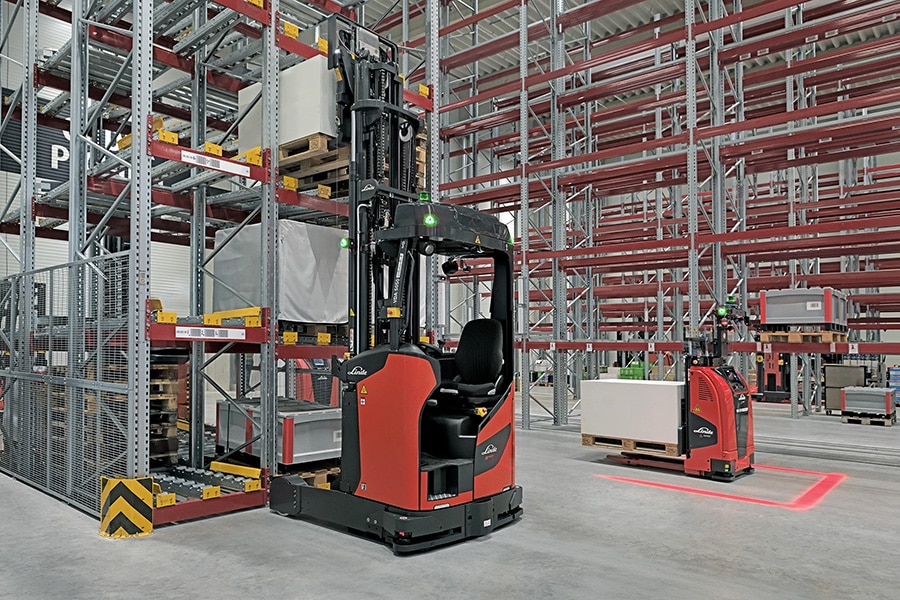
Anyone who visited the Linde Automation Summit 2025 in Aschaffenburg noticed it immediately: automation is at a tipping point. It is no longer just a few experimental robots or isolated AGVs. What Linde Material Handling demonstrated over these two days was a completely modern systems approach that transforms warehouses into precisely orchestrated logistics organisms.
The common thread through all the presentations? Automation has come of age. And that changes everything.
The intralogistics sector has always been highly dynamic, but the changes companies are facing today are structural. Labor shortages are no longer a temporary phenomenon, but a constant. Lead times are getting shorter, orders smaller, and seasonal peaks more extreme. More and more companies are realizing that they need to fundamentally reorganize their warehouses, rather than simply making them more efficient.
Linde's Summit made that evolution tangible. Not in keynotes full of buzzwords, but in concrete deep dives, test cases, simulations and robots that just work without problems. In a world where the term ‘AI’ sometimes promises more than it does, that was refreshing.
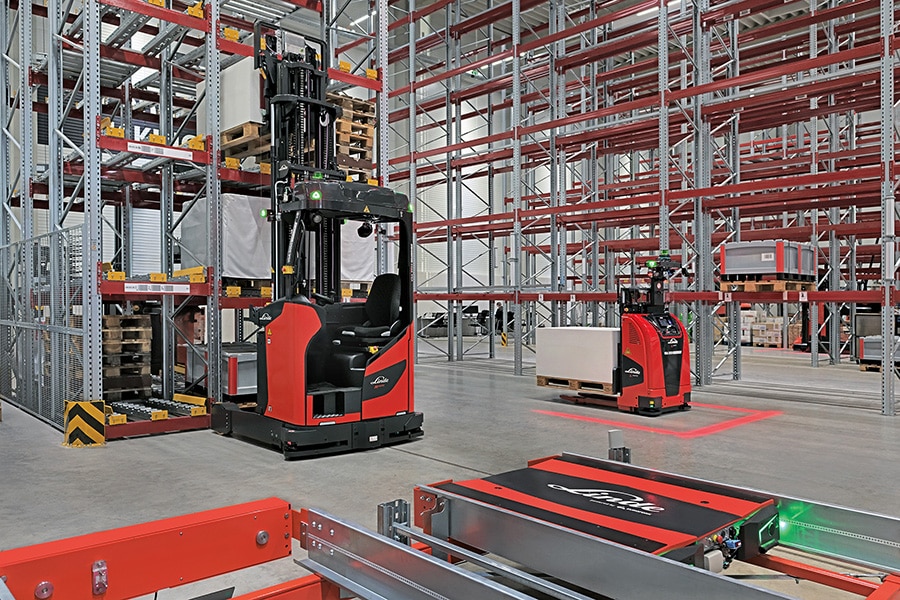
Those who followed the presentations keenly noticed that Linde repeated one theme: automation is no longer about the technology itself, but about flow.
As Torsten Rochelmeyer, Senior Director Strategy & Solution Portfolio (Linde), put it, “An AMR that drives from A to B is not automation. A system that understands and optimizes every process parameter. That is automation.”
This vision translated into four clearly recognizable pillars, each interwoven in the demonstrations and testimonials:
That last element proved perhaps the most revolutionary. Automation does not stop at commissioning: it continues to evolve, to learn, to optimize. Sometimes daily, sometimes seasonally.
In Europe, nine out of ten warehouses are located in existing buildings. So real innovation only works when it lands there too. Linde demonstrated that their hardware is not only designed for sleek greenfields, but can also cope with variable lighting conditions, unexpected obstacles, old infrastructure, floor slopes, seasonal rushes, mixed traffic with manual trucks, etc.
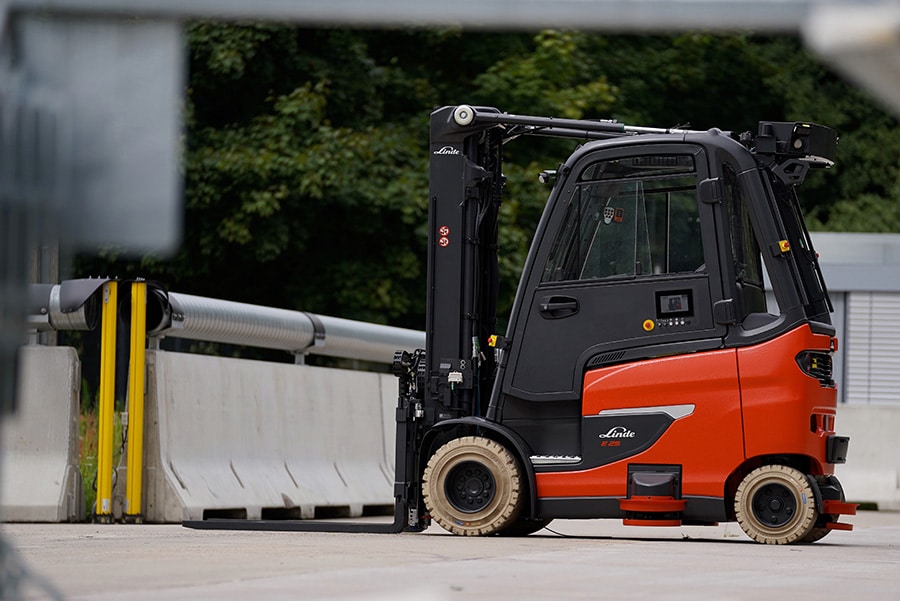
The Linde E-MATIC, the first automated forklift, stood out. Not because it looks futuristic, but because it can be used in just about any common application: indoors, outdoors, on loading and unloading docks, between racks, on ramps. Automating a forklift is technically complex: it requires robust sensors, extra layers of safety and advanced navigation. But that is precisely where Linde shows its maturity: a vehicle that is at once reliable, low-maintenance and future-proof.
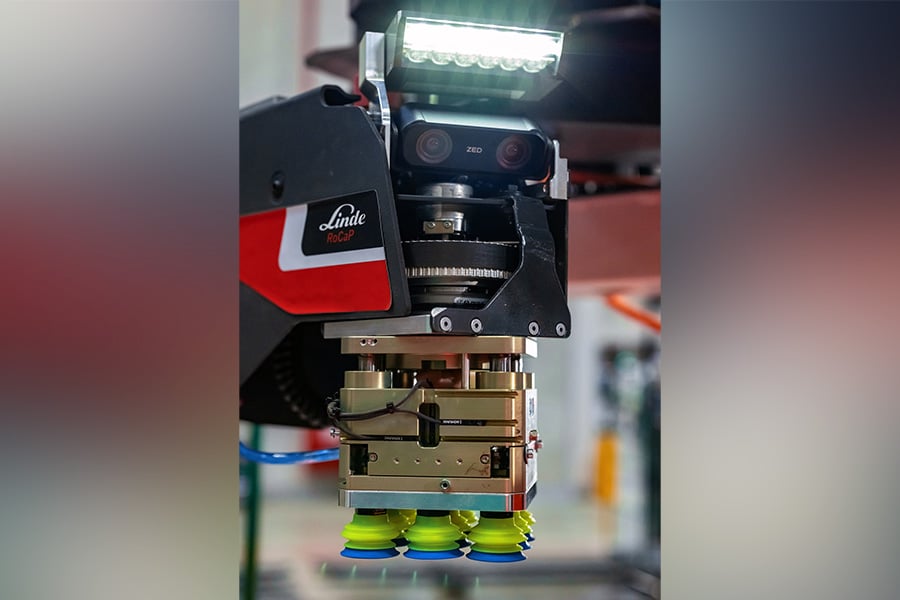
Equally striking was the RoCaP: Linde's robotic case picker developed in co-creation with drugstore group ROSSMANN. This system combines autonomous navigation with a smart robotic arm that picks heavy set-up boxes from shelves. Not science fiction, but a direct solution to labor pressure and ergonomics problems. Interesting: RoCaP works in existing racks and requires no infrastructure changes. This makes it one of the first robotic picking systems that can be effectively deployed in brownfields.
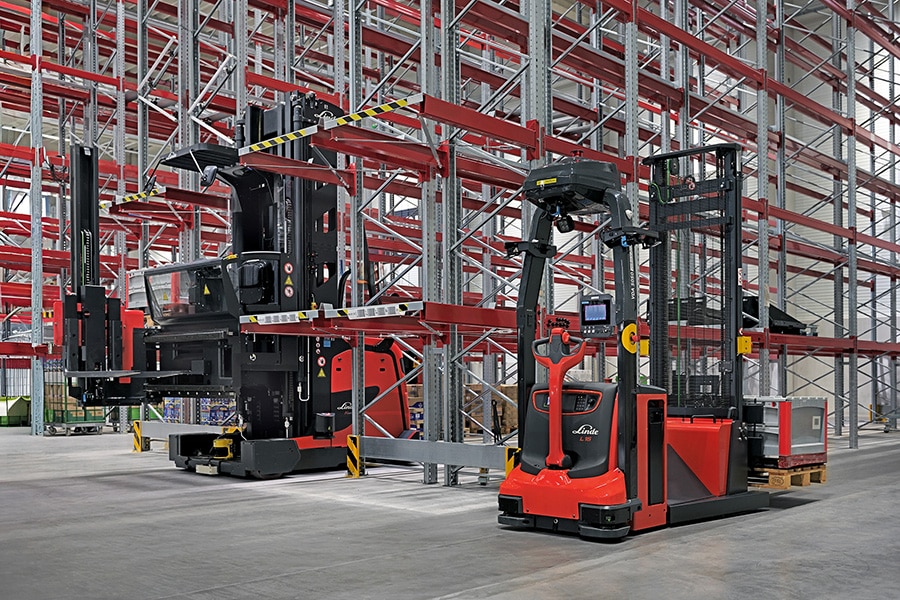
The session led by Daan Van Schuylenbergh, Head of Solution Design Automation Business Unit (Linde), and Piotr Kwiatkowski, Solution Design Engineer Automation Business Unit (Linde), was also a real eye-opener. It became clear that the future of automation does not begin on the warehouse floor, but in a digital copy of it.
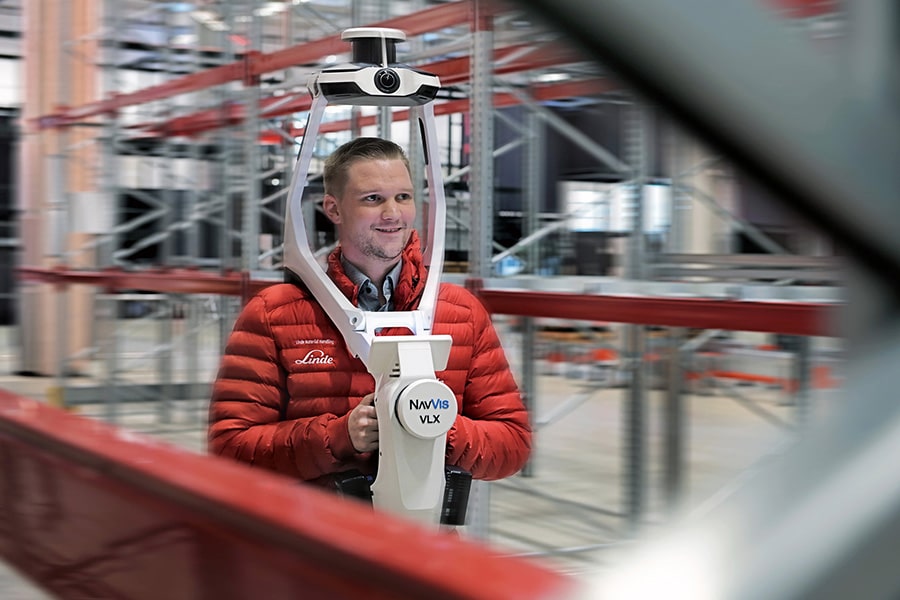
Using the portable 3D scanner NavVis VLX, Kwiatkowski walked through the Experience Hub. In no time, a razor-sharp, photo-realistic digital twin was online. Everything was automatically captured. In this way, every imaginable scenario could be simulated. Think of traffic flows, congestion points, picking routes, collision risks, buffer zones, aisle widths, robot densities, throughput forecasts, ...
The result is a design and engineering process that is radically shortened. Previously, commissioning was a risky and slow process in which everything had to be tested live. Now 80% is done in a virtual environment, completely error-free and secure.
This drastically reduces implementation time. Errors are detected before they occur. And companies can finally make decisions based on data rather than assumptions.
The digital twin does not stand alone; it is at the heart of a much larger transformation. Indeed, Linde's parent company, KION Group, entered into a strategic alliance with Accenture and NVIDIA. Together they developed MEGA, which stands for Metaverse for Engineering, Guidance & Autonomy. Not a classic software platform, but an architectural blueprint for physical AI in intralogistics.
Within MEGA, robots are no longer tested exclusively in real life. They are trained virtually in thousands of scenarios, ranging from changing order profiles to blocked aisles to aberrant human behavior. The simulation power of NVIDIA Omniverse allows what previously took weeks to calculate in minutes, making ROI estimates and project planning much more reliable.
Crucially, the digital twin remains constantly connected to the real warehouse. Sensors send feedback data to the simulation, which then sends optimized settings back to the physical environment. This creates a closed-loop system that continuously learns, adjusts and grows with changing conditions. The warehouse thus no longer becomes a static installation, but a self-learning logistics organism.
MEGA turns automation not into a collection of devices, but into a cohesive system architecture: a foundation on which companies can continue to build in the coming decades.
If hardware is the muscles and digital twins are the brain, then software is the conductor. The MATIC:move platform is not only stable and fast, but also designed for heterogeneous fleets:
Whereas traditional systems often operate in isolation, MATIC:move acts as a hub. A low-code interface allows workflows to be designed visually. For complex operations, there is MATIC:move+, which can handle traffic management and multi-vendor integration.
The bottom line: automation doesn't always have to be ‘all or nothing. MATIC:move enables scalable, modular automation - perfect for companies looking to grow incrementally.
A notable constant at the Summit was the ‘human first’ aspect. While the technology was impressive, a firm focus was on safety and change management. Luca Borg, Logistics Expert (ROSSMANN) shared how the company consciously included their employees in their RoCaP journey. Not with big campaigns, but with transparent explanations, real-time demos, added ergonomic value, clear safety explanations, direct interaction with the robot, ...
The result: employees did not see the robot as a threat, but as a physical aid. This was mainly because RoCaP consistently took on the heaviest boxes.
It also became clear that safety is non-negotiable. Linde's vehicles operate with multiple sensors, redundant braking systems, clear light signals, and safe stopping zones. Mixed traffic—the reality in almost every warehouse—was demonstrated live several times.
One of the most enlightening contributions during the Summit came from Dr. Oliver Zuchowski, Head of Intralogistics Automation (Bosch), and Matthias Koblitz, Senior Automation Consultant (Bosch). Their story made it clear that automation will only be successful when companies think systemically, based on a well-considered set of criteria, standards, and partnerships, rather than on a project-by-project basis.
They told how Bosch evolved from ‘automation projects’ to a mature automation framework being rolled out across Europe. No more proliferation of solutions, but predefined selection criteria, a centralized partner catalog, a clear decision-making model and - above all - a radical reduction of project lead times.
That approach, known internally as the pitstop methodology, reduces wasted time at every stage of a project: from requirements analysis to commissioning. Zuchowski emphasized that true scalability occurs only when automation is organizationally embedded. When clear governance exists. When all stakeholders have the same language. When the technology is standardized without losing the flexibility to optimize locally.
What ultimately lingers after two days in Aschaffenburg is how automation is gradually taking the form of a full-fledged enterprise architecture. Companies setting the pace showed that the greatest acceleration comes only when technology, processes and organization are brought into one coherent framework. The insights around selection criteria, partner catalogs and the pit stop methodology illustrate what mature automation looks like when it is supported by clear governance.
Digital twins and Omniverse technology make it possible to eliminate errors before they even occur. Projects become shorter, more predictable and less dependent on trial-and-error. And solutions like the case picker or the automated forklift prove that automation is not reserved for new sites, but can just pay off in existing infrastructure, without skyrocketing investments.
It is that thread that made the Summit so powerful: automation is evolving from single machines to a scalable, strategic system that continuously learns and grows with the complexity of modern supply chains.
Neem dan rechtstreeks contact op met Motrac Handling & Cleaning NV.
 Contact opnemen
✔ Leading provider of comprehensive intralogistics solutions since 1973✔ Official importer and distributor of Linde's leading forklift trucks and warehouse trucks✔ Technologically advanced products and years of expertise✔ Three branches across Flanders and Wallonia (Antwerp, Ciney, and Dottenijs service location)✔ Solutions from A to Z: new sales, used equipment, rental, 24/7 maintenance, advice More than half […]
Bekijk Bedrijfsprofiel