warehouselogistiek.eu
EN

The platform for internal & external logistics, supply chain and automation
Why ‘more capacity’ is the wrong reflex
Anyone involved in supply chain today can hardly escape the feeling that everything is moving at once: geopolitical shocks, volatility at sea, price fluctuations, and at the same time a market that has ... too much capacity in certain segments.
Current events provide new disruptions every week, but Alex Van Breedam - owner and CEO of TRI-VIZOR, supply chain keynote speaker & founder of ISCN.Academy - views them through the same lens: the real leak is in the structure of the industry. As long as ownership, branding and contract logic block collaboration, the biggest gains remain untapped. No matter how smart we plan...
Van Breedam points to a striking paradox in container shipping. While the public debate is often about ‘disruption’ and ‘shortages,’ under the surface he sees structural overcapacity emerging. He speaks of a fleet heading toward record levels (above 33 million container capacity) while effective demand is much - perhaps half! - lower. This problem, he says, will only really surface if the traditional East-West routes were to return to full normalization via the Suez Canal. Now it remains masked by detour routes - think Cape of Good Hope - keeping ships en route longer, so you artificially ‘need’ more fleet.
That means: when peace returns to the sea somewhere, it may just hurt economically. Because then it becomes apparent how much capacity is actually ready to go. And in markets with thin margins, that's a recipe for price pressure, undercutting and bankruptcies. Van Breedam makes the point: logistics is one of the few sectors where ‘volume’ often seems even more important than ‘quality of operations’, usually expressed in a profit margin. While that is precisely where margins are made or lost.
The real eye-opener for Van Breedam is in empty transport. Not only on the road, but also in global container traffic. He outlines how enormous flows of containers go from Asia to Europe or the US, while a large proportion return empty. And that is not only inefficient, it is also a huge climate and cost driver. His point: we could theoretically do the same global transportation with far fewer containers. How? If we rotate them much better.
It becomes concrete with an example that feels recognizable to Flemish logistics. A container of sports shoes arrives in Antwerp via a shipping company, goes on to a warehouse in the Kempen region and is unloaded there. What happens next? The container often returns empty to a place where there is a greater chance of reloading, and that is ideally the nearest terminal, but often the Port of Antwerp. Meanwhile, a nearby company - which does export - needs containers, but can't just use those ‘empty’ ones because contracts and ‘brands’ don't match. Result: two empty movements where one efficient reload was possible.
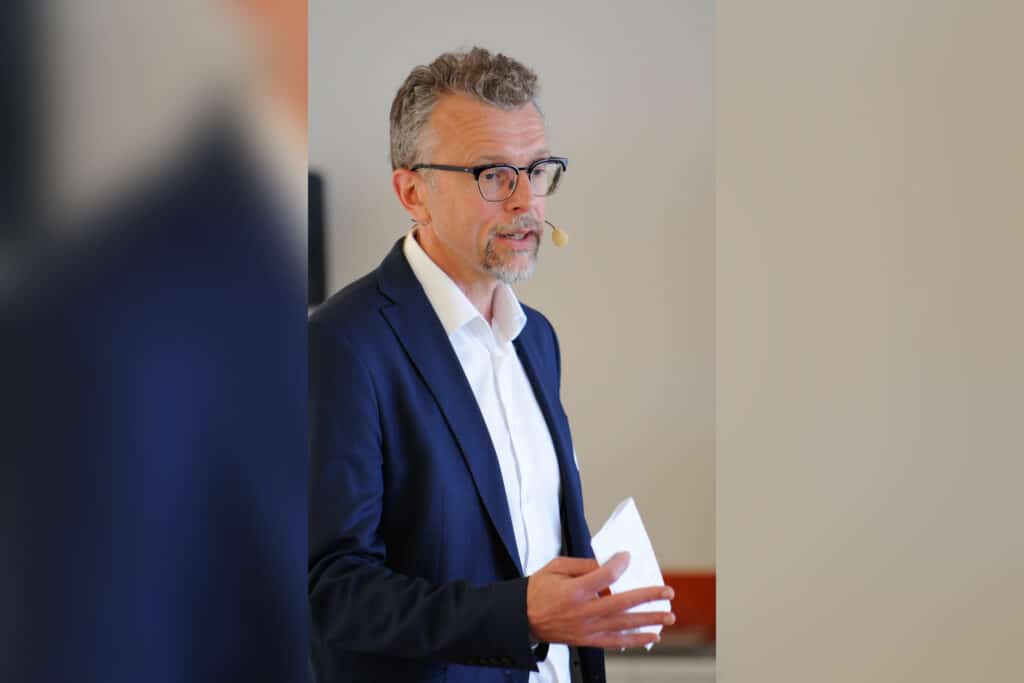
Van Breedam likes to provoke: “Put those nine biggest shipping company CEOs around one table and you can save billions in CO₂ in one day.” His proposal is essentially pooling: sharing containers and assets as if it were a modern cooperative. Not for romance, but because the business case holds true: fewer empty moves, higher rotation, better return on capital. The price you pay is less ‘sales volume’ on paper. The profit, in turn, is higher margins and a more robust and sustainable system.
His favorite metaphor comes from a completely different world: olive oil. Farmers used to buy one press together, because no one wants an expensive machine that sits idle 11 months of the year. That cooperative thinking - sharing assets because it is rational - is something he believes we should dare to apply again to containers and logistics infrastructure.
Anyone who thinks this is naive is given a counterexample. In Norway, cooperation in the salmon industry has worked for years, even between big players. Not because they suddenly became friends, but because two CEOs decided it had to be more efficient and sustainable. AND because the model can run without excessive legal ballast.
The uncomfortable conclusion: we often look for high-tech solutions (AI, digital twins, extra buffers), when some of the biggest gains are in plain sight lies. Not in more systems, but in fewer silos. Or, as Van Breedam sums it up almost laconically, “Just paint those containers gray!”