warehouselogistiek.eu
EN

The platform for internal & external logistics, supply chain and automation
How do you make a 1992 warehouse ready for the future? That was the question facing Toyota Parts Centre Europe in Diest. The workload would grow significantly in the coming years. Together with E'Log, they opted for a large-scale retrofit, with one condition: the operation could not be allowed to grind to a halt. E'Log soon proved to be more than a supplier. A partner that thought along, made quick changes and kept the project simple - without unnecessary complexity, with an eye for results.
Four cranes. Four crane rails. New travel and lift motors. And a highbay ready again today for the next decades.
In Diest, everything revolves around safety and reliability. The warehouse is one of the logistics hubs within Toyota Motor Europe. Together with thirteen other depots, the location processes 120 million parts and accessories for 44 European markets. From screws to bumpers, from small clips to doors.
But growth brings pressure.
“By 2030, we expect to achieve an increase of 38% in parts sales,” says Mark Seurs, maintenance manager at Toyota Parts Centre Europe. “So we have to be smart with the space we have. The highbay plays a key role in that.”
That highbay - an automatic warehouse more than thirty years old - was once intended for slow movers: large, unwieldy parts that barely moved. Today, Toyota Parts Centre Europe is opting for smarter deployment. No more slow pieces, but parts that rotate faster and can be stored more efficiently.
“The highbay offers enormous potential,” says Mark. “By also storing bumpers and headlights more intelligently as well as using crane movements more efficiently, we can make better use of the more than 5,000 pallet locations. But then the system has to be reliable. We simply cannot afford downtime in the future. So we need to make sure it is operationally reliable now.”
What began as separate maintenance orders grew into one integrated project. E'Log had been servicing the plant for two years and knew every nut and bolt. From that experience, three clear pain points emerged: rail wear, outdated motors and too little certainty about spare parts. Time to move on.
New construction? That was never an option. The structure still stood firm. The solution lay in a technical retrofit that combined everything: efficiency, reliability and minimal downtime.
The approach: one step at a time. One crane out of service each time, so that the warehouse remained operational five days a week. Four crane rails renewed. Four highbay cranes overhauled. Replaced all travel and lift motors.
In addition, a plan for spare parts emerged. Critical parts were mapped and stocked so that Toyota could not be surprised by a failure at the wrong time.
“E'Log knew our plant inside out,” Mark says. “That gave us confidence. Together we looked at what was most critical. They think along technically, but also practically: how do you keep everything running while renewing?”
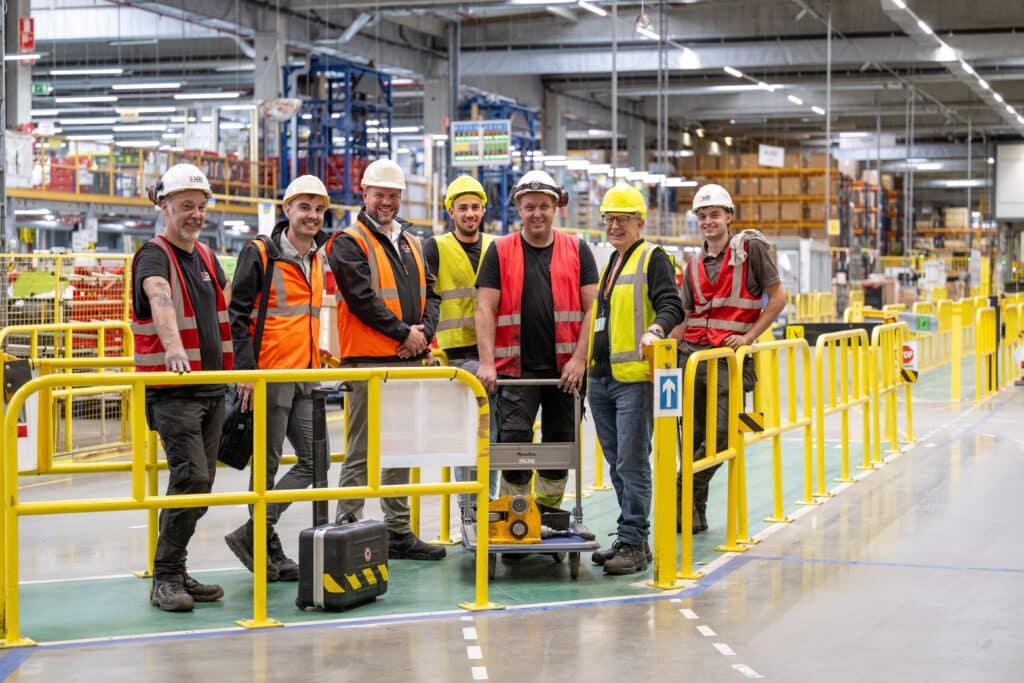
Project coordination was tight. Consultations every week. Each phase better than the last. Small details were adjusted along the way, which ensured tempo and calm. No unnecessary complexity, but clear steps and a transparent approach. The maintenance engineers of E'Log were there from beginning to end. Their knowledge, experience and flexibility gave us confidence.
Like any major project, this had its surprises. The new rail was ten millimeters higher than anticipated, which meant that the software and sensors had to be adjusted. And the motor sets on stock? Those didn't fit perfectly with the existing cranes.
“That was a bit of a scare,” Mark recalls. “We were about to start and suddenly the rail turned out not to be perfectly aligned. But thanks to the escalation plan and short lines of communication, it was resolved within hours. The work never stopped.”
Safety was always a priority in this process. E'Log worked closely with Toyota's HSE manager and their maintenance partner Bilfinger, supporting the internal maintenance team at Toyota Parts Centre Europe.
“Security is our top priority,” says Mark. “E'Log and the other partners adapted well to this. Everything was thoroughly prepared, especially the coordination between the works at height and those on the ground. This allowed everyone to work safely. And if anything did go differently than planned, we immediately discussed it in our weekly meeting. That openness just worked.”
Four cranes and four rails later, the highbay looks like new again. Perfectly aligned. Reliable. And ready for growth.
“We can be back at it for years to come,” Mark says with satisfaction. “Reliability is back where it should be, and we have a partner who thinks along with us about what's next.”
The gain is not in what was renewed, but in what was retained: continuity. The retrofit made the highbay more stable and efficient, without shutting down operations for a single day. Today, Toyota Parts Centre Europe utilizes the facility better than ever: more capacity, more security and less unexpected downtime. Just what the organization needs for future growth.
“If I had to give the project a score, it would be an eight out of ten,” Mark concludes. “There are always areas for improvement, but the cooperation was open, professional and solution-oriented. That's the most important thing for us.”
The highbay retrofit proves that innovation doesn't always mean starting over. Sometimes it's smarter to build on what's already there. With the right expertise, the right people and a partner who thinks with you, even a 30-year-old installation grows back into the future effortlessly.