[00:02] Safety in Modern Warehouses
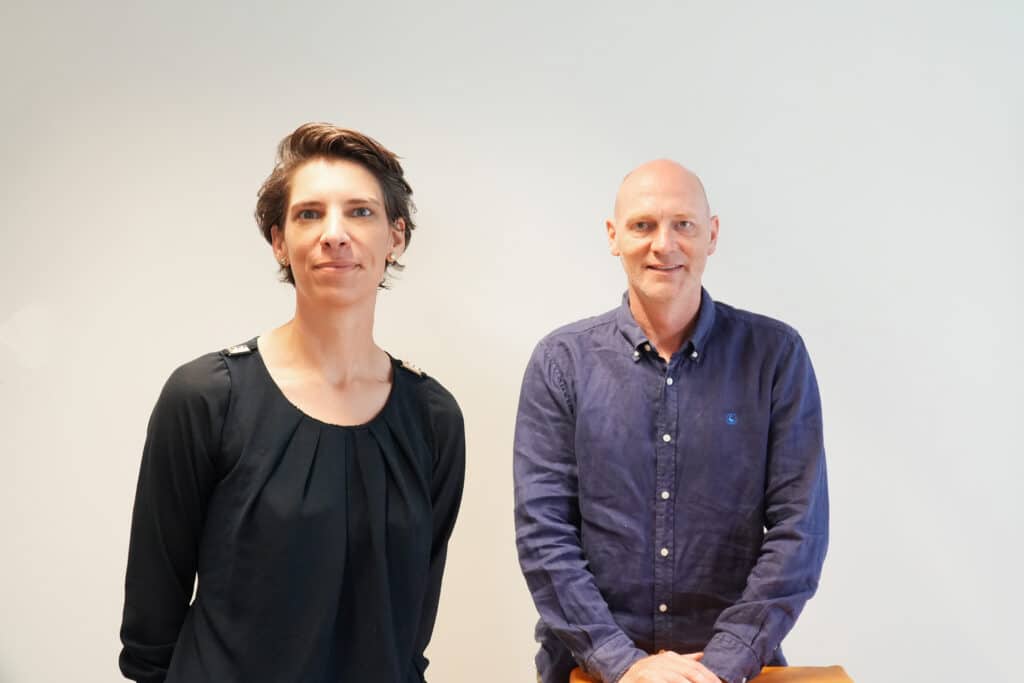
Björn Crul: Hello, listeners. Modern warehouses are becoming increasingly dynamic. People, forklifts, and AGVs, for example, all move through the same environment. Automation is on the rise, and goods are being stored more and more efficiently. As a result, the way safety is viewed in such environments is also changing. What does the new integrated approach to workplace safety look like, and what are the major challenges? Today, I’ll be discussing this with Sigrid Herbosch from Troax, a partner in innovative safety concepts. Troax has long been known for its safety fencing and mesh walls, but it also wants to explicitly position itself as a partner for a much broader safety concept. Sigrid, welcome to our studio. Let’s start at the beginning. Troax, as a company, you’ve undergone a profound transformation over the past few decades. What do you do today?
[00:58] The History and Activities of Troax
Sigrid Herbosch: Well, Troax actually got its start in 1955 in a small shed somewhere in a small Swedish village called Hillerstorp, where four brothers were manufacturing chicken wire. Over time, other safety products were added to the lineup. And I think it’s safe to say today that Troax has a presence on every continent through more than 45 sales offices and that we are the global market leader in steel mesh panels for machine safety, organizing warehouses and data centers, and setting up storage areas for apartments and garages.
[01:33] Expansion of Safety Services
Björn Crul: Essentially, responding to what’s happening in various markets where those solutions can be used. How did you go about making the decision to expand your product line? How does that change the company’s role?
[01:45] From Manufacturer to Safety Partner
Sigrid Herbosch: Actually, that’s the next logical step in a company’s growth. You have certain products that allow you to do certain things. But ultimately, Troax wants to look toward the future as a safety partner rather than just a manufacturer of steel fencing. Looking at the bigger picture. As in: how do we ensure safety in the workplace? How can we actually offer a comprehensive solution? And that’s really a logical consequence, not only in terms of a company’s growth but also the expansion of its portfolio. But I think it’s also a reflection of the times. Customers simply want a one-stop shop or a single point of contact that actually handles all aspects of safety. And that’s where Troax comes into the picture.
[02:34] Identifying Safety Issues
Björn Crul: Does one of your consultants then go on-site to assess the safety situation at a company and work with them to develop the right solutions?
[02:41] From separate zones to a comprehensive concept
Sigrid Herbosch: Yes, in the past, companies actually used to look at different zones separately. So you had a production zone, an order-picking zone, and so on. And then we’d receive a request from the client to address that specific zone. What happens now is that we do indeed conduct a risk analysis. Then we map out a comprehensive plan. We no longer look at which specific zones need to be shielded or require additional safety measures. No, it’s about the overall concept of what we need to address here. It’s no longer just that one zone. In fact, the entire work environment becomes the zone. Within that, we have to take a very thoughtful look at the possible solutions. These could include collision guards or fall-through protection for racking. So we’re looking at the big picture there.
[03:40] The Modern Warehouse
Björn Crul: This is a podcast from Warehouse and Logistics. So, naturally, we’re going to be talking about warehouse environments today. What does a modern warehouse actually look like?
[03:52] Data, Automation, and Speed
Sigrid Herbosch: Well, whereas in the past it was really confined to the areas I just mentioned, it has now essentially become a smart tech environment, where data, automation, and robots take center stage. And speed, in particular, has become a key factor. That was much less of a factor ten years ago. And you can actually bring that speed into a company through automated vehicles, robotics, automated order picking, and the like. So, because of these changes, a lot is changing in terms of safety as well. Because that’s where people come into contact with speed and those vehicles.
[04:30] Collaboration Between People and Vehicles
Björn Crul: Yes, and sometimes they have to work together very closely. Does that make safety more complex?
[04:35] New Risk Zones
Sigrid Herbosch: Absolutely. And that complexity also stems from that speed and from the intense collaboration between the two. So it’s especially the places where the two converge that become crucial here. And those often become risk zones. These are intersections within companies where machines interact with people, where vehicles come together, where people are walking, and so on. So that’s something that’s very difficult to address with perimeter fencing alone. It’s something that wasn’t given much thought in the past but is now coming into sharp focus.
[05:10] Forklifts, AGVs, and AMRs
Björn Crul: Can we get a little more specific about that? Let’s say you have a warehouse where, for example, operators work with manual forklifts, but where you also have AGVs or AMRs. What kind of safety measures would you need in that case?
[05:23] Anticipating Hazards
Sigrid Herbosch: Then you’re no longer talking about perimeter protection, because that’s actually more about demarcating zones or absorbing the impact. But then you’re talking about a kind of… That’s about preventing risks, anticipating hazards. For example, in situations where perimeter protection could never do that. An example of this could be a blind spot, where a forklift is speeding by on one side and a pedestrian is walking by on the other. That’s a dangerous situation. Another example could be narrow aisles in warehouses where forklifts are operating, where the forklift should actually receive a signal indicating: there’s already a forklift in this aisle or a pedestrian is approaching. These are very abstract scenarios that cannot be addressed with collision protection or fencing.
[06:20] Incorporating Safety Early in the Project
Björn Crul: You just mentioned that. Many logistics warehouses are actively working on this, whether in greenfield projects or in renovations of existing warehouses. At what point are you, as a safety partner, actually involved in such a project? What’s the ideal situation for identifying and avoiding all those risks?
[06:39] Better sooner than later
Sigrid Herbosch: Well, yes—actually, sooner rather than later. I think that’s the key. Often, people only react once something has already happened. That’s unfortunate. We should anticipate and, above all, understand how a warehouse operates, identifying all risks so we can prepare for those hazards. Otherwise, we’ll fall back into thinking in terms of separate zones—like, “This spot has a machine; that spot needs a guardrail.” In this area, order picking takes place, so we need fall protection or something similar there. But that’s no longer the case today. All those zones are interconnected by AGVs and automation systems. In other words, we need to look at the big picture. So we try to convince clients: view this as a comprehensive safety concept—not just across the different departments in your factory, warehouse, or wherever it may be—but actually try to tackle it on a global scale from the very beginning. That’s the ideal situation. Reality, however, may well be different. Often, you’re faced with a situation that already exists. Something has happened—an incident occurred, a collision took place. And then you have to make do with what you already have and implement a solution within that framework. But the systems are all flexible enough to handle that. Of course, you’ll need to take a moment to figure out the right approach. Are we going to patch things up, or are we going to tackle the problem at its root?
[08:14] More Extensive Renovation
Björn Crul: Or maybe a more thorough renovation, actually?
[08:16] Investing for the Long Term
Sigrid Herbosch: And I think, of course, we should always choose the second option. How are we going to address this thoroughly so that it doesn’t happen again next time? How are we going to invest in this now for at least the next ten years? So that’s important to us.
[08:30] The Role of Regulation
Björn Crul: You’re talking about the importance of investments that are essentially preventive in nature. What exactly is the role of regulation in all of this?
[08:42] Regulations and Internal Traffic Plans
Sigrid Herbosch: For guarding machinery. And then there’s also the Codex on workplace well-being. Whether it can be interpreted literally in every company is the question. But of course, it already contains a number of basic guidelines. And one basic guideline is that as soon as mobile work equipment enters a work zone, a company must draw up an internal traffic plan. That’s number one. Number two is that organizational measures must already be in place to keep pedestrians separate from moving work equipment. In principle, this can be achieved through a demarcated zone. It can be as simple as painted lines, but of course, heavy traffic wears them down, so they should actually be reviewed every few years. It can also be achieved through barriers and those Active Safety products. What else is important? For example, that forklifts are equipped with visual or audible warning signals. That people are warned. Also, those narrow aisles I mentioned earlier. There should be a signal indicating that a forklift is in those aisles. Or that a pedestrian is approaching. These are issues that need to be addressed.
[09:58] Active Safety
Björn Crul: I heard you mention “Active Safety” earlier. That’s actually a new product line that you’ve launched at Troax. What exactly does that entail? Are they technological solutions?
[10:09] Technological Solutions
Sigrid Herbosch: Yes, technological solutions. And I have to admit: when people ask me a question like that, I often think, “How am I supposed to answer that?” Because it’s very abstract and also very broad, but it really does come down to technological solutions that anticipate hazards and prevent risks by mapping the situation in real time. Think, for example, of projectors that display a pictogram on the ground. Or think of tags that alert people or forklifts—either the forklift itself or a person nearby—using light, sound, or vibration. We always work on those three levels, which you can also choose from. So that’s basically the concept. Essentially, we’re going to apply products where perimeter security ends—where it has its limits. And that’s where Active Safety takes over. In other words, everything that can’t be literally demarcated, so to speak.
[11:09] A concrete example
Björn Crul: Can you give a specific example of a situation or context where that really adds a lot of value?
[11:16] Blind Spots and Warnings
Sigrid Herbosch: Yes, that blind spot we were talking about earlier. On one side, the forklift is approaching at a certain speed—which is hopefully regulated, because that’s how it should be. On the other side, a pedestrian is approaching, completely unaware. Forklifts these days are very quiet—they’re electric. They’re no longer gasoline-powered, with the associated risk of not being heard in time. The moment those two enter each other’s path, you can establish a perimeter around both of them. The forklift transmits a signal. The forklift operator also carries a tag that can emit a vibration, light signal, or sound. In addition, the pedestrian also receives a signal—in the form of light, sound, or vibration—on their personal tag. Another scenario could be where a forklift has to pass through a narrow passageway, with the warehouse located just beyond it, but it’s very difficult to see that passageway. In this case, as the forklift approaches the zone—which, for example, is already being slowed down by an automatic retarder built into the forklift— There’s also a physical barrier to prevent crossing. And the moment the forklift has passed, a projector actually displays a crosswalk on the floor, letting the person know that they can now cross. Those are two examples.
[12:45] Technological and Physical Solutions
Björn Crul: From that last example, I can see that it's not so much the technology itself, but that you're also working toward integrating technological solutions with physical solutions.
[12:56] Combination of both systems
Sigrid Herbosch: Yes, absolutely. And I’m also convinced that the two work together perfectly and that they need each other. Because one stops working at a certain point, and that’s where the other takes over. And I think that as soon as things get a little abstract or there’s movement involved, we’re forced to rely on means other than the typical ones… Of course, it has to work in your environment. That’s a fact. So that requires careful consideration. But once that’s in place, you can actually cover any area. And that’s something we couldn’t do before. You have coverage for a machine cell. You have coverage for a pallet rack with fall-through protection. That’s all fine.
[13:37] Risks Associated with Internal Transportation
Björn Crul: But the more transportation you have, the more everything is stretched out.
Sigrid Herbosch: And what do you do about falling objects and the risks they pose? And what about warning people who are in dangerous zones or dealing with the speeds of forklifts? What about collisions? These are issues that are very difficult to address with conventional methods.
[13:54] Flexible Collision Protection
Björn Crul: I also saw on your website that there’s a solution for flexible vehicle barriers. That product is called Troax Barriers. In what kinds of environments do they offer the greatest value?
[14:06] Applications of Troax Barriers
Sigrid Herbosch: Actually, in much the same environments: from production halls to warehouses—including automated warehouses—where there are a lot of forklifts. Powered work equipment, so to speak. Equipment that’s actually designed to prevent collisions. So that’s the literal protection. Whereas Active Safety is more about anticipating hazards, the barriers will effectively stop an impact should one occur.
[14:39] Flexible and steel barriers
Björn Crul: What, then, is the fundamental difference between a flexible polymer barrier and a traditional steel barrier?
[14:47] Differences in the Event of an Impact
Sigrid Herbosch: There are actually three very significant differences, and they are also of great importance. That flexible barrier actually reduces damage to the vehicle, which can otherwise lead to very high costs. It reduces damage to the floor because, thanks to its flexibility, it absorbs the impact in such a way that the concrete doesn’t crack—instead, the force is absorbed by the base plate. And then, of course, there’s also the damage to the barrier itself. So, in the case of the steel barrier, the forklift is damaged, the ground is damaged, and the barrier itself is damaged as well. So you can only use it once. In that sense, it’s actually a short-sighted solution. Whereas a flexible barrier actually springs back—with a deflection zone of 250 mm, I should add—which means it can actually be reused. So it’s a sustainable solution.
[15:42] Testing of Safety Systems
Björn Crul: Sigrid, we’re talking about solutions designed to ensure people’s safety. Of course, a great deal depends on credibility. Your company has been building up experience since 1955. But how exactly are those systems tested today to verify that they actually do what they’re supposed to do?
[16:03] Independent Tests and Certifications
Sigrid Herbosch: Those tests are extremely important to us. We’ve made that a top priority from the very beginning, because, of course, you can say that your own products are truly very safe—that they’re the best on the market. Yeah, sure. The moment something happens, that will actually be proven through experience. But it’s much more important to have them tested independently. That’s why our products are tested one by one in our own test center, as well as by independent organizations. For example, we have TÜV. I think most people are familiar with that. But we also have PAS 13. That’s actually a global product code for testing industrial collision protection. So it covers the supply, installation, and testing of these systems. And we can provide those certificates for each of our products. That’s important to consumers. It’s not just Troax saying this—it’s independent organizations. And that’s much more important.
[17:08] A rapidly changing warehouse environment
Björn Crul: Let’s return to that modern warehouse environment. We just mentioned it. Technology is playing an increasingly important role there. Automation is on the rise. There are more cobots, more robots, and AGVs, and so on. It’s actually an environment that’s changing very rapidly these days. How do you adapt to that in a warehouse that’s secured at a certain point in time, only to have a new piece of equipment installed or a new piece of technology implemented shortly thereafter?
[17:36] Modularity and Future-Proofing
Sigrid Herbosch: Yes, we’re actually evolving along with the times. I think that’s what we need to do. The advantage of our products is that they’re all designed with modularity in mind. And I believe that modularity means future-proofing. The moment an expansion is needed, I build it in. No zone stays the same for ten years. I don’t believe in that anymore. Back in the day, if you’d told me that, I would have said, “Yes, that was true.” Factory environments used to be relatively rigid. That’s no longer the case at all today. So basically, anything that doesn’t change isn’t keeping up with the times. Troax notices that very clearly. That can also happen in the event of a collision. It happens very often with our products, because that’s what they’re designed for.
[18:26] Replace Damaged Components
Björn Crul: Yes, because then, for example, only a small part of the security system is broken, and a new component has to be installed.
[18:31] Sustainability of Modular Systems
Sigrid Herbosch: Yes, and it would be absolutely crazy to tell the customer, “Well, we’re going to tear the whole thing down.” We’d be happy to deliver a new one. No, what we actually do is replace just the part that needs replacing. So in that regard, the product is very sustainable and future-proof.
[18:47] The Cost
Björn Crul: Yes, Sigrid, that actually brings us to the question of the cost. Companies need to start investing in security. How should a customer approach this?
Sigrid Herbosch: No one likes to spend money just for the sake of it. But customers also need to consider the indirect costs. And I think that when we look at the downtime in a factory when something happens, or at the costs resulting from a collision or crash, goods falling, damaged goods, and perhaps even injuries sustained.
[19:32] Troax at Logistica Next
Björn Crul: That actually seems like a very logical line of reasoning to me, one that will also help prevent companies from experiencing incidents. Well, Sigrid, we’ve talked about a wide variety of solutions. People who want to see them in action can visit the Logistica Next trade show in Utrecht soon. What will they find at your booth there?
[19:52] The portfolio on the stock market
Sigrid Herbosch: All kinds of products that Troax offers. So we’re trying to showcase a complete portfolio of machine guardrails, fall protection for pallet racks, the Active Safety products, and our barriers as well. So I think they’ll get to see just about everything Troax has to offer.
[20:13] Advice and expertise at the booth
Björn Crul: So why should a warehouse or logistics manager definitely stop by your place?
Sigrid Herbosch: Not just for the great cup of coffee and the friendly people who’ll be manning the booth, but especially for the advice we can offer, the expertise my colleagues have built up over the years, and the enthusiasm with which they interact with customers.
[20:33] Practical information
Björn Crul: To come take a look. Troax will be at Logistica Next in Utrecht from November 3 through 5. Of course, you can always find more information about Troax and its safety solutions through the Warehouse and Logistics channels. Well, we’re almost at the end of the podcast. If you could give our listeners one piece of advice, what would it be?
[20:54] Looking at the Big Picture
Sigrid Herbosch: To examine the overall concept in relation to the work zone, the company, and its operations. No two companies are the same. You can’t simply replicate a previous situation. You can’t compare one company to another. It will be different for everyone. But try to integrate different zones with one another. Try not to view them in isolation from one another. Compare different safety solutions with one another. Because there isn’t just one solution—there are several. And from those, you can then choose based on preference or budget.
[21:28] Closing
Björn Crul: Sigrid Herbosch, thank you very much for this interview, and best of luck with Troax.
Sigrid Herbosch: Yes, thank you. I'd be happy to.
Björn Crul: That wraps up this episode of the Warehouse and Logistics podcast, dear listeners. See you next time!
warehouselogistiek.eu
EN

The platform for internal & external logistics, supply chain and automation