[00:00] Introduction
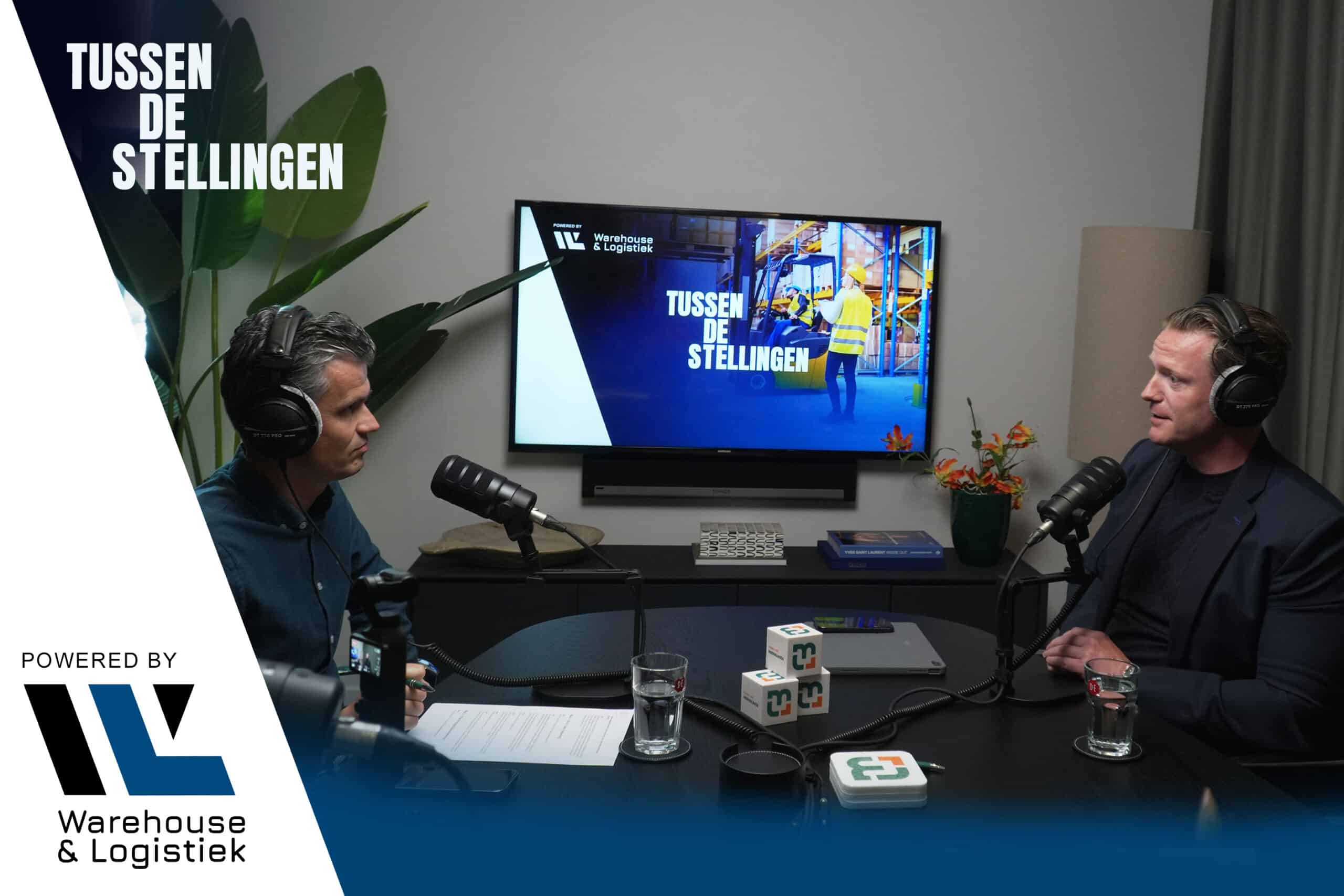
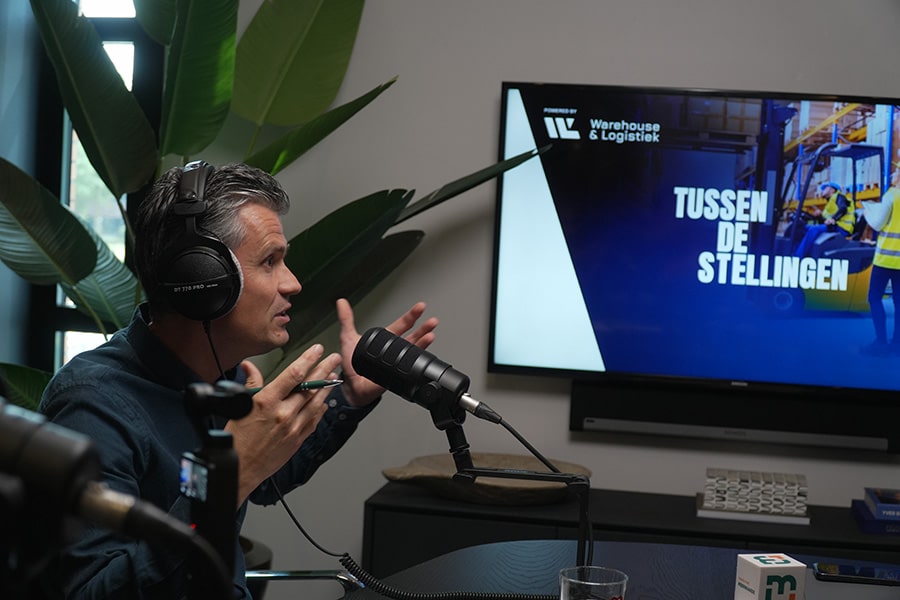
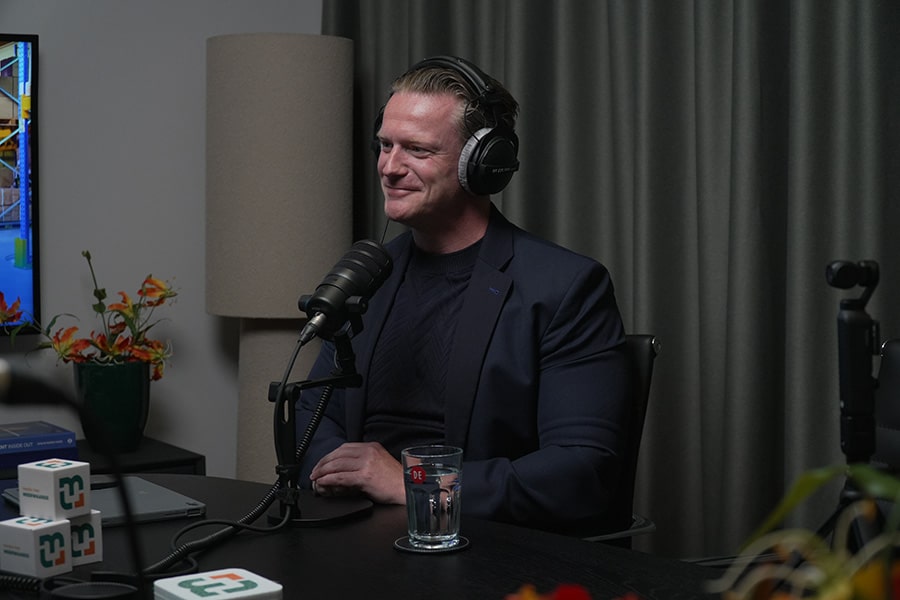
Roel van Gils: Welcome to another new episode of Between the Positions from Warehouse and Logistics Benelux. Today we’re taking a look at the world of warehouse automation—a world where space is scarce, staff are hard to find, and companies are under increasing pressure to deliver faster and faster. My guest today is Andy van Mieghem from Vanas Engineering, a specialist in smart intralogistics solutions. Andy, please introduce yourself.
Andy van Mieghem: Hey, thanks for the invitation. I’m Andy van Mieghem, and I’ve been working at Vanas for about twenty years. It started out as a family business and was later acquired by Modula—just two years ago. I’ve had the opportunity to experience every stage of the company’s development. I started by developing projects and drafting proposals. I found that really interesting: coming up with solutions. That’s where my passion began. After that, I got to visit clients to devise solutions on-site. I then became fascinated by our automatic platform lifts and the proprietary software we’d been developing for them for years. After that, I advanced to sales manager, took on operational responsibilities as well, and became general manager about seven years ago. Then came a number of investments and the acquisition of automation expert Pacoma Systems—a strategic decision. At the same time, we also expanded into the Netherlands. It’s been a wonderful journey, and I’m still passionate about it. Twenty years in, it still feels like my baby.
[01:34] What does Vanas Engineering do?
Roel van Gils: Great, wonderful. Welcome again, Andy. Let’s start with the basics: Vanas Engineering. Who exactly are you? What do you do?
Andy van Mieghem: Warehouse design and production storage, in a nutshell. We help customers save space, increase productivity, and enable employees to work more efficiently and error-free. Those are really the three most important things. We address these needs with everything from small static systems—the classic solutions—to more highly automated systems. We’re big believers in hybrid solutions. It doesn’t always have to be fully automated. These days, that’s all the rage—it’s very trendy—but sometimes traditional systems are perfectly suited and solve the problem in a very budget-friendly way. That’s why we offer that combination. Of course, there are also additional benefits such as ergonomics, but the main drivers remain space and efficiency. Those are the biggest challenges here in the Benelux. Wages are high, staff are hard to find, and space is scarce. That’s why we prefer to utilize vertical space rather than additional floor area.
[03:09] New construction or existing buildings?
Roel van Gils: Do you often work in existing buildings that are being redesigned for greater efficiency, or mainly in new construction?
Andy van Mieghem: Both. The ideal scenario is, of course, a greenfield project—a new construction—because you can be involved in planning the layout of everything from the very beginning. The reality, however, is that it’s very often a brownfield project, in an existing building. In that case, we try to make better use of the existing space and functionality. This often results in significant savings for the client, since they don’t have to build a new facility, relocate, or move their staff. If you can design an existing building well, it often yields an added benefit. For us, about 70 percent of our projects involve existing installations and 30 percent are new construction.
[03:55] Watch the entire process
Roel van Gils: So, as a system integrator, you look at the entire process?
Andy van Mieghem: Yes, preferably. That’s not always the case, but we’d prefer to review the entire process: from receiving the goods, to storage, order picking, packing, shipping, and sorting. The entire supply chain.
Roel van Gils: That's when you can achieve the most optimization.
Andy van Mieghem: Yes, in that case you create a design where everything is coordinated. It doesn’t all have to be implemented at once. We often work for small and medium-sized businesses. A “big bang” approach usually isn’t an option there. We opt for scalable solutions, but we do design with a five- to ten-year horizon in mind. If you start today with sorting systems or packaging systems with roller conveyors, we’re already looking at what the storage setup might look like in the future. That way, the installation is ready for the next step. Otherwise, you’ll end up with three separate puzzle pieces that you’ll have to force together later on. That often leads to bottlenecks.
[05:11] Where does automation begin today?
Roel van Gils: Is sorting and packaging also the logical starting point these days?
Andy van Mieghem: We see this as a turning point. Five years ago, the focus was mainly on warehousing and order picking. Today, packaging is also receiving much more attention, especially in e-commerce. This is, of course, related to the upcoming PPWR legislation.
Roel van Gils: I believe that will become mandatory starting in 2030.
Andy van Mieghem: Yes. The regulations will take effect this year, but they will become mandatory starting in January 2030. For packages, the maximum allowable air content will then be 50 percent. Filler material is also considered air for this purpose. This means you can no longer fill boxes with plastic bags or paper. Fifty percent may seem like a lot, but it’s a strict requirement because it applies to the total volume, not just the height. Everything around the contents counts. Many customers will therefore need to take action. It remains to be seen what penalties will be imposed, but knowing Europe, those rules will certainly be enforced. That’s why we’re seeing more often today that packaging processes are the starting point, followed by storage and picking.
[06:35] Thinking Ahead in Design
Roel van Gils: So ideally, you'd take that into account right from the start?
Andy van Mieghem: Yes. Take a classic static storage system: a large number of soccer fields filled with racks. If you’re relocating and need to set aside space for that again, or if you’re considering vertical storage right away—which allows everything to be stored in just one-fifth of the floor space—then it’s better to design the process with that in mind from the start. Especially with a greenfield project, you also need to consider factors like floor load capacity to ensure that future expansions remain possible.
[07:10] Why platform lifts?
Roel van Gils: You mentioned in the introduction that you're part of a larger group. Can you tell us a little more about that?
Andy van Mieghem: We had been an integrator and distributor of Modula machines in the Benelux for years. That is why we acquired Pacoma Systems in 2016—because we are strong believers in platform lifts.
Roel van Gils: Why?
Andy van Mieghem: Platform lifts are a very simple way to save space. The machines are built to the available height—up to twenty-two meters—for small goods. Anything that fits in shelf racks or flow racks can fit in a platform lift. They operate according to the “goods-to-person” principle. The platform descends and presents the products to the operator. A laser pointer indicates which product to pick. In some cases, this saves up to ninety percent of the space. It also drastically reduces walking distance. Even today, about 70 percent of order-picking time is spent walking. If you can reduce that, the operator becomes two to four times more efficient.
Roel van Gils: Of course, that makes it a lot more efficient.
Andy van Mieghem: Absolutely. What’s more, platform lifts are a budget-friendly form of automation. You don’t have to think of six-figure investments right away. Starting at around seventy-five thousand euros, you can already get a reliable platform lift that automatically delivers goods. We then integrate our software with the customer’s ERP or WMS system to fully support order picking. As volumes increase, we often combine platform lifts with roller conveyors. You can certainly pick orders at a platform lift and place everything on a table, but if you’re processing a lot of orders, those boxes and bins also need to be removed. You can either assign someone to do that, or you can set up a system where the bins are automatically removed. That’s why we acquired Pacoma Systems: to offer that combination entirely from a single source.
[09:40] Target Audiences
Roel van Gils: And what is your primary target audience?
Andy van Mieghem: When it comes to automation, we focus primarily on e-commerce and distribution. By that, I mean conveyor systems, packaging systems, and sorting systems. Pure storage solutions, such as a platform lift, are actually used everywhere. This could just as easily be a technical warehouse where spare parts for in-house production are stored or tools are managed.
Roel van Gils: Are you limited to certain dimensions?
Andy van Mieghem: Of course, there are limitations. You start at a height of about three meters, because otherwise a platform lift offers little space savings. In terms of width, they range from two to four meters. Often, several units are placed side by side. Various depths are also available, which allows for a high degree of flexibility.
Roel van Gils: And what kinds of products can be stored in it?
Andy van Mieghem: The shelves can be up to four meters wide. We have customers who store large products measuring 800 by 600 millimeters on them, as well as heavy parts that are removed from the machine using a spring balancer, so that employees don’t have to lift anything.
Roel van Gils: That's also good for ergonomics.
Andy van Mieghem: That's right. As a result, the possibilities are very broad—ranging from manufacturing companies that want to store labels close to the production line to traditional e-commerce environments where order picking is key.
[11:18] Why Companies Automate
Roel van Gils: When it comes to warehouse automation, what are the main reasons for automating?
Andy van Mieghem: It's still the same three: location, efficiency, and error-free operation.
[11:18] Key drivers for automation
Roel van Gils: And when it comes to warehouse automation, what are the main reasons for implementing automation?
Andy van Mieghem: It's still the "golden three": location, efficiency, and error-free operation.
Roel van Gils: Yes, that's exactly what you said at the beginning.
Andy van Mieghem: Yes, they’re still the same. That was true ten years ago, and it’s still true today. You only see a change when it comes to efficiency. In the past, the focus was often on reducing headcount—in other words, on cutting costs. Now you see the opposite: companies can’t find enough staff. Achieving growth through automation, with the same team.
Roel van Gils: Yes.
Andy van Mieghem: If one employee works four times as efficiently, you can do the math.
[12:11] ROI and the Impact of New Regulations
Roel van Gils: So it's no longer just about cost savings. Of course, that ROI is important, but…
Andy van Mieghem: No, not exclusively anymore, either. Of course, cost is always a factor, but it’s mainly about growth potential. Can you continue to store everything in your existing facility? Try calculating the ROI if you don’t have to move entirely. Then you compare the costs with an investment and simply choose the best solution. We’re also seeing the time horizon shift somewhat. In the past, an investment had to pay for itself within three years. Now there are customers who say: five years is fine, too, because the strategy is so important. We see this especially with packaging systems, where new legislation is also a major driver. Companies are investing to comply with those regulations.
Roel van Gils: Are companies already aware that this legislation is on the way?
Andy van Mieghem: No. Some are starting to think about it, but three years is still a long way off for many customers. Especially when we’re currently working on automation projects where customers are still looking at traditional box folders and box sealers that use a lot of filler material. That’s when we deliberately say: let’s think ahead for a moment. Otherwise, we’ll end up integrating a machine that will need to be replaced within three years by a modern model with height reduction.
Roel van Gils: So do you guys sometimes press the pause button yourselves?
Andy van Mieghem: Yes. To tell customers: don't make a bad investment right now, but think it through a little more and maybe make a good one a few months later—one that will pay off in the long run.
[13:57] The three divisions within Vanas Engineering
Roel van Gils: You focus on three niches—is that right?
Andy van Mieghem: Yes. Our main focus is warehouse and production layout. We combine this with various systems to achieve that goal. As I mentioned earlier: from traditional systems to fully automated ones. In between is semi-automation, which is Modula. We therefore distinguish three groups: Static Solutions, Modula, and Automation.
Why do we do that? Because they are three different areas of expertise. You can’t expect a single person to master all the knowledge required for those three niches. Moreover, a complete system integration requires a completely different approach than a project where someone is looking for 100 square meters of shelving or one or two platform lifts. That’s why we have separate specialists for each niche.
Roel van Gils: So that's really a separate department?
Andy van Mieghem: Yes. Within our group, there’s a separate department with specialists who know everything about those solutions. The generalist who visits the client first determines the direction the project will take and then brings in the appropriate specialist.
[15:22] Does a customer start with a solution or a problem?
Roel van Gils: Do customers already come to you asking for a specific solution?
Andy van Mieghem: Both of those things happen. Some customers say, “You have a wide range of products—help us out.” We’re seeing that request more and more often, especially in the automation world. These days, there’s a massive proliferation of systems. Ten years ago, you had miniloads, platform lifts, and high-speed shuttles. That was about it. Now there are hundreds of different technologies. And if Asia has its way, a few more will be added every year. That creates choice overload.
On the other hand, there are also customers who say, “We’re thinking about racks, lifts, or some other system.” That doesn’t mean we’ll just go along with it. Within our organization, we’ve agreed that our greatest strength is thinking along with the customer and providing advice. Just because someone asks for a particular solution doesn’t mean we’ll blindly offer it. We like to challenge the customer. Why do you need that? What are your current performance metrics? What are your growth plans? In two out of three cases, the customer turns out to have chosen the right direction. But in one out of three cases, we engage in a discussion and propose a different or partially different solution. For example, by placing “fast movers” in a different system than the client originally envisioned.
[16:39] The Modula Division
Andy van Mieghem: Our second division is Modula. It handles everything related to platform lifts, using our own software.
Roel van Gils: Developed in-house?
Andy van Mieghem: By Modula itself. This software is used worldwide, is highly scalable, and manages all machines. It is integrated with the customer’s ERP or WMS system so that orders are automatically forwarded.
That’s another niche as well. The product line includes seven different types of machines. We often talk about platform lifts, but there’s also the Flexibox, for example. Instead of picking up a single large platform, it can handle up to 180 bins per hour. That’s a much faster solution.
Roel van Gils: That's pretty fast.
Andy van Mieghem: Yes. We sometimes call it a platform lift on steroids. It really flies. But even in those cases, our specialists assess whether that’s really the right solution. Sometimes we combine one high-speed machine with two traditional platform lifts.
Roel van Gils: So all of that is possible?
Andy van Mieghem: Absolutely. A single software platform coordinates all these different machines. For example, there’s also a platform lift with a roller shutter above it. When someone needs a specific tool, only the compartment containing that tool is unlocked. The rest remains locked. This allows you to create an unmanned technical warehouse where employees can retrieve materials 24 hours a day, while still ensuring that inventory levels are accurate and you won’t face any surprises at the end of the year.
[18:33] The Automation Division
Roel van Gils: And what about the third division?
Andy van Mieghem: That’s Automation. That’s where we really operate as a systems integrator. Everything revolves around conveyors that connect the various zones and transport the goods. For projects like these, we usually start with an in-depth preliminary study and data analysis. Our logistics engineers create various designs. When they realize, for example, that platform lifts or other solutions are a better fit, specialists from other divisions join the team to help refine the design.
[19:18] When is data analysis necessary?
Roel van Gils: Is such a comprehensive data analysis also necessary for projects that involve only platform lifts or static solutions?
Andy van Mieghem: To a much lesser extent. Sometimes, yes, when we notice that the target speeds are high. In those cases, we bring in a data analyst from the automation department to provide support. But I’d say that’s necessary in only two out of ten cases. Most of the time, the specialist can handle the analysis on their own. If additional support is needed, we naturally provide it from the other department.
[19:49] From Analysis to Implementation
Roel van Gils: Of course, everything is analyzed at the beginning. What does a process like that look like next?
Andy van Mieghem: First, we review the data, if it’s available, because that’s still not a given. If data is available, we’ll get to work on it. Next, we’ll create a high-level design with a corresponding high-level budget to determine whether the business case makes sense at all. Once that’s approved, we’ll begin the detailed engineering phase.
I am a firm believer in collaboration. Collaboration within our own organization, but certainly also with the client. We understand the theoretical impact of our solutions, but the client knows their own processes and specific challenges. That’s why, during the design phase, we brainstorm together until we arrive at the final design.
Once the customer decides to proceed, the implementation process begins. This is followed by functional analyses, programming, on-site installation, testing, joint testing with the customer, going live in hypercare mode, and finally, after-sales support to provide ongoing maintenance and service for the automation system.
[21:14] Post-delivery engagement
Roel van Gils: So you'll still be involved even after the project is completed?
Andy van Mieghem: Yes, absolutely. We’ve definitely seen that customer needs have changed over the years, especially when it comes to conveyor systems. On the one hand, we handle routine maintenance and service. We have service technicians available 24 hours a day, seven days a week for that purpose. If requested, they can be on site within four hours.
In addition, we work with the client each year to determine whether the original requirements still align with the current situation. Has anything changed? Do we need to reengineer or adjust certain parts?
Roel van Gils: So you do that proactively?
Andy van Mieghem: Yes, if a client is willing to set aside time for that together, we definitely think that’s a good idea. It’s better to anticipate than to wait until problems arise. Often, a bottleneck only becomes apparent when companies are already reaching their limits. We try to stay ahead of that time pressure by actively contributing to the client’s growth plans and suggesting adjustments early on.
[22:22] Real-world example: Dozon
Roel van Gils: Could you also give an example of a project you've completed and what the results were?
Andy van Mieghem: A good example is Dozon, where we’ve essentially combined our three divisions. Dozon supplies building materials and all kinds of tools for the construction industry. About thirteen years ago, we built a warehouse there featuring a two-tier shelving system and roller conveyors that connected the various picking zones.
There were two picking zones on the ground floor and two on the first floor. The system operated on a “pick-and-pass” principle. Orders were released, bins were automatically sent to the correct zones, and the order pickers filled the correct bin each time.
Roel van Gils: Did all that happen automatically?
Andy van Mieghem: The picking itself was done by the employee. The bin was automatically moved to the correct zone, the picker placed the products inside, and sent the bin on its way. As soon as an order was complete, it was automatically sorted to the correct packing station and then sent directly to shipping.
Roel van Gils: Does that system still work the same way today?
Andy van Mieghem: No, and that’s exactly what makes the story interesting. About two years ago—after about ten years—the warehouse started to outgrow its capacity. That solution had worked perfectly for ten years. At that time, they were processing about 110 order lines per man-hour.
Roel van Gils: And before that?
Andy van Mieghem: That was actually even before my time, so I wouldn't dare put an exact number on it. But it must have been less than half that—somewhere around forty to fifty order lines per hour.
Roel van Gils: Then it was time to get down to some serious work.
Andy van Mieghem: Absolutely. Even back then, increasing our output to 110 order lines per hour was a huge improvement, without any extreme automation. However, over time, the building became too small. At the time, we were only using two levels, even though the building was nine meters high.
That’s when the discussion arose: should we build a third floor with additional conveyors, or should we take the next step? We proposed replacing some of the racks with platform lifts.
After analyzing the data, we determined that the fast movers could be perfectly accommodated in nine platform lifts. These were installed against the wall, nine meters high, and integrated into the same pick-and-pass system as the existing conveyors.
That way, we actually got the best of both worlds. A large portion of the traditional shelves was retained for slow-moving items and larger products, while fast-moving items were stored using a semi-automated system.
As a result, productivity increased from 110 to approximately 200 order lines per man-hour. In addition, storage capacity within the same building doubled. The system is also fully scalable, as nine additional platform lifts can be added at a later date. This will allow the customer to continue operating for many more years without the need for new construction.
I think that's a great example of working with a client to find solutions and offering phased solutions without it having to cost a fortune.
[26:02] Not always the most expensive solution
Andy van Mieghem: Automation is all the rage these days. Many companies immediately think of the biggest and most expensive solutions: robots, shuttles… If you invest a few million, it will undoubtedly work. But the question is whether you might be able to achieve the same result for a million less.
That’s exactly how we view automation. We strongly believe in hybrid solutions. Not everything needs to be fully automated. Sometimes you see companies trying to consolidate everything into a single automated storage system, including items that hardly ever move. In that case, you’re actually paying a lot for storage that adds little value. Sometimes a combination of techniques is simply much smarter.
[26:53] Real-world example: Medpets
Roel van Gils: Another interesting example?
Andy van Mieghem: Another great example is Medpets. It focuses less on order picking and more on packaging. Medpets supplies everything for pets: toys, as well as food. The company is heavily focused on e-commerce and had built a brand-new facility. So there was plenty of space there.
Together, we decided not to automate storage and picking. We opted for traditional shelving units about two and a half meters high and pallet racks for the larger items.
Roel van Gils: Because there was enough space available?
Andy van Mieghem: Yes, absolutely. We’ve also opted for traditional wave picking. Using standard picking carts, orders for about a hundred customers are picked at the same time. This minimizes the amount of walking through the aisles.
The orders are then sorted using an automated system with conveyors and an automated packaging line. We have opted for three different box sizes. The products are immediately placed in the correct boxes at the put walls.
Roel van Gils: Those sorting stations?
Andy van Mieghem: That's right. After that, the height of the boxes is automatically reduced.
Roel van Gils: So that's already happening?
Andy van Mieghem: Yes. As a result, virtually no packing material is needed anymore. The boxes are then automatically transported to the sorting stations, where up to two thousand packages per hour are sorted and sent to the appropriate carrier.
That’s where Medpets saw the biggest profit. In the past, packaging was done entirely by hand, using many packing tables and a lot of packing material. Now, the costs for packing material have been eliminated, and about half of the packing tables have been replaced by the automated packaging line.
[28:40] Ready for the PPWR regulations
Roel van Gils: Did they move into a new building at the same time?
Andy van Mieghem: Yeah, that was the plan anyway.
Roel van Gils: Was this concept their idea from the start, or did you develop it together?
Andy van Mieghem: We developed that together. They knew that packaging was a major bottleneck and wanted a solution for it right away in the new building. We then continued to brainstorm together, including ideas such as automatic height reduction of boxes.
We completed that project in 2023. In fact, they are now already fully prepared for the PPWR regulations that will become mandatory in 2030. When you receive a package there today, it’s no longer filled with air—it’s neatly packed to fit the contents.
Roel van Gils: Of course, that immediately generates a profit. What other benefits have they achieved?
Andy van Mieghem: Above all, efficiency gains. In addition, transportation costs have also decreased. When all your boxes are much more compact, you can fit many more packages into the same truck. The savings on packaging materials are also significant. For some customers, these savings amount to several hundred thousand euros per year.
Roel van Gils: I'd like to believe that.
Andy van Mieghem: Ultimately, it’s about material that’s immediately thrown away. Those were the three biggest advantages there. So the project wasn’t about saving space at all.
I think this is yet another great example of a hybrid solution. We combine simple shelving racks with efficient wave picking and a smart bit of automation in the back. Should they run out of storage capacity in the future, there’s already a plan in place to partially automate storage as well by making better use of vertical space. This way, storage, packaging, and automation all work together seamlessly.
[30:30] What sets Vanas apart?
Roel van Gils: Of course, there are other companies operating in this industry. In your opinion, what sets Vanas apart?
Andy van Mieghem: That actually fits perfectly into those three niches. There are plenty of companies that specialize in static storage solutions, plenty of suppliers of platform lifts, and plenty of companies that offer conveyors and automation.
Our competitive advantage lies in the fact that we bring these three disciplines together. This enables us to offer comprehensive solutions in which the platform lifts, conveyors, software, and control systems are fully integrated.
Roel van Gils: So there's no disagreement among the various suppliers on that point either?
Andy van Mieghem: Exactly. It’s a true one-stop shop for automation. There’s no finger-pointing at partners. There’s a single party that takes responsibility, coordinates everything, and ensures that the system’s overall performance remains optimal.
[31:33] Service in Belgium and the Netherlands
Roel van Gils: Is that what you do for clients in the Netherlands and Belgium?
Andy van Mieghem: Yes. We have two locations: one in Melsele, Belgium, and one in Waalwijk, the Netherlands. Both have their own service teams and technicians, so we can be close to our customers for maintenance and service. In the unlikely event of a malfunction—which, of course, can always happen with automation—we can be on site within four hours to quickly get the customer back up and running.
[32:00] Advice for companies looking to automate
Roel van Gils: In closing, if you could share one message with companies considering warehouse automation, what would it be?
Andy van Mieghem: Take the time to think about optimization early on, before it starts to cause problems. Above all, don’t let technology be your guide. That’s very tempting these days. Many companies say, “I want that technology because it looks great.” Or: “My neighbor uses that solution, so it’ll probably work for me, too.”
Try to look at this objectively. Work with a provider that offers multiple systems so you can get objective advice. That’s exactly what Vanas excels at. We offer a variety of storage, packaging, and transportation systems. Our specialists weigh all these options against one another and find the solution that best fits your needs.
If you’d like to compare that solution with other providers afterward, that’s fine, of course. But the advice is more objective than if you were to speak with a supplier who sells only shelving or only platform lifts. Such an advisor is more likely to steer you toward their own product line.
So, when you're looking for the best solution, be sure to find a partner who can contribute their own independent ideas.
[33:22] Closing Remarks
Roel van Gils: Great. Andy, thank you for your insights. Thanks again for coming.
Andy van Mieghem: You're welcome. Thanks for the invitation. I had a great time.
Roel van Gils: Thank you.