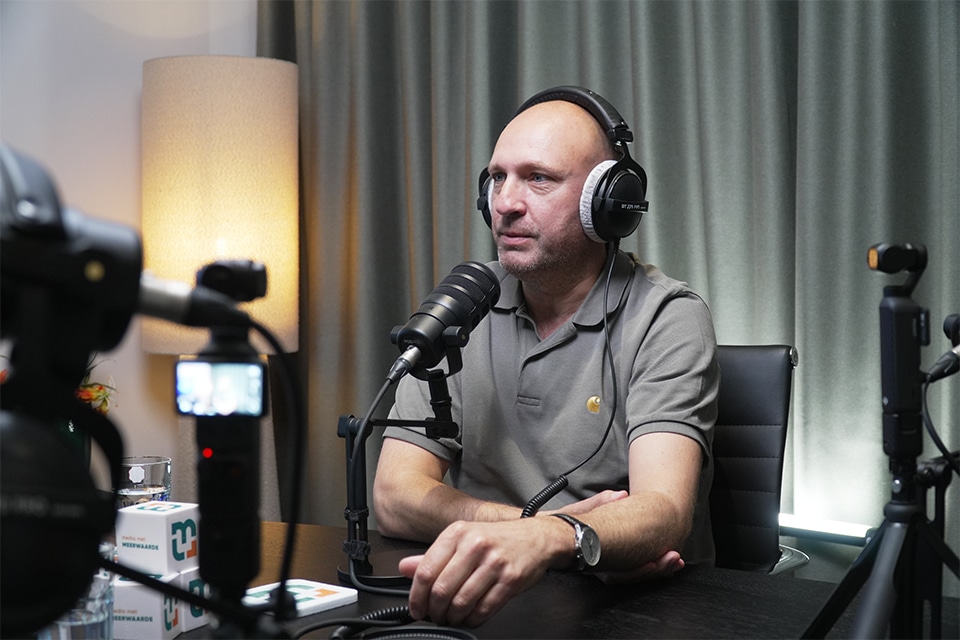
[00:00] Workplace Safety
Roel van Gils: A registration kiosk knocked over—a 10,000-euro loss—a rack nearly driven in half, a forklift operator who narrowly misses a coworker. These are not exceptions. Every day, situations occur in warehouses, distribution centers, and industrial settings that can have major consequences for people, machinery, and business continuity.
Roel van Gils: In this episode of Between the Positions We’ll be discussing workplace safety. Why are risks on the rise? What role do automation, labor shortages, and growth in logistics play? And most importantly: how can you prevent accidents before they happen?
Roel van Gils: Joining me at the table: Camiel van Asch from Flexbarrier. Camiel, welcome.
Camiel van Asch: Thank you.
Roel van Gils: Please introduce yourself.
Camiel van Asch: Yes, of course. My name is Camiel van Asch. I am the owner and CEO of Flexbarrier. Flexbarrier is a company that specializes in collision protection and a number of related products. Our goal is to make the workplace safer, prevent damage, and prevent accidents. We do this primarily in the logistics and industrial sectors, in the Netherlands and Belgium. That’s really our focus—every day.
[01:08] Injuries and Unsafe Situations in Practice
Roel van Gils: Okay. So you visit those kinds of companies every day. What kinds of things do you encounter there? Can you give a few examples?
Camiel van Asch: Yes, plenty. I’m already starting to smile. I won’t mention any names either. In some places in the Netherlands, it’s very safe and well-organized. People are proud of the company they work for. They take good care of their coworkers, the materials, the inventory, the racks, the columns, and the building—especially when it’s new.
Camiel van Asch: As that sense of commitment wanes—for example, when the percentage of temporary workers increases and their connection to the company weakens—you also see more damage occurring. It’s actually just like with your own house or car: when it doesn’t look as nice anymore, you often take less care of it. That’s how it works in logistics and industry, too. Then you see that the number of claims—and sometimes the number of accidents—simply goes up. We see this every day, in all sorts of ways.
Roel van Gils: Do you have any examples of that?
Camiel van Asch: Absolutely. I always take before-and-after photos. I could put together a whole collection of the “before” photos. Sometimes entire openings have been driven right through the wall. Sometimes you can see that the forks of a forklift have gone right through the wall above the opening. Then you really think: How was this even possible?
Camiel van Asch: If a column like that is still supposed to support the building, then I’d really like to be back outside as soon as possible.
Camiel van Asch: You see the same thing with positions. Sometimes they’re half-broken.
Roel van Gils: They’ll be propped up for a little while longer, so to speak.
Camiel van Asch: Yes, the first steps are being taken. But deep down, you know this just has to be replaced. Sometimes people wait to see if it will be noticed during an inspection.
Camiel van Asch: You also see situations where someone is sitting at a desk on the shop floor, while EPTs and forklifts are constantly driving around him. Then I think: I wouldn’t want to be sitting there myself, knowing that all that internal transport activity is happening right behind me. Those are exactly the situations we’re noticing.
[04:07] Awareness of Safety Risks
Roel van Gils: We can address these situations, but are companies aware of these risks?
Camiel van Asch: Yes, I would say so. The great thing is that I often do a walk-through with the warehouse manager or site manager at a location. They are often well aware of a number of risks. But the question, of course, is: Is safety really a priority within the company? Most companies place safety high on their list of priorities. The next question is: To what extent do they actually put that into practice?
Camiel van Asch: You could say, “Safety is extremely important here.” But then you actually have to do something about it. I see that when I walk through the facility with a site manager or warehouse manager. I can quickly tell how seriously they take it. I can also tell if there’s a budget for it. I often see that they’ve already thought through a number of scenarios. That’s when we can really take action.
Camiel van Asch: During a tour like that, we also come across plenty of situations he hadn’t noticed. That’s where the added value of our advice comes in. Then we can discuss those points. For example, I might say, “Do you realize there’s someone sitting behind a desk there?” Maybe that situation wasn’t on his list, but I would put it there. Then he can decide for himself what to do with that information.
Roel van Gils: But you did notice him.
Camiel van Asch: Yes, exactly. I did notice him. In the Netherlands, it also varies a bit depending on the type of company. Sometimes they’re companies with an American parent company. In those cases, security is incredibly important, especially given the risks and the potential financial consequences. Then budget is often not an issue at all, or at least much less important. It just has to be secure.
Camiel van Asch: Other organizations, especially in logistics, operate on minimal margins. Everything has to be fast, fast, and efficient. As a result, there is sometimes less room and budget for safety, because operations have to run as efficiently as possible.
[06:17] Causes of Damage
Roel van Gils: What are the common causes of these kinds of abuses?
Camiel van Asch: It mainly has to do with the forces generated during internal transport. With a hand pallet truck, it’s not too bad. But as soon as you’re using a forklift, enormous forces are released. The weight of the vehicle, the weight of the operator, and the weight of the load all combine.
Camiel van Asch: If that vehicle, traveling at six, ten, twelve, or even fifteen kilometers per hour, hits something, the impact is simply enormous. That’s the source of a lot of damage. That will always happen. As long as there’s internal transportation—whether indoors or outdoors—there’s a danger. Outdoors, these are often trucks or box trucks, but as long as there’s movement, there’s a risk.
[07:30] Automation increases the challenges
Roel van Gils: But that sounds like security is becoming increasingly challenging.
Camiel van Asch: Absolutely. As automation increases, you see that reflected in warehouses and factories as well. These facilities house machines and automated systems that have required significant investment. There’s always a boundary between the area where internal transport vehicles operate and the automated section.
Camiel van Asch: Those two must never come into contact with each other. If they do, and someone drives into the automated section, the consequences would be incalculable. That would bring an entire operation to a standstill, not to mention the enormous damage to the automated system.
[08:19] What the Best Companies Do Differently
Roel van Gils: You mentioned right at the start that there are major differences between companies. What do the best companies do differently?
Camiel van Asch: They ensure order and tidiness. Without immediately referring to the 5S model—of which Safety is one of the “S”s—you can see that safety is truly a priority there. You can see that reflected on the shop floor. There are posters on the walls, there are morning meetings where safety is discussed, and you see structure everywhere in the building.
Camiel van Asch: A tidy room doesn’t automatically mean it’s safe. But in a workplace, a warehouse, or a factory, I do see that order and tidiness give people peace of mind. When you then reinforce that structure with clear lines and collision protection, it creates even more clarity. That’s when you see companies that really have their affairs in order.
Camiel van Asch: At companies where that’s not the case, the warehouse is often just a mess. And then you also see that the risk of damage increases. If people take good care of their belongings, things stay tidy. If they don’t, that’s when the trouble starts.
Roel van Gils: So safety isn't just a cost item. You also need to have it properly organized from an organizational standpoint.
Camiel van Asch: Yes, absolutely.
[10:00] From Assessment to Recommendation
Roel van Gils: You mentioned that you don’t just supply products. You also guide clients through the entire process. How does that work? How is that done?
Camiel van Asch: Think of it this way. At some point, we approach a company or they approach us. Nine times out of ten, we suggest: let’s start with a site visit. That way, we can see and get a feel for the situation. You can observe the flow of activity, see if the workplace is busy or quiet. You can also see if there are any valuable or fragile items on the premises.
Roel van Gils: Yes, so the initial assessment.
Camiel van Asch: Yes, that’s right. We just call that a site visit. We go to a warehouse or factory and take a tour together. After that, we can already provide some initial advice. For example, we might say: “Consider solution A or solution B.” We gather all of that information and, based on it, put together a summary in the form of a presentation.
Camiel van Asch: We link that presentation to a quote. During the presentation, I show the client everything I’ve noticed. Suppose I’ve identified twenty issues—that doesn’t mean the client wants us to include all twenty in the quote. The client will set their own priorities. They might say, “Go ahead with this one, but hold off on that one for now.” Ultimately, we’ll incorporate that into the final recommendation and the final proposal.
Roel van Gils: Yes.
Camiel van Asch: So that means we start with a consultation. We brainstorm with the client. I always say: we do it together. It’s not just mine—it’s ours. Security is what we work on every day, but from that point on, it’s also the client’s responsibility.
Roel van Gils: Do you focus solely on your products, or do you also provide broader advice?
Camiel van Asch: Yes, definitely. If it goes beyond our products, we don’t hesitate to mention that either. Sometimes there are topics we don’t handle ourselves, but we’ll still bring them up. We now have a number of partners and contacts we can refer clients to. Then we exchange phone numbers and say, “Why not reach out to them?” Ultimately, our services consist of an initial consultation. If it turns into an assignment, we turn it into a project and carry it out from start to finish. That includes installation, if the customer wants it. A customer can also do it themselves if they have the people and time to do so. Otherwise, we’ll take care of it.
[12:44] Road Markings as a Component of Safety
Camiel van Asch: Road markings are also becoming an increasingly important part of our business. Markings and collision protection are closely related. You have walkways that you equip with collision protection. These sometimes connect to a crosswalk where people need to cross. This is how we ensure clarity, tidiness, visibility, and structure on the work floor.
Roel van Gils: But ideally, you'd handle the editing as well?
Camiel van Asch: No, we just try to manage it. It's an option for every customer. Of course, we'd like to sell something, but I'll only sell something if you want it too.
Roel van Gils: Why is that final step—the assembly—so important?
Camiel van Asch: Because we employ professional installers who know how to communicate with customers on the job site. We often find that the situation has changed between the time the items are ordered and the time they are installed. Our installer is sometimes on site for several days and notices other things. In such cases, we may need to adjust the original plan.
Roel van Gils: Really?
Camiel van Asch: Yes. We come up with that on the spot. We tailor it to the situation right there and then and make it happen. Customers appreciate that.
[14:23] Road Markings or Collision Protection
Roel van Gils: You’ve already mentioned a few products: collision protection and lane markings. Which solutions are used most often?
Camiel van Asch: Everything comes with a budget. Sometimes you can create a certain level of safety just by adding some line markings, which are less expensive than collision protection. You can mark off areas on the floor and say, “Nothing is allowed to be placed here anymore.” But it’s still a flat surface. Something can always be placed on it.
Roel van Gils: Sure.
Camiel van Asch: Take it from me: if they need the space, they’ll put something there anyway. Until you install collision protection. Then it’s simply no longer possible. So you take it a step further in managing and securing the situation. Of course, that does require a larger budget. That way, depending on the product or solution we offer, you can increase safety step by step.
Roel van Gils: Yeah, I get it.
Camiel van Asch: But of course, that also significantly improves safety.
Roel van Gils: That's right.
[15:33] Steel or plastic?
Roel van Gils: And I understand that plastic is gaining ground in collision protection.
Camiel van Asch: Yes, that’s right. Look, I always make a distinction between indoors and outdoors. And depending on where we are, we also look at: Okay, what’s actually happening here? What kind of vehicles are driving outside? Are they trucks or box trucks? Do the forklifts go outside too? That’s still an open question.
Camiel van Asch: We also take a look at what’s being used indoors. In certain areas, only hand-operated pallet jacks are used. They have a much lighter impact than a forklift or a reach truck. So we always start by assessing what’s happening in that specific area. What’s the best solution here?
Roel van Gils: Yes, but made of steel or plastic?
Camiel van Asch: Yes. When you look at the requirements and what’s being driven indoors or outdoors, you’ll see that we often opt for a steel solution outdoors, sometimes combined with concrete.
Roel van Gils: Actually, because of the heavier weight.
Camiel van Asch: That's right. Because the impact is simply greater there. With steel, you can choose from a wide range of strength grades. You can even fill a steel crash barrier with concrete. Then you really have a solid solution for trucks.
Camiel van Asch: Indoors, you can see that steel has traditionally been used a lot. Nowadays, there’s a clear trend toward plastic. In existing buildings, steel is increasingly being replaced by plastic collision protection. It’s flexible, absorbs the force of an impact, and causes less damage to both the collision protection and the internal transport vehicle.
Camiel van Asch: So you see this trend in existing buildings, but new construction is also increasingly being equipped with plastic collision protection right from the start. The thinking is: let’s use the right type from the very beginning.
Roel van Gils: Because there are all kinds of degrees to that as well.
Camiel van Asch: Yes, definitely.
Roel van Gils: And that means less consequential damage, too.
Camiel van Asch: Yes.
[18:15] Safety Fencing
Roel van Gils: Okay. You mentioned guardrails. We’ve talked about collision protection. Do you also install safety fencing?
Camiel van Asch: Yes. Machine safety.
Roel van Gils: So you can't walk into it.
Camiel van Asch: Yes. Those are wire mesh fences that you literally can’t reach through with your hand. You’re not allowed to get near the machine, for any reason whatsoever. That’s already a familiar sight in industry. You see it a lot in factories.
Camiel van Asch: You’re seeing this more and more often in warehouses, too. There are more and more areas within a warehouse that need to be secured. Using security fencing, a door, a security system, and, for example, a badge reader, we essentially create a cage or a separate zone within a warehouse. That way, goods can be stored safely.
Camiel van Asch: You see this more and more often, because a warehouse often contains different types of products, some of which have different values.
Roel van Gils: Okay, but what about a separation between, say, multiple tenants?
Camiel van Asch: That happens, too. For example, someone might have built a 50,000-square-meter warehouse. That’s often purchased with future growth in mind. It’s rare that the full 50,000 square meters is needed right away. Perhaps 10,000 or 20,000 square meters will remain unused for the time being.
Camiel van Asch: Then you can simply say: dock doors 1 through 12 are ours, and we’re renting out dock doors 13 through 18, including the storage space behind them. Then we’ll install a mesh partition as a divider. You can easily remove it later or reuse it elsewhere. That way, you create a nice separation between Party A and Party B.
[20:31] Folding gates on mezzanine floors
Roel van Gils: And finally, we have the swing gates.
Camiel van Asch: Yes, you often see those on a mezzanine floor.
Roel van Gils: Yes.
Camiel van Asch: Sometimes you come across mezzanine floors where they’re missing. Then I think: How do they put a pallet up there and take it back down again? The person standing above isn’t safe. They’re just looking down into a gaping hole.
Camiel van Asch: So even there, you still see risks that make me think: this really could be done differently or better. You can use sliding systems, possibly automated ones. You can equip people with fall protection. And you can install a tilting gate.
Camiel van Asch: That tilting gate always ensures a safe working environment. The pallet can be placed safely, while the person working on the mezzanine remains protected. They can never fall down through the tilting gate. That, too, is another way to improve safety on the work floor.
Roel van Gils: And those are basically your four product categories.
Camiel van Asch: Yes. The largest category is collision protection, followed by line marking, and then the other categories. In addition, my colleagues and I occasionally check out other products in warehouses and factories. Why? Because there are new developments.
Camiel van Asch: One example of this is LED projection. This isn’t marking lines with paint, but rather lines projected from the ceiling. You mount an LED projector on the ceiling, and it projects lines or a crosswalk onto the floor, for example.
[23:14] Innovation: Sensors and Smart Detection
Roel van Gils: That might be a good way to transition. When we look at developments in existing products, do you still see major innovations there?
Camiel van Asch: Yes. When it comes to crash barriers—which have traditionally been made of steel—there is definitely a trend toward plastic. Plastic has a number of advantages over steel. This is mainly due to its flexibility and impact-absorbing capacity.
Camiel van Asch: Whatever you see—and while I don’t see this happening much with steel yet, I do see it with plastic—is that sensors are being used in the poles. There’s collision protection that involves a sensor inside the pole. This allows you to detect where most collisions occur.
Roel van Gils: The greatest impact.
Camiel van Asch: Yes, where the critical spots are—and where vehicles have collided with the collision barriers. That gives you, as it were, a heat map of the locations where the most impact occurs.
Roel van Gils: That's where the criticism lies.
Camiel van Asch: Exactly. You can also create a heat map of traffic patterns. That way, you can see all the routes people are taking. Then you can ask yourself: Should I perhaps take a closer look at that corner, in relation to the people who work or walk around there? Have I set things up safely enough there?
Camiel van Asch: You’re also seeing technology being combined more and more often. For example, we’ve implemented a solution that features collision protection along a walkway and a crosswalk displayed using LED projection. As long as no forklift is approaching, you can see the crosswalk and cross through an access gate.
Camiel van Asch: When a forklift approaches, the crosswalk automatically disappears and the gate locks. It all works with sensors. You then have to wait until the forklift has passed. You can also set the system to work the other way around, giving pedestrians the right of way instead.
Camiel van Asch: So you’re seeing technology being combined with traditional forms of collision protection more and more often. This combination with sensors is clearly on the rise.
Roel van Gils: You really do see that more and more often.
Camiel van Asch: Yes.
[25:50] Why Plastic Is Increasingly Becoming the Preferred Choice
Roel van Gils: With a steel crash barrier, you can obviously tell when it’s been damaged. With a plastic one, maybe not as much?
Camiel van Asch: That's right. With steel, you can see the damage right away. With plastic, it's much less obvious.
Roel van Gils: Then, of course, the question is: to what extent is safety still guaranteed?
Camiel van Asch: The moment someone hits a steel collision barrier hard, it’s effectively written off. It bends, dents appear, the anchors can come loose, and sometimes there’s even damage to the floor. It may still be standing, but it no longer fulfills its function.
Camiel van Asch: I see that all the time. I’ll walk past a fence like that and kick it. The customer usually doesn’t like that very much, but then I ask: “Do you want to leave it like this, or should I include it in the quote?” Then we laugh about it together, but he also knows he has to do something about it.
Camiel van Asch: Plastic is a good solution in that case. It’s much more flexible than steel. Of course, it’s not infinitely flexible, because ultimately the vehicle has to be stopped.
Roel van Gils: Ultimately, it must retain its strength.
Camiel van Asch: Exactly. In addition, plastic causes much less damage to the vehicle. Think of it like a car scraping against a guardrail. You can immediately see the damage to both the guardrail and the car.
Camiel van Asch: The same goes for a forklift. I visit sites where the forklifts are in terrible shape. Of course, a forklift like that is also worth quite a bit. If you want to trade it in later, a buyer will also see that it’s taken quite a beating.
Roel van Gils: He's been through a lot.
Camiel van Asch: Yes, he had a good life. That also means additional depreciation on your vehicle. That’s how plastic crash protection pays for itself compared to steel.
Roel van Gils: And what about the lifespan of plastic?
Camiel van Asch: That’s excellent. With steel, you often find that an entire fence or a single post has to be scrapped after it’s been hit. With plastic, often only a few parts are damaged. That way, you don’t have to replace everything. You simply order the damaged components and restore the system to its original condition using a combination of existing and new parts.
Roel van Gils: That's even more sustainable, too.
Camiel van Asch: That's right. Even though it's made of plastic—and people sometimes perceive it as less sustainable—we're actually trying to make it as sustainable as possible in this way.
[28:51] What will the safe warehouse of the future look like?
Roel van Gils: Okay. And looking ahead to the future: what do you think a safe warehouse looks like?
Camiel van Asch: That actually brings me back to what we were talking about earlier. Just last week, I was at a client’s site that’s doing a great job with this. We submitted a major proposal there for an existing warehouse that’s currently a bit of a mess.
Camiel van Asch: The warehouse manager will bring some structure to that. This brings me back to the 5S model—or whatever theory you use. Ensure order, cleanliness, calm, clarity, and safety.
Camiel van Asch: This warehouse manager understood that well. He explained to management that if the warehouse were tidier and better organized, productivity could increase. For example, you wouldn’t have to search for pallets as often. There would be fewer instances of damage, and employees would have to make fewer unnecessary movements, whether or not supported by automation.
Camiel van Asch: Finding a pallet takes time. The truck is waiting, the driver is ready, and the cargo needs to be loaded. If you can get a better handle on that, it will immediately result in profits.
Camiel van Asch: We were talking about an investment of about 100,000 euros in collision protection. That sounds like a lot of money. But if it makes you more productive and safer in the long run, and you consider the volume of goods coming in and out every day, you’ll quickly recoup that investment.
Camiel van Asch: Then you turn it into a business case for management. They can then simply say, “This is a sound decision.”.
Camiel van Asch: I also have an example from a meat-processing company. There, annual damage to doors, passageways, and walls amounted to approximately 200,000 euros. The investment required to secure all critical points was approximately 80,000 euros.
Camiel van Asch: The expectation was that this would reduce annual losses from 200,000 euros to about 100,000 euros. Then you wouldn’t have to explain to anyone that such an investment pays for itself. As a result, it was approved very quickly.
Roel van Gils: And did it actually pay off?
Camiel van Asch: Yes. Fortunately, we have clients we've been doing business with for years, precisely because it works.
Roel van Gils: So they provide feedback on that as well.
Camiel van Asch: That’s right. Sometimes I get sent videos or photos of situations on the job site. Then you can see how the damage occurred. At that moment, we both look away for a second and think: How could this have happened?
Roel van Gils: But it happens.
Camiel van Asch: It happens. Even in the Netherlands.
[32:09] Safety Starts with Behavior
Roel van Gils: Finally, Camiel, what message would you like to share with our listeners?
Camiel van Asch: We’re living in a time when the labor market is tight. A lot is being asked of people. We all have to work a little harder with the same staff, because there aren’t any extra hands available.
Camiel van Asch: That means we’ll continue to automate. That requires investment, but it will ultimately pay off.
Camiel van Asch: My message to warehouse managers and site managers is, above all: keep a close eye on the people on the shop floor and their behavior. In many warehouses, people from different backgrounds and cultures work together. That is precisely why safety must remain a top priority.
Camiel van Asch: Ultimately, safety depends on behavior. If, as a warehouse manager or site manager, you manage to steer that behavior in the right direction, then as far as I’m concerned, you’re the star of the week. But that’s only possible to a certain extent, because we are—and always will be—human.
Roel van Gils: But lines are, of course, very universal. Everyone understands that.
Camiel van Asch: That's right. The same goes for collision protection, signage, and all other visual solutions. They make it clear to everyone what you expect.
Camiel van Asch: I hope that every warehouse manager and site manager will continue to prioritize safety. That they will actually take action on this. And that they will receive the necessary funding from management to do so.
Camiel van Asch: First and foremost, try to influence people’s behavior. And where that doesn’t work—because that’s just the reality—you can make use of the solutions and products available for that purpose.
Roel van Gils: Great. Thank you. And make the most of it.
Camiel van Asch: Thank you.