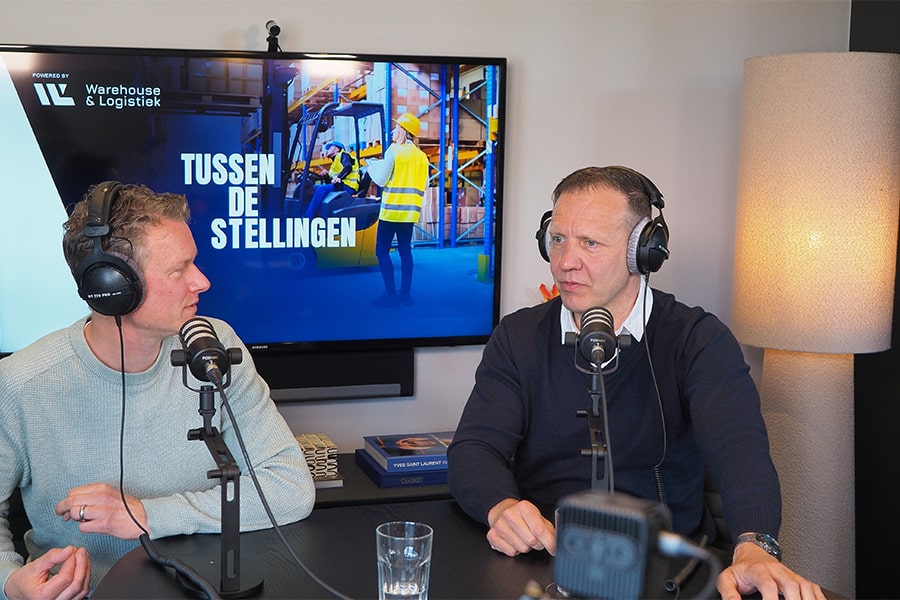
Transcript
Between the Racks (Warehouse & Logistics) – Episode 5
Conversation with Jon Koster (Motrac)
Host: Jerry Helmers
Guest: Jon Koster
[00:00] Introduction
Jerry Helmers:
Hello dear listener, you're back with another episode from the podcast series. Between the Positions from the Warehouse & Logistics platform of Louwers Mediagroep in Weert.
And in this episode, there is none other than Jon Koster of the company Motrac in my studio. Welcome. We will introduce you to all our listeners in a moment. But before we do that, I would like to present you with a number of statements that you can only answer with once or disagree May I answer? Are you ready?
Jon Koster – [00:17]:
I'm ready.
INTRODUCTORY QUESTIONS
[00:37] Proposition 1 – Mindset as an obstacle
Jerry Helmers:
The first proposition: The biggest obstacle to innovation in warehouses is not money, but mindset.
Jon Koster – [00:45]:
That's a good one. I agree.
Jerry Helmers – [00:56]:
Agreed. You build up the tension immediately. Then I feel like we'll have to come back to that later.
Okay, then here's the next statement: Logistics service providers systematically underestimate how much profit they are losing due to inefficient internal processes.
Jon Koster – [01:20]:
Agreed.
Jerry Helmers – [01:20]:
And then a third proposition: Data-driven working in warehouses is no longer a luxury, but an absolute prerequisite for remaining competitive.
Jon Koster – [01:36]:
I agree once again.
Jerry Helmers – [01:36]:
Okay. We would like to introduce you to our listeners.
Your name is Jon Koster. You are 51 years old. Tell us a little about yourself. Your work at Motrac. What do you do at Motrac?
CHAPTER: Introduction of the guest
[01:58] Function & background
Jon Koster – [01:58]:
I am an automation expert.
Jerry Helmers – [02:00]:
Automation expert.
Jon Koster – [02:02]:
I have been working in automation and logistics for 20 years, and have been with Motrac as an automation expert for over a year.
Jerry Helmers – [02:19]:
Why Motrac?
Jon Koster – [02:24]:
The momentum within Motrac is there now. We are looking at automation much more than we did in the past. So I thought: this is a great opportunity to be at the beginning of this journey.
[02:50] Training & entry into the sector
Jerry Helmers:
Is your background in mechanical engineering?
Jon Koster – [02:55]:
Yes, mechanical engineering.
Jerry Helmers – [02:56]:
How do you get into this sector?
Jon Koster – [03:00]:
I grew up in the automotive industry, working for a supplier. At one point, a position became available in automation sales.
I spoke to my manager at the time, and he asked: Why do you choose this?
I said, “It's a bit like working with remote-controlled cars. My three-year-old son likes that, and I like it too.”
Jerry Helmers – [03:37]:
Yes, me too.
Jon Koster – [03:38]:
And that's how I got into it. With one or two side steps, I've actually always remained in this sector.
[03:46] Men's world & technology
Jerry Helmers:
It's a man's world. Where are the women?
Jon Koster – [03:55]:
Women are few and far between. I don't know. I think technology and the world of women...
Jerry Helmers – [04:02]:
Smart girl is prepared for her future.
But what exactly does Motrac do?
CHAPTER: What does Motrac do?
[04:24] Profile of Motrac
Jon Koster – [04:24]:
Motrac has been a household name in the Netherlands for over 65 years. We are the exclusive importer of all Linde solutions for internal logistics: forklift trucks, pump trucks, narrow aisle trucks.
Linde has traditionally been known in heavy industry. Over the past twenty years, they have focused more on 3PL providers and e-commerce.
The themes you see in the logistics market: staff shortages, safety, sustainability, lack of space, and energy.
Jerry Helmers – [05:13]:
What makes you a reliable partner?
Jon Koster – [05:17]:
We have a solid organization. Purchasing, sales, service: everything is wonderfully organized.
Jerry Helmers – [05:28]:
And what makes you an expert?
Jon Koster – [05:40]:
I have a wide range of interests: AGVs, robotics, AI, software. I am developing my skills broadly and applying them in logistics.
[06:02] How does an expert remain an expert?
Jerry Helmers:
How do you keep your knowledge up to date?
Jon Koster – [06:30]:
Everything I read on Instagram, Facebook, LinkedIn. I listen to podcasts in the car.
Jon Koster – [07:01]:
I have a subscription to a magazine that covers more than just technology, including biology. I keep myself as broadly informed as possible about automation.
CHAPTER: Labor market & technological developments
[07:19] Labor market & technological developments
Jerry Helmers – [07:19]:
When we conclude this podcast in about half an hour, you will also be able to give tips to listeners. You focus on SMEs with warehouses or logistical challenges.
So, can we promise in advance that you will have some useful tips or points to consider? Are you up for the challenge?
Jon Koster – [07:33]:
I'll do my best.
Jerry Helmers – [07:52]:
When I look at the sector, I see labor market issues and incredible technological developments. AI has become a huge factor.
How important is the role of logistics in solving these challenges?
Jon Koster – [08:34]:
Very big. It's getting bigger and more critical. When I started 20 years ago, automation was a niche market. Nowadays, it's a requirement. First look: Is automation possible? Only when it is not possible do they switch to manual operation.
[09:15] What caused this shift?
Jerry Helmers – [09:15]:
Where does this shift come from? Is it the labor market?
Jon Koster – [09:22]:
That's right. The labor market is a major driver. Safety is also important. Safety is excellently regulated within AGV systems.
[09:45] Automation costs money... or does it?
Jerry Helmers – [09:45]:
But automation costs a lot of money. Or is it not that bad?
Jon Koster – [09:48]:
It costs money. Whether it's a lot of money is subjective.
Jerry Helmers – [09:55]:
Shouldn't you then explain that it's mainly about returns?
Jon Koster – [10:03]:
Certainly. My job is to convince people technically and show them how quickly they can recoup their investment.
[10:15] Labor market remains tight
Jerry Helmers – [10:15]:
I don't expect the labor market problems to be resolved quickly. This presents a commercial opportunity for you, but also a responsibility for SMEs to remain alert.
Jon Koster – [10:37]:
Automation is really a must. In small companies, you can free up someone because they no longer need to operate the forklift.
And for 24/7 businesses: every movement you get out of it frees up people. Then you don't need to hire as many people.
CHAPTER: Knowledge in companies
[11:14] Is there sufficient knowledge within companies?
Jerry Helmers – [11:14]:
Do companies have enough knowledge to know what to look for when it comes to automation?
Jon Koster – [11:30]:
Many companies are starting to realize this. They are hiring logistics engineers. They are taking a critical look at processes.
We can also watch along: This is your process. Where do you want to be in 3–5 years?
CHAPTER: Mindset & Innovation
[11:59] Back to the mindset statement
Jerry Helmers – [11:59]:
The first statement: “The biggest obstacle is not money, but mindset.” Where did your doubts lie?
Jon Koster – [12:17]:
Because mindsets have only really changed in recent years. People say, “I have to do something, otherwise I won't be able to sell my products.”
But for small SMEs, money is still an issue.
[12:42] SMEs caught up in the issues of the day
Jerry Helmers – [12:42]:
Isn't it true that SMEs are caught up in the issues of the day? The week is over before you've had time to think about automation.
Jon Koster – [1:05 p.m.]:
I recognize that. Once we sit down at the table, we take them along on the journey: How do you see yourself in 3–5 years?
We are looking at how we can grow together.
CHAPTER: Macroeconomic responsibility
[1:30 p.m.] Competitive position of the Netherlands
Jerry Helmers – [1:30 p.m.]:
If SMEs do not embrace automation, it will undermine our competitive position. As a supplier, do you also feel a social responsibility?
Jon Koster – [1:55 p.m.]:
Certainly. I proclaim that everywhere I go.
Jerry Helmers – [1:59 p.m.]:
Will people change their minds when they see their competitive position?
Jon Koster – [2:06 PM]:
Sometimes, yes. It depends on the industry. Some companies are defensive or conservative.
Jerry Helmers – [2:17 p.m.]:
What do you mean by that?
Jon Koster – [2:20 PM]:
They often say, “That's how we've always done it, and that's how we've grown.” But you have to do something to increase efficiency.
CHAPTER: Young versus old in willingness to innovate
[14:41] Difficult moral dilemma
Jerry Helmers – [2:41 PM]:
Would you prefer someone younger than 35 or older than 50 at the table?
Jon Koster – [2:49 p.m.]:
In principle, it doesn't matter to me. But if I have to choose: the younger one.
They are often more open-minded, even though they have less experience. Sometimes they teach me new things.
Jerry Helmers – [3:24 p.m.]:
Where does the conservatism of older people come from?
Jon Koster – [3:55 p.m.]:
Experience. If they have had a project go wrong in the past, they become cautious. They don't know exactly what automation software does and say, “Wait a minute.”
CHAPTER: Should people over 50 be required to undergo further training?
[16:24] Proposition: compulsory training?
Jerry Helmers – [4:24 PM]:
Should we require people over 50 to take courses and training on automation, IT, and AI?
Jon Koster – [4:38 p.m.]:
Agreed.
Jerry Helmers – [4:39 PM]:
Is there anything in it?
Jon Koster – [4:45 p.m.]:
Sure. Trade shows, podcasts... staying curious. It's in my nature.
Jerry Helmers – [5:05 PM]:
But still, I'd rather have a younger person at the table.
Jon Koster – [5:08 PM]:
That usually goes a little faster.
CHAPTER: Process improvement, efficiency, and return on investment
[17:16] Motrac's three pillars of improvement
Jerry Helmers – [5:16 p.m.]:
You focus on three improvements for SMEs: process improvement, efficiency improvement, and return improvement. Can you give an example of each of these three?
[5:48 PM] Process improvement
Jon Koster – [6:01 p.m.]:
That's actually our standard approach. Wherever we go, we take a look: what is the current process and where can improvements be made?
Jerry Helmers – [6:14 p.m.]:
Can you explain the concept of process?
Jon Koster – [6:16 p.m.]:
Placing a pallet at a location, or placing semi-finished products in a robot cell and taking away an empty pallet.
Jerry Helmers – [6:30 p.m.]:
To put it simply: something goes from A to B, and at B it must be further advanced on its way to the end user. Is that a good definition?
Jon Koster – [6:55 p.m.]:
Yes, those are processes, manufacturing processes.
Jerry Helmers – [7:00 p.m.]:
What questions do you ask a customer?
Jon Koster – [7:08 p.m.]:
In addition to technical data such as the number of movements per hour, I ask: Where are you today, and where do you want to be in 3–5 years?
If a customer says, “This solution will only get me through the next two years,” we look at how we can make it future-proof.
Jerry Helmers – [8:01 p.m.]:
So process improvement means ensuring that everything keeps running without any downtime.
Jon Koster – [8:15 p.m.]:
Yes. And sometimes we ask: why do you do this first and then that? Then they say: “That's how we've always done it.” Sometimes you can combine two steps.
Jerry Helmers – [8:33 p.m.]:
Do you feel like a consultant?
Jon Koster – [8:41 p.m.]:
More and more. Experience allows you to see solutions at other companies that you can apply.
Jerry Helmers – [9:00 p.m.]:
Proposition: I am able to identify blind spots in SMEs.
Jon Koster – [9:00 p.m.]:
Agreed.
Jerry Helmers – [9:13 p.m.]:
An entrepreneur should be pleased with that.
Jon Koster – [9:16 p.m.]:
Certainly. Sometimes we don't find any blind spots, and then the process runs smoothly. But for the future, you have to keep looking.
[21:52] Efficiency improvement
Jerry Helmers – [21:52]:
What are you talking about?
Jon Koster – [9:57 PM]:
Efficiency comes from process improvement. Our AGVs can operate at night. This means that everything is ready in the morning and you can start two hours earlier.
Jerry Helmers – [10:37 p.m.]:
But shouldn't night work be monitored?
Jon Koster – [10:46 p.m.]:
In principle, no. They work safely. There have been occasions when people cycling past at night have called the police because they saw something moving, but no one was working.
Jerry Helmers – [23:13]:
Do entrepreneurs want to hear this amid the hustle and bustle of everyday life?
Jon Koster – [23:19]:
Yes. Efficiency delivers quick results. Decided today, implemented tomorrow, results the day after tomorrow.
Jerry Helmers – [23:31]:
You sound almost business-like.
Jon Koster – [23:50]:
Business administration is not my background, but I do look at all aspects of a production environment.
[24:04] Yield improvement
Jerry Helmers – [24:04]:
Improved returns: tell me more.
Jon Koster – [24:23]:
The process runs more smoothly, and in a shift operation, you often recoup your investment quickly. With two shifts, it's faster; with three to five shifts, it's a no-brainer.
Jerry Helmers – [25:01]:
Do you have a specific example?
Jon Koster – [25:11]:
We implemented AGVs that store pallets 24/5 for a customer in the starch processing industry. During the day, the buffer was emptied. They no longer needed to deploy a night shift, freeing up two employees.
Jerry Helmers – [26:00]:
Can you express that in percentages?
Jon Koster – [26:54]:
No, but the payback period was approximately 1.3 years.
CHAPTER: Trust & cooperation
[27:36] What makes your work enjoyable?
Jerry Helmers – [27:36]:
What is the best part of your job?
Jon Koster – [27:47]:
The diversity of industries. You get a look behind the scenes. You see what companies are up against.
[28:13] Customer trust
Jerry Helmers – [28:13]:
Customers have to expose themselves. How do you radiate confidence?
Jon Koster – [28:42]:
Personal contact. Being honest about what is and isn't possible. Twenty years of experience helps to recognize processes.
Jerry Helmers – [29:09]:
In Germany, companies hand out their entire specification booklet at trade fairs. Do you do that too?
Jon Koster – [29:32]:
Yes. Sometimes you have to sign an NDA. But you can definitely take a look inside.
Jerry Helmers – [30:04]:
Are you sitting here nervously, afraid to reveal anything?
Jon Koster – [30:18]:
Always.
CHAPTER: The logistics of the future
[30:32] Dark factories & dark warehouses
Jerry Helmers – [30:32]:
What will the industry look like in five or ten years?
Jon Koster – [30:44]:
Logistics is becoming more interesting. Technology and AI are improving. In China, you already have dark factories: lights off, products in, cars out.
I think we will also see dark warehouses: robots will do the work, with only the most complex tasks remaining for humans.
Jerry Helmers – [32:01]:
Will humans still be needed in the future?
Jon Koster – [32:08]:
Ultimately, everything can be automated, but not within the next five to ten years.
[33:02] How can SMEs benefit from this?
Jerry Helmers – [33:02]:
Can SMEs anticipate this?
Jon Koster – [33:15]:
Absolutely. Stay informed about new developments. See what AI can do for you.
Jerry Helmers – [35:08]:
Do you guys do anything with AI yourselves?
Jon Koster – [35:19]:
Linde has launched a digital twin project with Nvidia and Accenture. 3D scans are used to create a digital representation of processes. You can test AGVs virtually, detect errors, and link live data.
AI cameras can even detect people, causing vehicles to brake automatically.
CHAPTER: Tips for SMEs
[37:19] Tip 1 – Start small
Jon Koster – [37:19]:
Start small. Modularity. You can easily add AGVs and scale up.
Jerry Helmers – [37:49]:
Can entrepreneurs accurately predict their growth?
Jon Koster – [37:50]:
It remains anyone's guess, but you can take general trends into account.
[38:11] Tip 2 – Different types of staff
Jon Koster – [38:11]:
The type of personnel will change: from order picker to operator.
Robots take over physical tasks, humans intervene when necessary.
Jerry Helmers – [38:23]:
SMEs need to be aware of this.
CHAPTER: Final proposition
[38:44] Can SMEs survive without automation?
Jerry Helmers – [38:44]:
Proposition: Small and medium-sized enterprises that do not invest in intralogistics optimization today will no longer exist in five years' time.
Jon Koster – [38:53]:
I think they still exist, but their competitive position has deteriorated significantly. You are obliged to keep an eye on technological developments.
CHAPTER: The commercial pitch
[39:49] The commercial pitch
Jon Koster – [40:15]:
At Motrac, we believe that intralogistics can be smarter, safer, and more sustainable. That's why we not only supply high-quality Linde forklifts and warehouse trucks, but also complete solutions to make logistics processes future-proof.
As a total solution provider, we combine equipment, automation, energy solutions, racking, service, and consultancy in a single integrated offering.
Our focus is on four pillars:
Automation – smart AGV/AMR solutions.
Energy – lithium-ion, hydrogen, and energy management.
Safety – innovative safety technologies.
Connectivity – real-time insight via connected trucks and data platforms.
Motrac stands for reliability, partnership, and maximum availability. We think along with you, build along with you, and grow along with you.
[41:56] Closing remarks
Jerry Helmers – [41:56]:
Thank you, Jon, for this moment.
What should listeners definitely remember?
Jon Koster – [42:07]:
Motrac.
Jerry Helmers – [43:02]:
SMEs need to think about these issues. Sometimes you have to force yourself to step back from the issues of the day.
Jon, thank you for coming. I hope to see you again sometime.
Dear listeners: my name is Jerry Helmers and Between the Positions is a production of Louwers Mediagroep. Project manager: Michel van Strijp. Technology: Daan Halters.
Thanks for listening, and see you next time.
![Automation of logistics concepts, is it a viable option? [Podcast] 3](https://warehouselogistiek.eu/wp-content/uploads/2025/07/afl-3_Peter-kopie.jpg)