warehouselogistiek.eu
EN

The platform for internal & external logistics, supply chain and automation
“The first violin in the perfectly tuned supply chain orchestra”
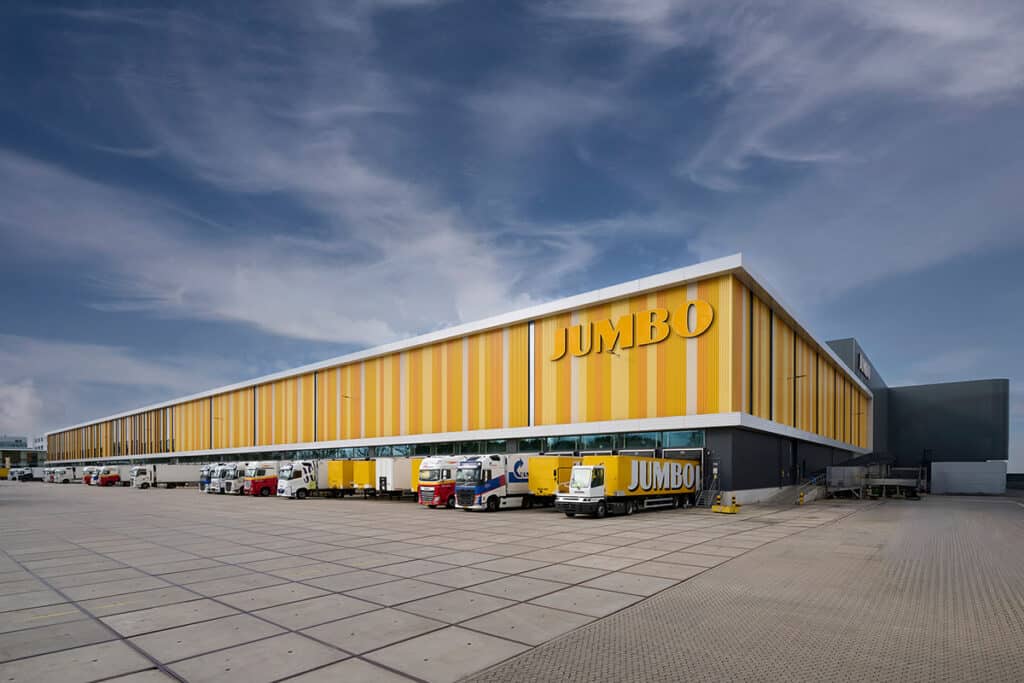
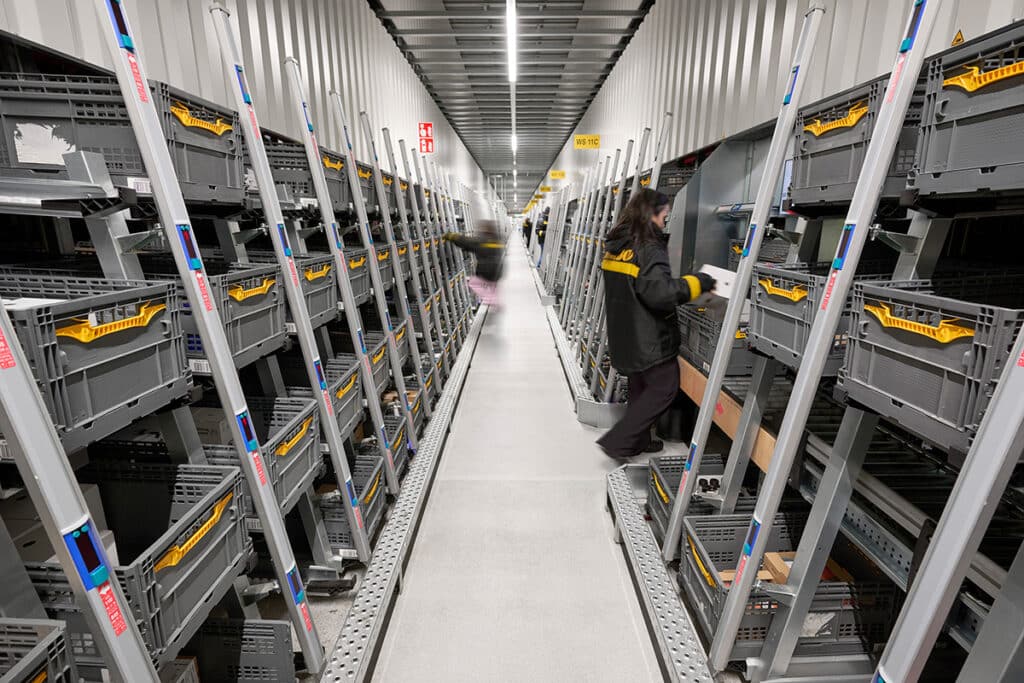
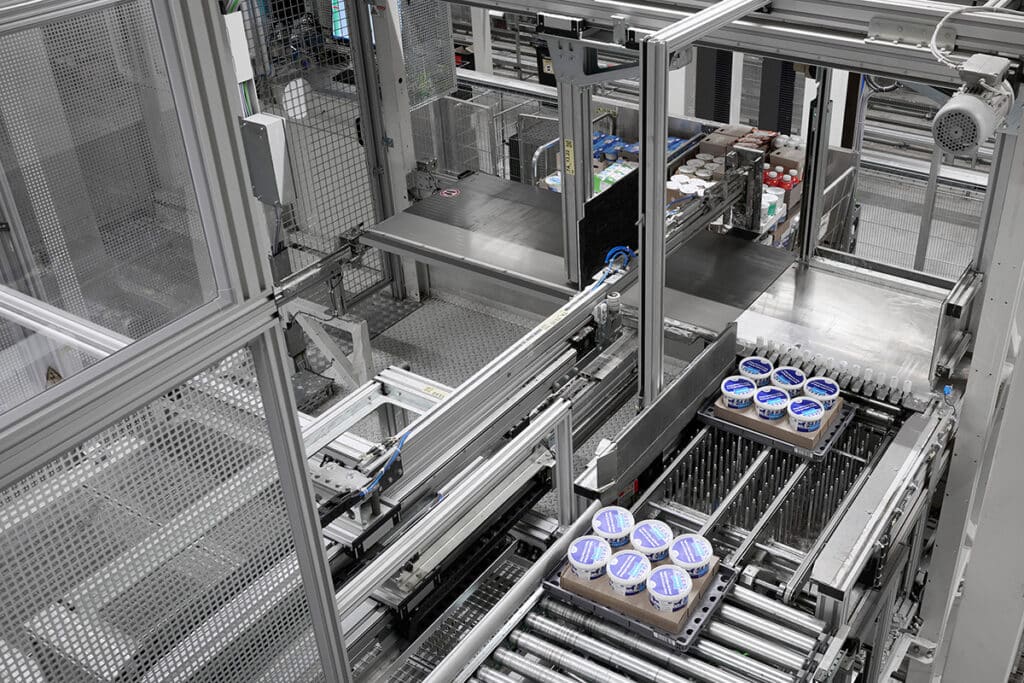
Since mid-2024, Jumbo, the second largest food retailer in the Netherlands, has had an almost fully automated logistics center for fresh produce. This center helps set the pace of the entire supply chain, without playing a leading role - the requirements were clear. Jumbo and WITRON present a concept at the Central Distribution Center in Nieuwegein that redefines modern logistics centers. The emphasis is on speed, availability and flexibility. The 40,000 square meter complex supplies over 725 stores in the Netherlands and Belgium with nearly 3,000 different fresh and ultra-fresh items. The range includes dairy products, a large selection of cheese, meat products, tapas, salads, chilled drinks and much more. More than 1 million units can be picked here daily at an ambient temperature of +2 degrees Celsius with the OPM (30 COM machines), AIO and CPS modules. In addition, a fully automated buffer at the goods issue optimizes the transport of the roll containers stacked per branch to the supermarkets.
The fresh distribution center is now the second project Jumbo has successfully completed together with WITRON. It previously involved an efficient distribution center for long-life products, where up to 565,000 trade units can be picked from an assortment of 14,300 items on peak days using OPM (31 COM machines), DPS and CPS.

Dutch supermarket chain Jumbo faced a series of challenges that called for the construction of one of Europe's most ambitious logistics hubs. These included the expected shortage of labor in the future, the ever-expanding shelf-life and fresh assortment, the ever-increasing demands of consumers - especially when it comes to fresh produce - and the speed at which customers want to do their shopping via the supermarket and webshop. The almost fully automated logistics center for fresh produce in Nieuwegein, which was designed and realized by WITRON as a lifetime partner, is today the core of supplychain. A supply chain that is more integrated, flexible and customer-friendly than ever before. The consumer is ultimately the one who sets the pace.
The central fresh produce warehouse (CDC) is designed for a maximum capacity of more than 1.06 million picking units per day. The concept already takes into account modular expansion in the event of future growth. All logistics departments are connected by an efficient network of transport technology. This consists of more than 670,000 places for pallets, trays and crates and 120 rack controllers. All this is controlled by an ultra-functional WITRON warehouse management system. All components, both for technology and IT, were developed, produced and commissioned by WITRON.
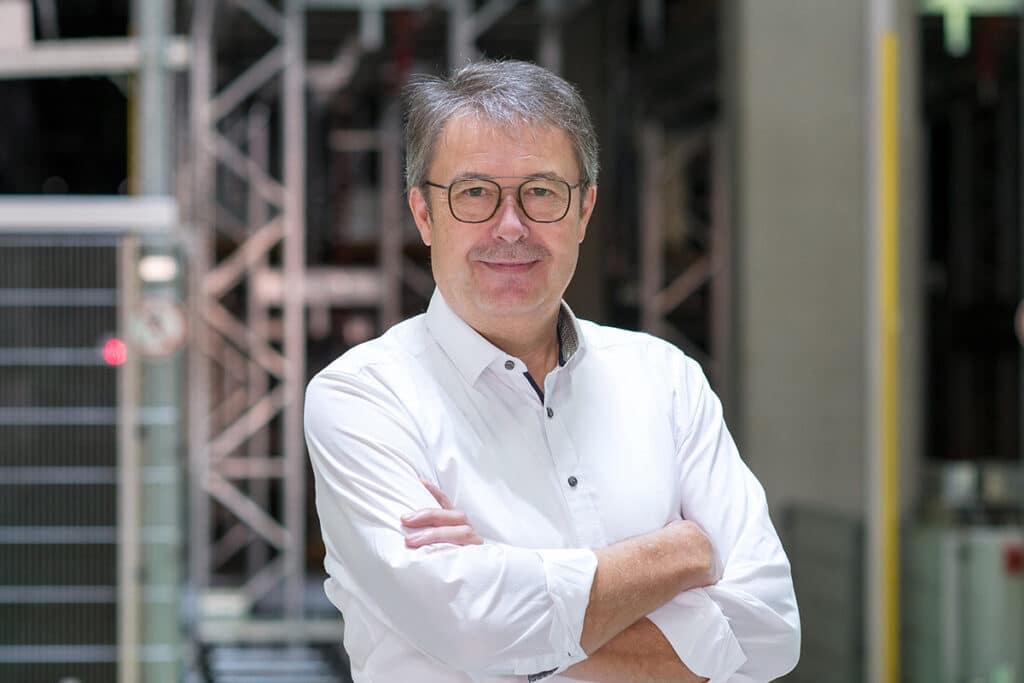
When Jumbo was plotting its future several years ago, it became clear that the existing structures would not meet future demands. “We expected to run into challenges in the labor market, we took into account more items and we wanted to consistently restructure our fresh logistics with a focus on maximum customer service, maximum product freshness and sustainability,” recalls Karel de Jong, Director of Supply Chain in Jumbo's management. The company wanted to expand the number of SKUs, differentiate the assortment more strongly and make fresh logistics significantly more flexible. At the same time, there was less and less slack for regional warehouse spaces due to the increasing diversity of items. The solution developed involved the centralization, automation and densification of processes.
Especially with ultra-fresh products, accurate timing is essential. Temperature, daily business activities and weather conditions are factors that directly affect volume. “For us, agile means being able to react super fast to changing needs. When the weather changes, so does demand. We have to be able to respond to that,” De Jong explains. “The freshness of the products must reach the consumer's table immediately and not remain in the warehouse.”
For WITRON, the project represented a profound change in the company's internal operations. Today, the warehouse is no longer a stand-alone block, but a coupled organ in the supply chain orchestra. Johannes Meißner, technical director at WITRON, describes the development as follows: “The DC is no longer a separate system, but an integral part of our customer's organism. Only in this way can you really optimize supplychains.” As a result, the function of the warehouse changes from pure storage and buffer to a dimensional control tool. Karel de Jong adds in this context, “But the DC is not the conductor. The customer is.” As a metaphor for the warehouse, he uses the ‘first violin’ in a harmonious supply chain orchestra - important, present, leading, but not all-important.
As a logistics hub with the distribution center for perishable and fresh goods, Nieuwegein is altogether one of the largest WITRON projects in the world. The complex includes more than 60 COM machines and has space for over 1 million pallets, trays and crates and around 200 shelving units with a maximum capacity of 1.6 million picks per day. The German company opts for reliable technology with OPM, AIO, CPS and the buffer in goods dispensing. This provides maximum availability, as the DC is the backbone of the service to Jumbo's customers in the Netherlands and Belgium. In addition, an on-site WITRON service team ensures that all IT and technical processes run smoothly.
The partners both emphasize: the choice does not depend on the number of machines, but on the specific requirements of the particular application area. How do you balance the system? All items are delivered to the branches on roll cages. Smooth cooperation between the subsystems is therefore essential to ensure maximum consolidation and densification. Or as De Jong puts it, “The solution is not just another machine. The key to success is a finely tuned overall concept with an important role for those operating the plant and the team of shiftleaders.”
The effects of branch automation are measurable:
As a result, supermarket shelves are filled more directly, faster and with fewer operations. In addition, processes that were previously handled via direct delivery - such as fresh fish - are now centralized via Nieuwegein. And thanks to forecasting and replenishment processes, Jumbo delivers exactly what the stores need. The result for the customer: fresher products, a better matched assortment, more and faster availability.
Automated processes require standardization. This can be seen, among other things, in the processing of a wide variety of packaging. “That is why we have trained colleagues who have gained solid knowledge in this area,” De Jong said. Cardboard packaging, adhesive strength, wrapping film and the quality of the cardboard and pallets determine material flow values and stability. WITRON and Jumbo provided early support, identified critical packaging and ensured transparency with suppliers. The result: better input control, which in turn leads to more stable processes at the distribution center. By and large, Jumbo employees were able to prepare very well for their new tasks - no more manual processes, but working towards automated production. In consultation with WITRON, it was possible to view future activities in WITRON-implemented environments in detail and exchange extensive views with users. “Thanks to the numerous projects we have realized in Europe, North America and Australia, we can offer our customers with our extensive experience all the support they need on the important topic of change management,‘ adds Meißner, CEO of WITRON.
Technology can be bought - culture cannot. Jumbo implemented lean principles with the Jumbo Production System (JPS), including a more transparent shopfloor, stand-ups at every shift and employees solving problems themselves as much as possible. Once a day, a central steering meeting takes place centrally in the DC - not in the office, but simply in the middle of the floor. “Here the colleagues analyze the past day and once again discuss the tasks and goals for the next shift. If this half-hour runs smoothly, it will be a good day,” says De Jong with a grin.
What measures can we expect next? Jumbo sees the supply chain as an end-to-end network structure rather than a collection of individual warehouses. The integration of branches, the link with suppliers, the optimization of transport routes and automation - including in e-commerce, which is currently still manual - are essential elements of the future strategic direction.
“In this regard, automation is not an end in itself, but a tool that can be used as needed. Differentiation in the product range remains the core of our business philosophy, where we place particular value on efficiency and profitability,” Karel de Jong explains. Johannes Meißner summarizes the situation as follows: “Automation was the foundation. Now the phase of integral optimization begins.”