warehouselogistiek.eu
EN

The platform for internal & external logistics, supply chain and automation

Many Dutch warehouses work daily with racking that has been in use for years without a complete and up-to-date inspection file. This does not automatically mean that something is wrong, but it does show that inspection is not always organized structurally in practice.
At the same time, legislation sets clear requirements for safety and the use of work equipment. Warehouse racks are explicitly covered by this.
Within the Working Conditions Act, the responsibility lies with the employer. Article 3 requires the creation of a safe working environment, including the means by which work is carried out. This sounds general, but is given concrete form in the Working Conditions Decree.
Article 7.4a describes when inspection is necessary. This is not one fixed moment, but several situations that occur in practice. Consider the phase immediately after installation, but also moments when a rack is modified, moved or rebuilt. In addition, periodic use plays a role, as do situations in which damage occurs, such as from a collision.
Exactly how often an inspection should take place depends on use and risk. In practice, an annual inspection is often used as a starting point, especially for heavily used warehouses.
What is not optional is documentation. Inspections must be demonstrable. That means reports must be available in the workplace and can be presented during an inspection.
The RI&E also plays a role in this. It should explicitly address risks associated with racking, such as instability, falling goods or damage caused by internal transport. At the Health and Safety Portal from the Ministry of SSW provides extensive background information on how employers can fulfill these obligations in practice.
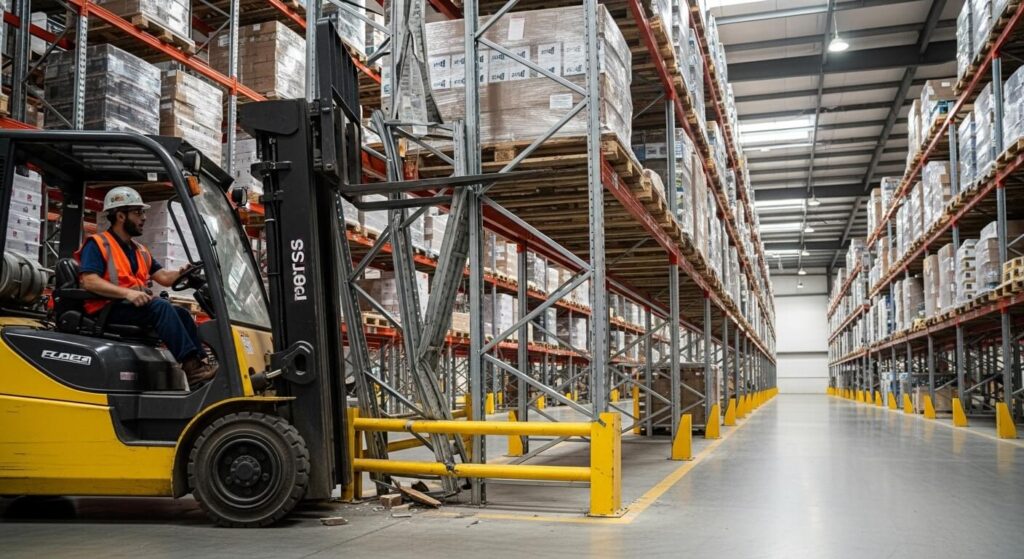
In addition to legislation, the standard EN 15635 is widely used in practice. This standard gives direction on how to organize safe use and maintenance of scaffolding. In the Netherlands, this standard is often used as a reference in inspections and audits.
What is striking about EN 15635 is that it is not just about annual inspections. Instead, the standard looks at the whole of daily practice, internal control and external assessment.
An employee who sees or causes damage is supposed to report it immediately. In addition, internal visual checks are usually performed on a regular basis, often weekly. Those internal checks are actually the first line of defense.
Above that is the annual inspection by an outside expert. Who looks at the entire structure with a technical view.
Within this entity, one person is often designated to keep the overview. In the standard, this is called the PRSES. In practice, this is the person who ensures that reports are followed up, inspections take place and documentation is kept in order.
Other standards, such as EN 15512 and EN 15620, play a more background role. They determine how a rack is designed and what tolerances are acceptable. Organizations such as the NEN publish these standards and additional practice guidelines that help apply them concretely within a warehouse environment.
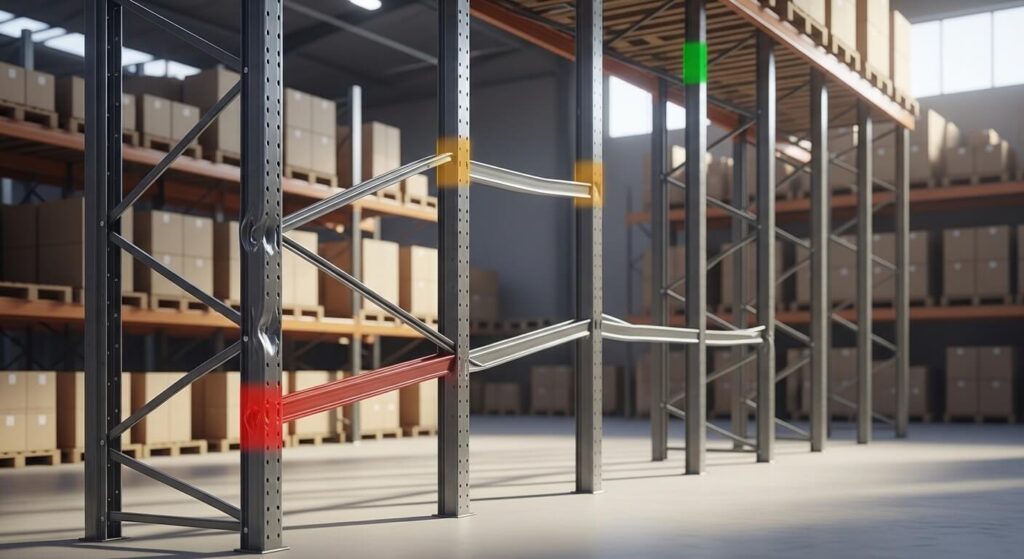
During inspections, damage is not only described but also classified. This is usually done with a color classification that helps to quickly determine what needs to be done.
Small deformations often remain within safe margins. These are recorded and followed up on the next inspection. As soon as damage rises above that, the situation changes. Then, for example, a section has to be relieved before it can be used again.
For more severe damage, there is little discussion. Then it involves direct action, such as taking part of the rack out of service and replacing parts.
What is important is that damage is not static. What seems limited today may escalate if recovery is not achieved. Therefore, the value is primarily in following up, not just noting.
An engineering inspection goes beyond just visible damage. The inspector assesses the behavior of the structure as a whole.
Uprights are checked for deformation and misalignment. Especially in the lower zones, this is relevant because that is where most impact damage occurs. Beams tell a lot about load and use. Deflection, connectors and welds give clues about structural loading.
Less conspicuous parts also play a role. Consider locking pins that are missing or latches that are not functioning properly. Floor anchoring is another critical issue. If base plates are not properly attached, the entire structure loses stability.
It also looks at things that are often overlooked, such as protective devices and load boards. The latter are essential to knowing what a rack can actually carry.
Apart from scheduled inspections, there are situations where immediate action makes sense. A rack that is visibly leaning or moving under load requires immediate attention. The same goes for missing parts or anchors that are coming loose from the floor.
More subtle signals can also be relevant. Noises, small shifts or unexpected distortion often indicate that something is wrong.
A pattern emerges in incident analyses within the industry. Damage rarely arises from a single cause, but from a combination of factors. Collisions, insufficient damage follow-up and lack of oversight often play a role together.
Those who want to get a grip on inspection usually start with documentation. Not because they have to, but because it provides insight.
A good record shows how a rack is constructed, how it is used and what has happened to it over time. Inspection reports, recovery records and training records complement each other.
The annual inspection is usually performed by an outside party. This ensures an independent assessment. Internal inspections also remain important precisely because they are more frequent.
When documentation is missing, it becomes more difficult to prove compliance with the duty of care. This can have consequences in incidents or in discussions with insurers.
For many organizations, the challenge is not in knowledge, but in organization. Inspection is often picked up only after an incident or during an audit.
Setting up the process structurally creates peace of mind. Clear responsibilities, fixed checkpoints and clear documentation make all the difference.
Companies looking to professionalize this regularly work with specialized parties such as Rejuva. Who support in setting up inspection processes, performing checks and putting the complete racking file in order.