warehouselogistiek.eu
EN

The platform for internal & external logistics, supply chain and automation
Geopolitical instability and the complexity of cross-border trade are causing European companies to place greater emphasis on customs management. However, internal expertise remains insufficient to proactively anticipate change and non-compliance risks
Main results:
Global trade is becoming increasingly complex: geopolitics, volatile markets and an ever-growing web of regulations make customs and trade compliance a strategic priority for European companies. At the same time, internal capacity and specialized expertise often fall short of keeping pace with developments. That is the main conclusion of the second Strategic Radar Customer Survey 2026 from Customs Support Group (CSG). For this survey, Europe's leading independent provider of customs clearance and trade solutions, evaluated questionnaires from nearly 200 European manufacturing and retail companies.
Customs management is increasingly shifting from the back office to the boardroom: nearly 44% of companies surveyed indicate that the customs function has become more important. 18.5% describe this as a significant increase in importance to the organization. This shows that companies are taking the increasing complexity and volatility of cross-border trade more seriously at the strategic level.
However, the reality is a bit more complicated: while the strategic importance of customs management is growing, many organizations lack specific expertise and capacity. “The research shows a paradox,” said John Wegman, CEO of Customs Support Group. “Customs and trade compliance is more important than ever, but many companies are understaffed and reactive rather than proactive. This is very risky in a geopolitically unstable environment. External trade advisors and specialized customs agents can fill this gap. They are increasingly positioning themselves as long-term strategic facilitators, rather than purely operational suppliers.”
Thanks to the growing strategic importance of customs management, operational customs handling is outsourced in many companies: 70% of the European companies surveyed do not have an internal team for customs declarations and rely on external partners. Even when internal teams do exist, they tend to be small: about two-thirds of European companies that handle customs declarations themselves employ only up to four full-time staff for this purpose. But even those companies tend to work with external partners.
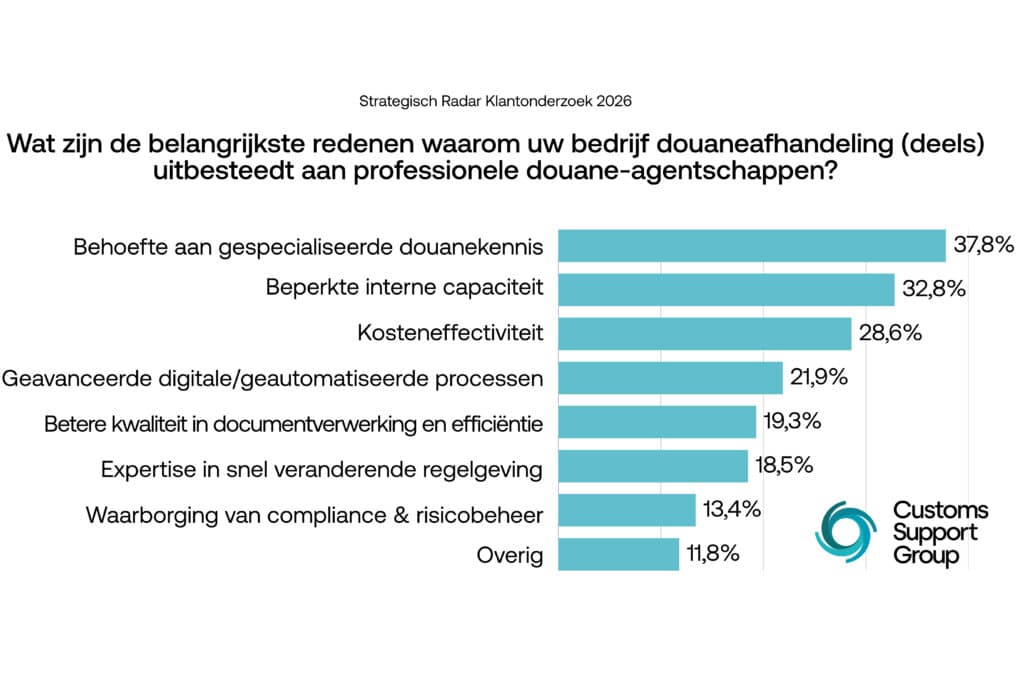
Lack of specialized customs knowledge is the main reason for outsourcing for 38% of the respondents. A third cite lack of capacity as a reason and slightly less than 30% find outsourcing more cost-effective. Other benefits include access to digital solutions (22%), better documentation quality (19%) and support with rapidly changing regulations (18.5%).
Despite a shortage of in-house expertise, there is considerable reluctance when it comes to hiring: although 23% of European companies have hired additional staff in the customs compliance department over the past 24 months, only 6% plan to hire more. 58% has no expansion plans at all.
As tensions around tariffs continue to rise, correct goods classification is essential for determining import duties and understanding the impact on the supply chain. Although customs declarations are often outsourced, goods classification remains an internal responsibility: 60% classifies goods entirely in-house, 20% combines in-house expertise with external support.
Only 30% have high confidence in their own commodity classification, which is relatively low given the importance of the task. Control mechanisms for commodity classification also remain limited, with only one in three companies checking their classification annually, while a third have never done a check. Only 12% plans to conduct a review this year.
As a result, more than half of the European companies surveyed (56%) are at risk of misclassification, with potentially huge financial and operational impacts, such as increased costs or customs inspections. Indeed, 28% report having already experienced these consequences at one time or another. Proper goods classification is also crucial to take maximum advantage of trade agreements, many of which are new.
“This discrepancy between accountability and evaluation practice is troubling,” says John Wegman. “Companies that establish classifications once and then fail to evaluate them regularly create unnecessary risks: from additional payments to audits and operational delays or miss out on commercial opportunities. When internal capacity is limited, partial outsourcing to trusted external partners can help fill this gap.”
Compared to last year, artificial intelligence plays a less prominent role this year. No company relies entirely on AI for classification. Only 24% uses AI regularly or occasionally for commodity classification. Interestingly, 55% still refrains from implementing AI for these tasks.
“This reluctance is justified,” said John Wegman. “Commodity classification has major implications for regulatory compliance, and organizations don't want to risk an algorithm misclassifying commodities and causing huge fines. Human expertise, what we call ‘real intelligence,’ remains the foundation. That said, AI can, for example, add value by consolidating data and supporting analytics, while leaving the final classification decision to experienced human specialists.”
The war between Russia and Ukraine remains the biggest external burden on supply chains, with 32% of European companies reporting direct impact from this conflict. Close behind is the Red Sea crisis (23%) and the tariff dispute with the US (21%).
Consequently, many companies are concerned about future geopolitical instability and uncertainty. On a scale of one to five, the level of concern is around 3.1. About a third are worried or very worried.
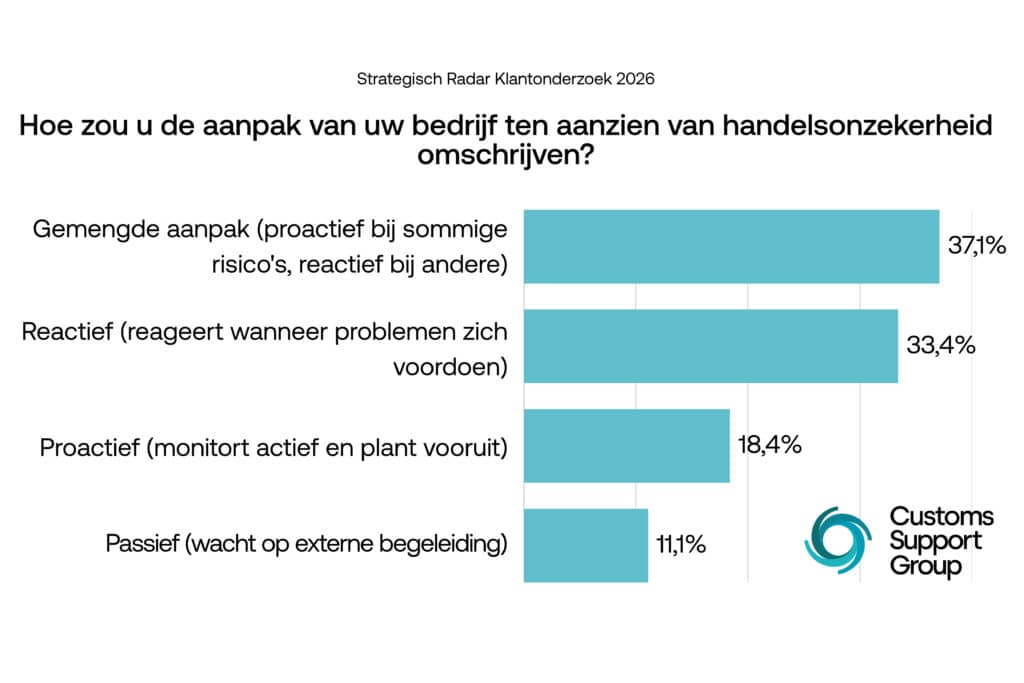
Nevertheless, many companies are reacting reactively: more than 42% have not taken specific measures against geopolitical tensions and their impact on the supply chain. In addition, three-quarters of European companies have not taken measures to mitigate the risks of tariff conflicts. Overall, only 18% say they address trade uncertainty proactively and with foresight. A third respond only when significant problems arise, and some 10% describe their approach as passive.
“This is not sustainable. By 2026, a reactive approach will no longer be feasible,” warns John Wegman. “Regulatory pressures, intensity of enforcement and geopolitical instability are expected to lead to more proactive and structured responses. Organizations that do not adopt this approach are at higher risk of non-compliance, increased costs and operational disruptions.”
Customs Support Group conducted the Strategic Radar Customer Survey among 194 European importers and exporters in the fourth quarter of 2025. The online survey focused on five key themes:
Respondents came from Italy, the Netherlands (17.5% each), Germany (16.1%), Poland (13.3%), Belgium, the US (7% each), France and the UK (5% each), among others. Respondents worked in logistics (28.8%), customs (19.1%), management (14.6%) and procurement (8%).