warehouselogistiek.eu
EN

The platform for internal & external logistics, supply chain and automation
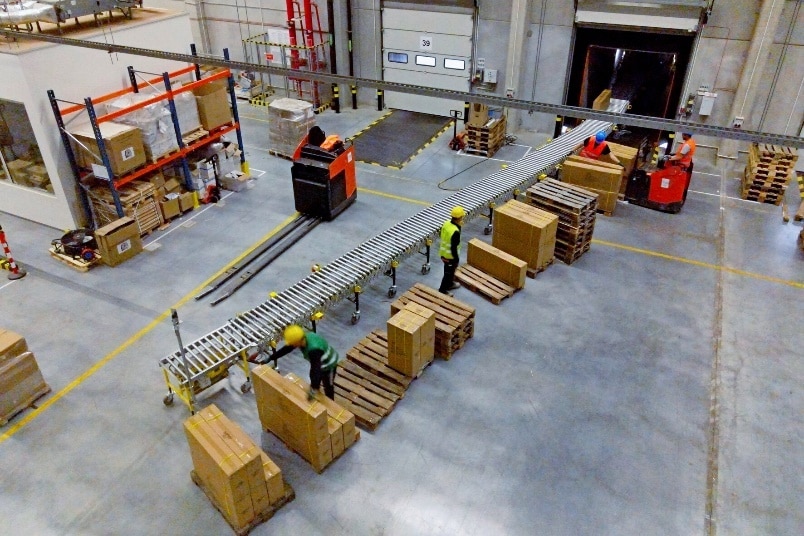
Anyone who manually loads or unloads dozens of containers every day is familiar with the problem: heavy cardboard boxes, awkward postures, and exhausted employees. The Destuff-it™ and Restuff-it™ mobile transport systems offer a solution that pays for itself faster than expected. With these systems, Schmalz offers a solution that achieves three goals at once: higher productivity, better working conditions, and measurable cost savings.
Smart technology is needed to increase productivity while reducing strain on the back. This is exactly where the Destuff-it™ and Restuff-it™ mobile transport systems come in handy. These ergonomically designed solutions are suitable for companies that process large numbers of containers on a daily basis. Destuff-it™ supports unloading, while the bidirectional Restuff-it™ variant loads and unloads freight boxes using the same conveyor belt. Both systems adapt to the respective requirements and are particularly effective where space is limited: in containers and truck compartments.
The transport systems are particularly suitable for non-palletized and unsorted goods. While the products are continuously fed via the conveyor belt, employees can sort the packages and palletize them at the end of the line. With a throughput of two containers per day, the machine pays for itself in less than two years. Overtime charges during peak hours are significantly reduced and the utilization of the loading dock is considerably improved.
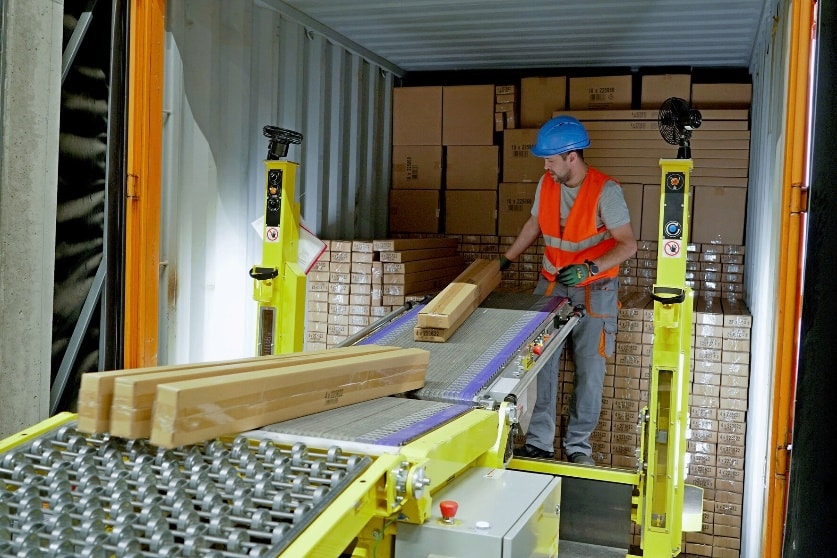
The movable operating platform can be raised to a height of 699 millimeters and brings the employee to each package—whether it is at the very bottom or high up in the container. The system head, which can be moved in all directions, adapts to any position on the container wall.
The platform can carry 250 kilograms, while the conveyor belt itself can move loads of up to 75 kilograms. With a width of 610 millimeters and a speed of 3.7 meters per second, Destuff-it™ and Restuff-it™ can transport up to 2,000 cardboard boxes per hour from the container. The operator controls the machine via an easily accessible console. The transport systems are self-propelled and can be easily moved from dock to dock.
Advanced safety features protect operators during use. Before anyone gets trapped, the system detects the obstruction and stops the belt. LED strips illuminate the area and reduce the risk of tripping.
A study by Ohio State University (USA) confirms that the transport system significantly reduces strain on shoulder and back muscles and the spine compared to manual labor. This also leads to a measurable increase in employee satisfaction.